Follow Us on Google
By Chukwudi Nweje
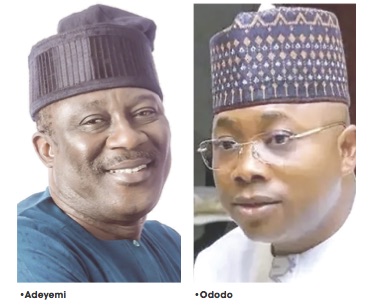
As activities toward the November 11 governorship election in Kogi State gather momentum, there are fears in the camp of the All Progressives Congress (APC) candidate, Alhaji Usman Ododo, following the appeals filed by aggrieved aspirants in the Kogi State APC primaries, Senator Smart Adeyemi and Abubakar Achimugu. Both Adeyemi and Achimugu have proceeded to challenge Ododo’s nomination at the Supreme Court, respectively.
The fundamental grounds on which Senator Adeyemi filed his appeal and which have reportedly been brought before the Supreme Court is that the primary election that ushered in Ododo as the APC candidate was fraught with irregularities and evidence of substantial non-compliance with the Electoral Act. Adeyemi contended that the election only held in 11 wards, all in one local government, specifically in Kogi/Kotonkarfe, out of 239 wards across the state, with the caveat: “What happened to the 228 remaining wards?” “At what level were the results announced and was the entire process, starting from the cast of votes, announcement and collation of results done in accordance with the electoral act 2022 (as amended), which stipulated that results should be announced at each polling units at every ward and collated at the local government headquarters?
Achimugu is contesting the qualification of Ododo on the basis of improper resignation, while still drawing salaries from the government even after he purportedly turned in his resignation letter. He averred that claims that Ododo submitted his resignation letter to Governor Yahaya Bello was untenable and an afterthought, as the appropriate channel to do so is the Civil Service Commission, which copies ought to have been submitted to the Independent National Electoral Commission (INEC) and the party.
The Background
Senator Adeyemi and Achimugu, in separate motions, had dragged the APC and Ododo to court to challenge the authenticity of his nomination at the April primary election.
Adeyemi had argued that no primaries of the APC worthy of that name took place anywhere in the state. He insisted that the results displayed by the electoral committee were mere allocation of votes.
He had approached the federal high court, Abuja, insisting that the primary election, which produced Ododo ran foul of Section 177 of the 1999 Constitution, and also contrary to Section 29 and 84 of the Electoral Act, as well as article 20 of the APC constitution.
On the other hand, Achimugu was in court questioning the eligibility of the APC candidate on the ground that he did not resign from the civil service at the time of purchasing, and submission of his nomination and intent forms. That he held on to his post as Auditor General for Local Government, overlapping the time limit stipulated in the electoral act. Ododo was alleged by Achimugu to have received salaries from Kogi State Government both as a civil servant and a governorship aspirant.
However, the Federal High Court Abuja in the separate judgments delivered by Justice James Omotosho on July 12, held that Adeyemi and Achimugu did not prove their allegations that Ododo was not lawfully nominated by the APC.
Justice Omotosho quashed their petitions for lack of evidence, respectively. But, dissatisfied with the judgement, the aggrieved aspirants took their cases to the appeal court.
However, in the lead judgment delivered by Justice Muhammed Shuaibu on August 18, the appeal court upheld the verdicts of the lower court in a unanimous decision.
The legal battles continue
Fresh reports at the weekend indicated that Adeyemi had filed for appeals against the appellate court’s decision, at the apex court.
Checks revealed that Adeyemi’s appeal filed last Friday was based on the following grounds: That, among other irregularities, the results as announced at the end of the April 14 direct primary election were not in consonance with the results the committee claimed to have collated across the wards in the state; that in the process of allocating votes to the various aspirants, the election committee decided to allot a bogus 78,704 votes to Ododo, and 311 votes – the least number of votes to Adeyemi; that the number of votes announced for Ododo was higher than the figure recorded, while that for Adeyemi was lower, respectively; that the election held in only 11 wards in Kotonkarfe Local Government, excluding 228 wards out of the 239 electoral wards in total; that direct primary election mode allows party members to vote for their preferred aspirants at designated units in each of the 239 wards; and that contrary to the provisions of the Electoral Act 2022 (as amended), votes were merely allocated to aspirants.
“We have enough evidence to prove that no real election took place in the Kogi State chapter of the APC on April 14. Where a semblance of election took place was only in 11 wards in one local government, Kogi/Kotonkarfe. What happened to the 228 remaining wards? Again, the votes the election committee claimed it recorded did not correspond with the results they announced; this is before the Supreme Court. We are pushing for the appeal at the Supreme Court. History has shown that losing at the lower courts does not mean we will lose at the Supreme Court. The cases involving Governor Hope Uzodimma in the Imo State governorship election verdict and former Senate President, Ahmed Lawan, in the senate primary election of Yobe North are a few examples of landmark judgments in cases presumed to have been lost at the lower courts but were upturned in the appellants’ favour by the apex court,” a source close to Adeyemi disclosed.
Quoting Section 84, subsection 4 of the Electoral Act 2022, Paragraphs (a) (b) and (c) under “Nomination of Candidates by Parties” and “Direct Primaries,” he inferred: “A political party that adopts the direct primary procedure shall ensure that all aspirants are given equal opportunity of being voted for by all members of the party and shall adopt the procedure outlined; Paragraph (a): In the case of presidential primary, all registered members of the party shall vote for aspirants of their choice at a designated centre at each ward of the federation; Paragraph (b) that the procedure under paragraph (a) shall be adopted for direct primaries in respect of Gubernatorial, Senatorial, Federal and State Constituencies.”
He noted further that “this is the position of the law. The justices of the federal high court and appeal court don’t make laws, they can only interpret. The relevant laws have been contravened in the process leading to Alhaji Usman Ododo’s nomination as the candidate of the APC for the November 11 governorship election in Kogi State. The process that led to Ododo’s nomination is inconsistent with the provisions of the electoral law, and the APC constitution, therefore, such cannot stand in the eye of the law.”
Peace process
In the aftermath of the swearing-in ceremony of the newly appointed members of the APC NWC by the National Chairman of the Party, Alhaji Umar Ganduje, the new leadership of the APC has decided to revisit the petition submitted by Senator Adeyemi against the outcome of the Kogi State Governorship primaries.
“The case looks bad. But the national leadership of the APC is leaving no stone unturned to have Adeyemi and Achimugu stop their lawyers from filing any further appeals at the Supreme Court,” revealed a source in the APC headquarters. The source added: “To this effect, meetings have been held at top levels. There are efforts to placate the aggrieved aspirants, and ultimately persuade them to have a change of plans and not proceed to the Supreme Court. Recommendations have been made to that effect. It also depends on what the Ododo camp is bringing to the table.”
Baring the outcome of the peace process, it is left to be seen if the aggrieved aspirants would halt their appeals. However, withdrawal of the cases from the Supreme Court may only be effected before the adjournment for ruling on the appeal, which is time bound.