Follow Us on Google

From Sola Ojo, Kaduna
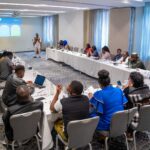
To strengthen the community capacity as the first respondent to disaster outbreaks, the National Emergency Management Agency (NEMA) and Kaduna State Emergency Management Agency (SEMA) on Wednesday began a 3-day training for locals on early warning system set-up and strengthening in Kaduna State.
The training, which formed a significant part of system strengthening on emergency coordination and response project in the state, was aimed at reducing vulnerability in terms of hazards.
Speaking to reporters at the sideline of the training at a hotel in Kaduna, SEMA Executive Secretary Abubakar Hassan said, having gone to the communities to collect data on types of disasters they may have, it became necessary to come back and harmonise the data for immediate and further planning by his agency.
‘It is important that before we get people to do what they need to do, we went into the communities to find out what hazard is peculiar to them. Having done that, it is equally important to come back, harmonise these data and then go back for early warning.
‘Once you educate someone, he or she will be prepared to put into practice the new skills and guard him or herself against any disaster which is likely going to affect lives, property, farmlands or even livestock.
‘This is about data and that was why we went into these communities because it no longer about sitting here in the city and begin to assume what happens in the communities. It will help us in terms of planning for the future and even immediate response to disasters,’ he said.
Head, Information and Public Relations, NEMA, Northwest, Halima Daudu Suleiman said: ‘We want to see SEMA coming up with a good contingency plan that will encompass a project that other states can come and borrow from SEMA. We are changing strategy and it is not going to be about relief things but less disaster and more responses.
‘The only lapse we have identified and intend to solve is the gap between SEMA and local emergency management committees (LEMC). There is a need to strengthen LEMC and that we will work on,’ she noted.
An environmentalist and consultant, Gloria Kasang Bulus, noted that, so far there is a growing population that will in turn increase interactions, there is going to increase in hazards to and we need to learn how to mitigate them.
‘The field officers are being trained again in the early warning system after which they would return to the 23 local government areas to set up this early warning system. They will set up the system at the community level so the locals are thought how to prepare for hazards based on their hazard profiling and priority. The essence is to alert communities early enough and know what to do in the event of any hazard.
‘We have a growing population and so the disaster risks. We have disasters like disease outbreaks like the famous COVID-19, communal clashes, pastoralists/crop growers clashes, food insecurity, oil spillage, flooding, fire etc which we must learn to manage,’ she added.
The Controller General, Safety Awareness and Environmental Support Initiative, and a field worker in this project, Yahaya Muhammed, said his involvement has opened his eyes to the need to move from city to grassroots for effective results.
‘The new thing about this project is that it opens our eyes to the need to go down to the grassroots even though it has been a part of what my organisation has been doing. For example, one of the new things I learnt on the field in the course of this project happened in the Kudan ward of Kudan local government where I was told about a pest called Sharon which can eat up hectares of crop in a few hours which is already leading to food shortage and we all know the impact.
‘Again, when it comes to the issue of a flood, we only look at it from city perspectives. But, when we go to the grassroots, we realise that both humans, property and farmlands are affected.
‘The challenge we face in the field has to do with unfamiliar environments where you meet people of different languages which you must learn to communicate effectively your intention which is to save lives using their knowledge and skills,’ he added.