Follow Us on Google
•Lament food prices drop
At the moment, life in Kaduna State is better as a result of a drop in the prices of foodstuffs. Families can now afford to buy more, compared to what obtained in previous year, even with the same salaries.
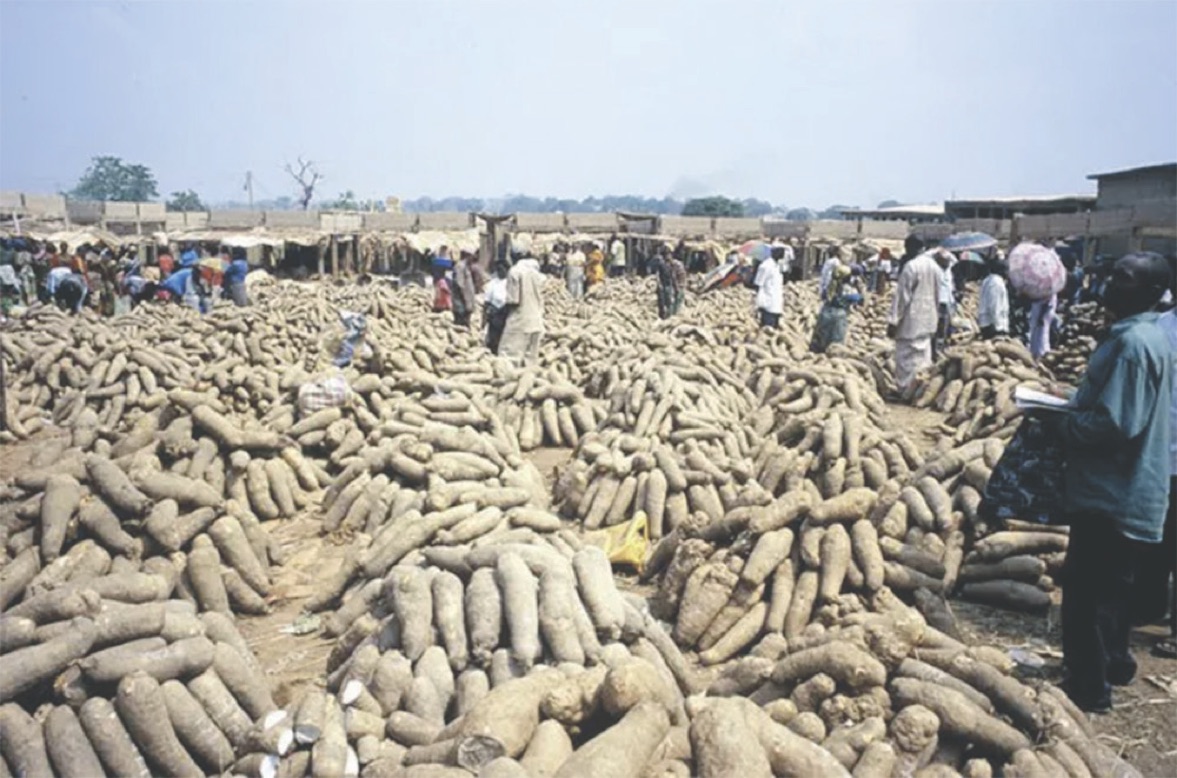
At the weekly Monday Market in Kaduna metropolis, buyers are able to buy larger quantities of staple foods than they did previously. Ironically, one man’s meat is another man’s poison. As the buyers celebrate the drop in the prices of foods and farm produce, farmers are left to groan, watching their year-long efforts melt away.
This is because the returns on their investments are far less than they had anticipated. A survey by Daily Sun showed that maize, rice, beans, garri, yams, vegetable oil, among others, recorded price drops compared to what they were by the third and last quarters of 2025.
Maize recorded the sharpest drop. A 100kg bag of maize now sells for as low as N22,000–N25,000, far below the estimated break-even price of over N44,000 per bag. “This price is killing us,” cried a maize farmer from Soba Local Government, who asked not to be named. “We spent millions of naira cultivating our farms. Now, the buyers want to take our produce for almost free,” he lamented.
Jummai Nuhu, a rice dealer at the same Monday Market, said: “Foreign rice dropped from N90,000 to N70,000 per 50kg bag, while local rice now sells for about N48,000, down from N65,000 some three months ago. Beans and garri have also become cheaper and affordable. A local measure of beans that sold for N3,500 now goes for about N2,500, while garri crashed from N1,200 to as low as N500.”
“I can finally buy garri without calculating every single cup,” Hauwa Sadiq, a mother of four exclaimed as she joggled through the prices of some food items at the Monday Market.
“Before now, we just managed hunger.. But now we can confront hunger with our arsenal of foodstuffs,” she added.
Usman Baba, a trader at the Monday Market, attributed the drop to reduced cost of transportation from their farms to the markets and a “low consumer patronage. Buyers still don’t have cash, even though the prices are low. Buyers are still unable to buy that much. They just buy small and in little quantities.
“Technically, we have a situation where fewer money is chasing after more goods and like the economists will say, supply is now higher than demand and, surely, the prices will fall.”
Behind the falling prices, however, lies a deeper despair. There is a growing tension among farmers; this is certainly not a good omen, that gloom is looming. For instance, a group of 2,143 grain farmers recently declared that they lost over N10.16 billion during the 2025 farming season following the crash in the selling price of maize.
In a letter to the Secretary to the Government of the Federation (SGF), copied to the Minister of Agriculture, the CBN Governor and senators of the three zones, the farmers lamented their distress and urged government to urgently intervene. They warned that many of them, still willing to continue farming, may not be able to embark on farming in 2026 without urgent government support.
Operating under aegis of a maize farming scheme coordinated by Alhaji Rufai Muazu Dikko (Sarkin Labar), the farmers said that they cultivated about 10,000 hectares of maize in Igabi, Soba, Kauru, Zaria and Sabon Gari LGs. They added that production costs soared during the period due to high input prices, adding that fertilizer alone was sold for N60,000 per 50kg bag, while urea rose to N50,000: “Cultivating one hectare, therefore, costs over N2 million, double the price of the previous year. With an average yield of 45 bags per hectare, farmers needed to sell each 100kg bag at N44,578 to break even. But instead market prices plunged to about N22,000 per 100kg bag, a price that translated to a loss of N22,577 per bag.
“With these losses, the farmers cannot afford the cost of farming next season.”
The farmers are seeking a CBN-backed bailout in the form of free or subsidised fertiliser and inputs for the 2026 season, proposing to repay government with maize after their harvest.
So far, experts have warned of a far bigger danger to the food supply chain this year, noting that the worst is near, if the farmers elect to abandon their farms for other callings due to poor market prices.
“There is no doubt that the farmers’ losses could threaten future food supply in the state,” said Maikudi Sani, an agricultural analyst resident in Kaduna. He added that, “If farmers quit, today’s cheap foods will become tomorrow’s nightmare.”
However, the Federal Government is seeing the development from an entirely different perspective. Government has since attributed the recent price drop to the positive reforms of the administration.
Minister of Agriculture and Food Security, Abubakar Kyari, said the decline in the cost of farm produce was due to increased production and targeted market interventions:
“We are beginning to witness a decline in food prices across several commodities. This confirms that we are moving in the right direction.”
He added that programmes like the National Agricultural Growth Scheme–Agro-Pocket (NAGS-AP) are being strengthened to ensure affordable inputs and sustained production.