Follow Us on Google
From Mohammed Abubakar. Dutse
As part of its efforts to address the shortage of qualified teachers and further bridge the inherited gaps in pupil–teacher ratios, the Jigawa State Government has engaged about 2,000 teachers to teach in its primary, junior and secondary schools across the state.
A breakdown of the distribution of the engaged teachers showed that 1, 200 were offered permanent and pensionable offers, while 820 teachers were engaged under its ad-hoc teaching programme known as J-Teach.
Incidentally the 1,200 newly engaged teachers were products of the programme.
Presenting the letters of awards to the two categories of the teaching staff, at a ceremony in Dutse, Governor Umar Namadi described the occasion as a demonstration of his administration’s commitment towards promoting quality education by providing enough manpower to teach in schools across the state.
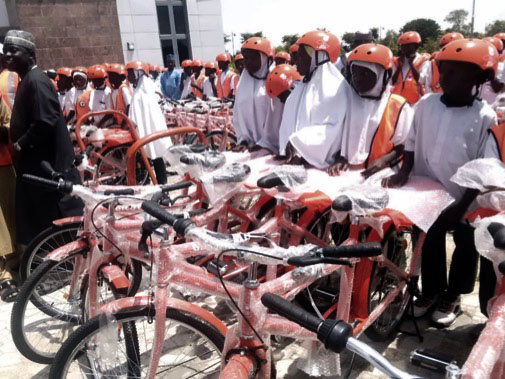
At the same occasion, the governor performed the launch of the distribution of over 450 branded bicycles donated by the Guaranteed Trust Bank, ( GTB) to students from the hard-to- reach communities who travel a long distance to access education.
The development is coming barely a month after the government provided school uniforms, bags and writing materials to thousands of learners across the state to improve access and strengthen learning conditions.
The governor said, ‘Today, we complement that investment by expanding the teaching workforce and directing qualified teachers to schools where shortages are most acute, particularly in underserved rural communities. This occasion therefore marks another purposeful step towards better teaching, improved learning outcomes and a stronger future for every child in Jigawa State
“We’re formally presenting appointment letters to 2,020 beneficiaries: 1,200 former J-Teach personnel who have successfully completed the required training and selection process and are now being converted to permanent and pensionable status, and 820 newly recruited personnel joining the J-Teach programme.
“Beyond strengthening the teaching workforce at the post-basic level, these appointments advance our commitment to creating jobs and sustainable livelihoods for qualified young people.
“This occasion also includes the distribution of 450 bicycles donated by Guaranty Trust Bank to pupils and students who travel long distances to schools in hard-to-reach communities. By easing the burden of daily travel, these bicycles will improve access, punctuality, attendance and retention, particularly for learners whose homes are far from their schools.”
He commended the bank for the thoughtful gesture under its corporate social responsibility. This worthy partnership demonstrates how the private sector can complement government efforts to ensure that distance and location do not deny any child the opportunity to learn
Namadi described education as central to the vision for a greater Jigawa, noting, “We firmly believe education will always be the most decisive factor in determining how individuals and communities can prosper. More than ever, in a rapidly changing world powered by information and communication technology, people can scarcely thrive without the knowledge, skills, and tools that quality education provides.
“This enduring reality explains why we continue to commit a significant proportion of our annual budget to education. It also means our investments in classrooms, furniture, instructional materials, technology, and school governance must be matched by enough qualified, motivated, and properly supported teachers.
“Government recognises that better learning outcomes depend above all on teacher quality; accordingly, through the Teacher Development Agency, we will give sustained attention to induction, continuous training and retraining, improved teaching methods, and professional development at both the basic and post-basic levels.
“This intervention fulfils a commitment made at the inception of our administration: to improve unfavourable pupil–teacher ratio through the recruitment of qualified teachers, sustained training and retraining, and a more balanced deployment policy.
Other News
“The objective is not simply to increase staff numbers, but to ensure that every school—particularly those in underserved rural communities has the right mix of personnel to deliver effective teaching and meaningful learning.
“Today’s appointments continue an initiative through which we have deliberately and steadily expanded the teaching workforce. Since 2023, the J-Teach pathway has brought 7,500 personnel into basic education, with 3,000 subsequently converted to permanent and pensionable appointments after training and a competitive selection process.
“At the post-basic level, nearly 2,000 personnel entered through the same programme, and 1,000 later secured permanent status. These efforts were reinforced by deploying more than 2,100 graduate teachers and employing about 600 teaching and non-teaching staff for Mega Schools and other Boarding Senior Secondary Schools across the state”
He urged the Ministry of Higher Education, its agencies and all school administrators to ensure that these appointments produce visible improvements: more teachers in schools and subject areas where shortages are greatest, reduced pressure in overcrowded classrooms, stronger lesson delivery, improved attendance and better learning outcomes.
According to him, “Posting and redeployment must therefore be guided by verified need, relevant qualifications, merit, subject specialisation and performance. Deployment must also be closely monitored to prevent the re-emergence of imbalances between urban and rural schools.
“To the 1,200 appointees entering permanent and pensionable service, your new status provides greater security and dignity, but it also places upon you a solemn responsibility to serve with integrity.
“To the 820 newly recruited J-Teach personnel, this appointment offers an opportunity to learn, contribute and demonstrate your readiness for greater responsibility. I urge all of you to be punctual and disciplined, to teach with competence and compassion, to embrace training and retraining, to accept deployment wherever your service is most needed, and always to place learners’ interests above personal convenience.”
He pledged the government support with effective induction, mentoring, supervision and fair performance assessment and called on education authorities, school leaders, traditional and religious leaders, parents and communities to welcome these appointees, support them in their duties and hold them accountable for results.
“Together, we must ensure that every appointment makes a measurable difference in the classroom and that every child, wherever he or she lives, has access to a qualified teacher and quality education”
Namadi commended the bank for donating 450 bicycles to support pupils and students attending schools in hard-to-reach communities, noting that the intervention would ease their journeys to school and demonstrates the meaningful contribution that responsible corporate citizenship can make to educational access.
He congratulated all the beneficiaries and urged them to justify the confidence placed in you through dedicated service and measurable impact in our schools.
The Commissioner for Higher Education, Prof. Isa Yusuf Chamo said the offers would bridge the teaching gaps being experienced in the school system in the state.
“With the number of that have been recruited today, would get the necessary boost, when you do analysis of the sector in the state, you’ll discover that a number of teachers retire on regular basis and need to be replaced.”
The Northeast Divisional Head of the bank, Mr. Bulama Laminu, who handed the bicycles to the governor described the gesture as part of the corporate social responsibility of the bank, hoping that the donation would help the benefitting students of over coming the challenges of traveling long distance to access education.
Besides they donated bicycles, the official hoped that the bank would intervene on future in order sectors of the economy of the state, described the bank and the state as partners in the business of developing the state.
Laminu said the bank had been doing business in the state over the past 15 years, a period, he described as productive and expressed the appreciation of the bank for the patronage it has been receiving from.the both the state government in particular and the residents of the state at large.