Follow Us on Google
From Stanley Uzoaru, Owerri
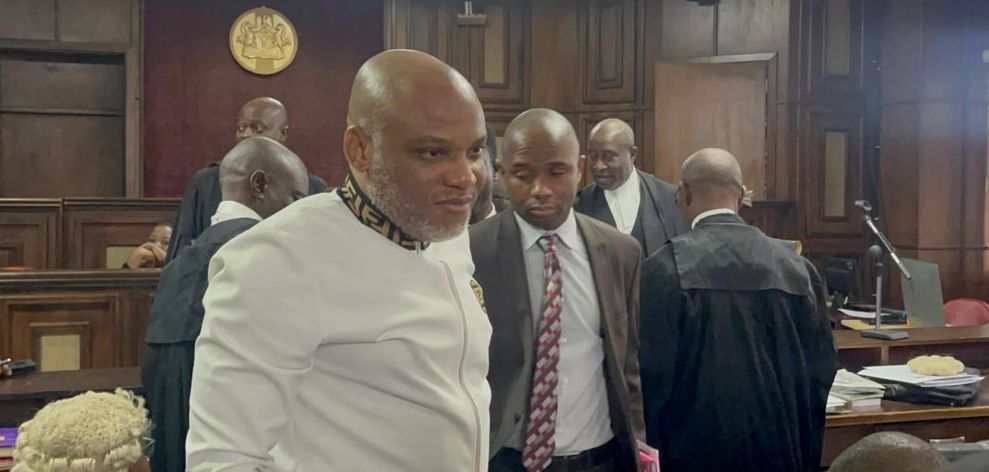
The Indigenous People of Biafra (IPOB) has expressed concern over the continued silence of the United Kingdom concerning the “illegal “detention of its leader, Nnamdi Kanu.
In a statement, spokesperson of IPOB, Emma Powerful, expressed the group’s displeasure over the development, claiming that the UK was aware of the domestic and international laws that were infringed upon by the Nigeria government, yet preferred to remain silent about it.
Part of his statement read: “The Indigenous People of Biafra (IPOB) decries the continued silence and apparent complicity of the UK Government in the face of Nigeria’s gross and well-documented violations of international law, domestic law and judicial precedent against Mazi Nnamdi Kanu, a British citizen and freedom advocate.
“Mazi Kanu was abducted in Kenya in June 2021 in a state-sponsored criminal act of extraordinary rendition and forcibly returned to Nigeria without any extradition proceedings; a flagrant breach of Section 15 of Nigeria’s Extradition Act, Article 12(4) of the African Charter on Human and Peoples’ Rights, and Articles 9 and 14 of the ICCPR, to which both Nigeria and the UK are state parties.
“What makes the UK’s silence especially appalling is that this is not an abstract diplomatic disagreement, but a matter in which the UN Working Group on Arbitrary Detention (Opinion No. 25/2022) unequivocally declared Kanu’s detention illegal and ordered his immediate release and compensation.
“The Kenyan High Court ruled that his abduction on Kenyan soil was unconstitutional and awarded damages for Kenya’s complicity.
“The Nigerian Court of Appeal (October 2022) held that Kanu’s extraordinary rendition constituted a fundamental violation of Nigerian law, effectively nullifying the proceedings against him.
“The Federal High Court sitting in Umuahia (2022) awarded him ₦500 million in damages for the same violations.
Other News
“Three judicial forums in Nigeria, Kenya and at the UN level have all concluded that Kanu’s fundamental rights were trampled.
“Yet, the UK Government, under the pretence of consular ambiguity and dual nationality, has refused to act or even issue a formal condemnation. This is in stark contradiction to its own principled reaction in the Dikko affair (1984), where it condemned Nigeria’s attempted rendition of Umaru Dikko from the UK in the strongest diplomatic terms. It severed diplomatic ties and threatened legal action for violations of international law and British sovereignty.
“In Dikko v. The State [1987] 2 NWLR (Pt. 56) 539, the Supreme Court of Nigeria, per Karibi-Whyte, JSC, made a judicial pronouncement that remains timeless and that is that the trial of an accused person, who has been brought before the court in violation of international law and without compliance with extradition procedures is a nullity. Jurisdiction cannot be conferred upon the court by illegality.
“It is deeply ironic if not disgraceful that while Nigeria is abandoning its own Supreme Court precedent, the UK has chosen silence, thus betraying the very principles it once stood for.
“To add further insult to the injury, the alleged offences for which Kanu is being persecuted, primarily the political broadcasts, were not committed in Nigeria. The applicable Nigerian law, Section 76 of the Terrorism (Prevention and Prohibition) Act 2022, provides that Nigerian courts can only assume jurisdiction where the alleged act is also a crime in the place it was committed; the well-established principle of double criminality.
“There is no evidence nor allegation that the UK, where these broadcasts were allegedly made, has found them criminal under the UK law. Therefore, by Nigerian law, no court in Nigeria has jurisdiction from the onset to put Kanu on trial,” Powerful stated.
In view of these, IPOB has called on the UK Government to publicly condemn the extraordinary rendition and continued detention of Kanu and invoke diplomatic and legal mechanisms to demand his immediate and unconditional release.
“The UK must choose between its stated commitment to human rights and the rule of law, and its political convenience in shielding a rogue state. It cannot do both. History will not forget where Britain stood at this defining moment,” he stated.