Follow Us on Google
• Says real-time transmission not practical due to poor broadband penetration, electricity supply
From Adesuwa Tsan, Abuja
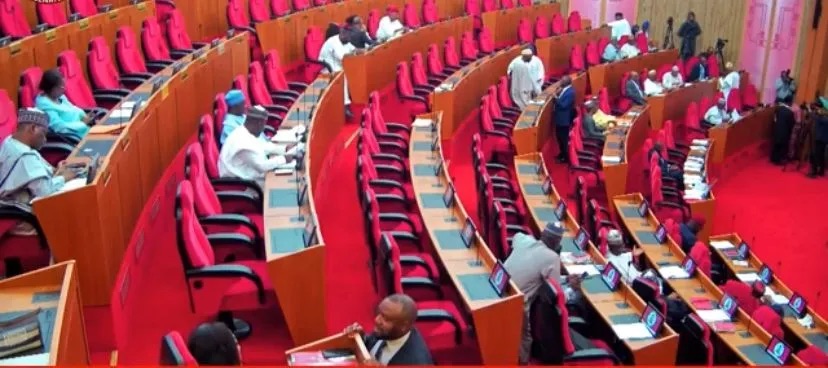
The Senate has warned that insisting on mandatory real-time electronic transmission of election results under Nigeria’s current infrastructural conditions could plunge the country into crisis, explaining that this informed its controversial decision to make electronic transmission discretionary in the ongoing amendment of the Electoral Act.
As it prepares to reconvene from its recess tomorrow instead of the earlier scheduled February 24, the upper chamber said its decision was guided strictly by empirical data and extensive consultations, and not by emotion, public sentiment or political pressure.
In a statement yesterday by the Directorate of Media and Public Affairs, the Senate Leader, Opeyemi Bamidele, said the redrafting of Clause 60(3) of the Electoral Bill, 2026 followed a careful evaluation of Nigeria’s communications and power infrastructure.
According to Bamidele, lawmaking carries huge obligations globally, stressing that the Senate could not afford to enact laws that might ultimately undermine the interest and security of the citizenry.
The controversy erupted after the Senate resolved against the original provision in Clause 60(3), which mandates that the presiding officer at each polling unit “shall electronically transmit the results to the INEC Result Viewing Portal (IReV) in real time.” Following public criticisms, the chamber reviewed the clause and opted to strengthen electronic transmission while introducing a caveat that in the event of internet failure, Form EC8A would serve as the primary means of result collation.
Bamidele acknowledged that Clause 60(3) “is an initiative that any legislature or parliament globally will have embraced ordinarily,” citing its potential to deepen public trust in democratic institutions, particularly the National Assembly and the Independent National Electoral Commission (INEC).
However, he said the Senate was compelled to weigh this aspiration against Nigeria’s infrastructural realities.
Citing data from the Nigerian Communications Commission (NCC), Bamidele disclosed that Nigeria achieved only about 70 percent broadband coverage in 2025, while internet user penetration stood at just 44.53 percent of the population within the same period.
He also referenced the Speedtest Global Index, which ranked Nigeria 85th out of 105 countries in mobile network reliability and 129th out of 150 countries in fixed broadband reliability.
“Based on the Speedtest Global Index, Nigeria’s mobile network reliability was 44.14 megabits per second. This is extremely low compared with UAE that has 691.76 mbps; Qatar with 573.53 mbps; Kuwait’s 415.67 mbps; Bahrain’s 303.21 mbps and Bulgaria’s 289.41 mbps. The Index placed Nigeria far below global average,” he said.
He added: “Nigeria’s fixed internet broadband rating is quite low by the global standard. Out of 150 countries, Nigeria occupied 129th position with only 33.32 mbps. In this rating, Singapore came first with 410.06 mbps followed by UAE’s 382.35 mbps; France’s 346.25 mbps, Chile’s 348.41 mbps and Hong Kong’s 345.25 mbps.”
On power supply, the Senate Leader cited official figures showing that at least 85 million Nigerians, about 43 percent of the population, still lack access to grid electricity.
Other News
“This shortfall speaks to the state of our power infrastructure. Even though our generation capacity hovers roughly between 12,000 and 13,500 megawatts, our distribution and transmission capacity is acutely limited. As we all know, it can only deliver 4,500 megawatts to households nationwide,” he said, expressing optimism that the Electricity Act, 2025 would drive improvements from this financial year.
Against this backdrop, he warned that making real-time electronic transmission mandatory could destabilise the country.
“By the global standards, the real-time electronic transmission of election results may not be practicable at this stage of our development. To avoid a situation that compounds our country’s woes, it is better we make it discretionary since Section 62(2) of the Electoral Act, 2022 has already established the National Electronic Register of Election Results,” he said.
He explained that the factors guided the Senate’s initial decision to retain Sections 60(3 and 5) of the Electoral Act, 2022 and its subsequent redrafting of the provisions with a caveat.
“The data speak directly to the stark realities of our federation and not the emotion or sentiment.
“We recognise that lawmaking globally comes with huge responsibilities. As representatives of the people, we cannot enact laws based purely on public emotion or sentiment. These are huge obligations that the Constitution places upon us all and we cannot discharge the responsibilities to the detriment of the citizenry,” he said.
He added that lawmaking is the lifeblood of public governance and must be anchored on facts, evidence and realities, rather than populist pressure.
“If our law does not capture the realities of the federation, then it is a script for anarchy or a ploy for instability,” he said.
According to him, this logic guided the Senate’s decision to redraft Clause 60(3 and 5) by deleting the phrase ‘real time,’ while still substantially addressing public concerns.
“The caveat, in this case, is the outright deletion of ‘real time’ from the clause so that we will not end up with an electoral governance framework that cannot respond to the stark realities of our fatherland,” Bamidele explained.
In a related issue, the Clerk of the Senate, Emmanuel Odo, had earlier issued a notice to all senators informing them that the Senate will reconvene tomorrow, February 17, “to enable them to attend to very crucial issues.”
The notice read: “I am directed by the President of the Senate, Sen. Godswill Obot Akpabio, to inform all Senators that the senate will reconvene plenary session on Tuesday, February 17, by 11am at the Senate Chamber.
“Consequently, all Senators are kindly requested to note and reschedule their engagements accordingly to enable them to attend as very crucial decisions will be taken on National issues, during the Session.”