Follow Us on Google
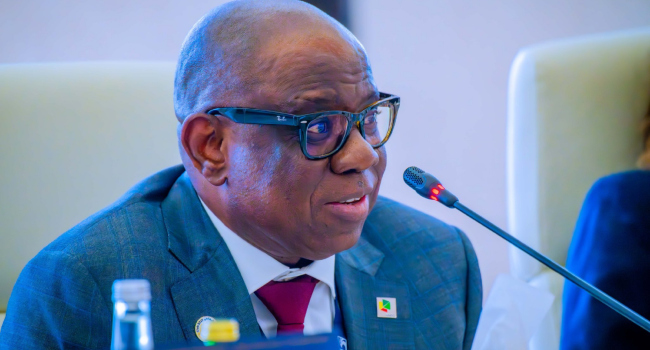
In today’s high-stakes corporate and public sector leadership, performance is no longer judged by promises but by proof. Results must be tracked, decisions interrogated, and progress clearly demonstrated.
One year after Bayo Ojulari assumed office as Group Chief Executive Officer of NNPC Limited, the moment calls for a clear-eyed assessment of his leadership, what has changed, what has worked and what lies ahead.
Ojulari did not arrive at a moment of calm. His appointment on April 2, 2025, came against the backdrop of mounting public skepticism and internal contradictions. The state of Nigeria’s refineries, particularly those in Port Harcourt and Warri, had become a lightning rod for debate. Officially, they had been recommissioned after years of costly rehabilitation. Unofficially, many doubted whether those facilities were genuinely functional.
The gap between declaration and reality had become too wide to ignore, feeding a broader crisis of credibility around the national oil company. It was into this uncertainty that Ojulari stepped, confronted with a choice that often defines leadership: preserve appearances or pursue the truth.
He chose the latter, and in doing so, reset the tone of governance at NNPC. Rather than defend inherited claims, he immersed himself in the mechanics of the system, reviewing technical reports, engaging operational teams, and interrogating data. What followed was a decision as simple as it was profound: shut down the refineries. It was not the kind of move that courts applause in the short term. It disrupted narratives, unsettled expectations, and exposed uncomfortable realities. But it also sent a clear message that the era of managed optics was over. If the refineries were to work, they would work properly; if they were not, they would not be dressed up to appear otherwise. In that moment, Ojulari signaled that under his watch, transparency would not be a slogan but a practice.
That signal quickly found expression in institutional behaviour. One of his earliest moves was to restore the publication of NNPC’s monthly financial and operations reports, a transparency mechanism that had fallen into inconsistency. With their return came a renewed ability for stakeholders to track the company’s performance, production volumes, revenues, operational efficiencies, without relying on speculation. The culture of disclosure deepened further in November 2025, when NNPC Limited held its first-ever earnings call following the release of its audited 2024 financial statements. The announcement of a N5.4 trillion profit after tax captured headlines, but beyond the numbers lay a more consequential shift: the company was beginning to speak the language of accountability expected of global energy players.
Still, leadership is not measured by transparency alone. It must be weighed against clearly defined objectives, and in Ojulari’s case, those objectives were set by Bola Ahmed Tinubu with unmistakable clarity. The mandate was ambitious, raise crude oil production to two million barrels per day by 2027, scale gas output to eight billion cubic feet per day within the same timeframe, expand refining capacity, and attract tens of billions of dollars in fresh investment. It was a tall order by any standard, particularly in a sector long burdened by structural inefficiencies and external pressures.
One year on, the evidence suggests that while the journey is far from complete, the direction has shifted. In upstream operations, Ojulari has overseen a notable increase in production through NNPC Exploration & Production Ltd. Output climbed from a daily average of 203,000 barrels in 2023 to 312,000 barrels by December 2025, with peaks reaching 355,000 barrels, the highest level recorded in decades. National production has also edged upward, moving from roughly 1.5 million barrels per day to about 1.62 million. To the uninitiated, the increment may appear modest, but within the context of Nigeria’s oil sector, where theft, vandalism, and operational disruptions have long suppressed output, it represents meaningful progress. Each additional barrel reflects not just production capacity but improved system integrity.
Other News
If oil production tells a story of recovery, gas tells one of momentum. Developments within the NNPC/Renaissance joint venture have positioned gas as a central pillar of growth, with output already hitting 2.2 billion cubic feet per day. The optimism surrounding this trajectory is not speculative. As Tony Attah of Renaissance Africa Energy Company noted, the venture has surpassed its immediate targets and is already recalibrating towards higher benchmarks. This growth is being reinforced by critical infrastructure projects. The River Niger crossing of the Ajaokuta-Kaduna-Kano pipeline has brought long-awaited clarity to a project that had lingered in uncertainty, while the Obiafu-Obrikom-Oben pipeline is nearing completion. Together, they represent more than engineering milestones, they are the arteries through which Nigeria’s gas ambitions can flow into industrial reality.
Yet, it is in refining that Ojulari’s leadership has been most paradoxical. On paper, little progress has been made toward expanding capacity. In practice, however, his decision to shut down the refineries may prove to be one of the most consequential moves of his tenure. By refusing to perpetuate underperformance, he has created space for a more credible and sustainable approach to refining. It is a strategy that sacrifices immediacy for integrity, choosing to rebuild rather than patch.
Investment, meanwhile, has emerged as a strong pillar of his first year. The groundwork laid for the Bonga Southwest Aparo deepwater project stands out as a defining achievement. By securing presidential approval for fiscal incentives, Ojulari has effectively unlocked the pathway for a potential $20 billion investment. In a global energy landscape where capital is increasingly selective, such positioning matters. It signals to investors that Nigeria is willing to align policy with opportunity, reducing uncertainty and enhancing competitiveness.
Internally, the financial pulse of the company has also strengthened. Within a year, NNPC Limited has reportedly remitted N14.706 trillion in statutory contributions to the federal government and related agencies. This figure is not merely a reflection of earnings; it speaks to improved discipline in revenue management and a renewed commitment to fulfilling the company’s fiscal responsibilities.
Early in his tenure, Ojulari acknowledged the weight of expectations placed upon him. The targets, he admitted, were tough. One year later, that admission reads less like caution and more like context. Out of the core mandates before him, he has made substantial progress on most, while deliberately slowing down on refining to reset the foundation. It is a record that suggests not perfection, but purpose.
As he steps into his second year, the questions will grow sharper. Progress must be sustained, gains must be scaled, and early decisions must translate into lasting transformation. But if the first year has established anything, it is that Ojulari is not inclined toward easy narratives. His approach has been to confront reality, however inconvenient, and to build from there.
In that sense, his first year has not merely been about “walking the talk.” It has been about redefining what the talk should be, and backing it with action.
Ben Ekori, an energy sector expert and public affairs analyst wrote this piece from Lagos.