Follow Us on Google
From Scholastica Hir, Makurdi
At last, a fragile peace appears to have returned to the troubled All Progressives Congress (APC) in Benue State. This reconciliation gives credence to the old political adage that there are no permanent friends or enemies, only permanent interests. In the volatile theatre of Nigerian politics, alliances are rarely static, and Benue State remains a premier example of this unpredictable ebb and flow.
Since the dawn of the Fourth Republic in 1999, the political trajectory of the state has been largely defined by Dr George Akume. Often referred to as the “George of Africa,” Akume has remained a towering figurehead from his tenure as Governor under the Peoples Democratic Party (PDP) to his pivotal role in leading his supporters into the ACN and subsequently the APC. As a seasoned kingmaker, he successfully installed his successor, Gabriel Suswam, in 2007 and later facilitated the victories of Samuel Ortom in 2015 and the incumbent, Reverend Father Hyacinth Alia, in 2023.
What began as a formidable partnership between Akume, now the Secretary to the Government of the Federation (SGF), and Governor Alia soon descended into a defining crisis. Initially, both leaders dismissed rumours of a rift as the fabrication of political jobbers. However, the fallout soon exposed deep fractures within the state party and spilled into the Benue State House of Assembly, turning the legislature into a battleground for supremacy.
At the heart of the conflict was the classic struggle between an established godfather and a leader seeking independence. Akume provided the structural machinery for victory, while Alia brought a “tsunami” of grassroots popularity through his “Yes Father” movement and his reputation as a Catholic priest known for healing masses.
The first sign of friction appeared during the victory celebrations of 2023. Akume wore a shirt inscribed with the phrase “Never Bite the Finger…” and invited journalists to complete the sentence. While aimed at the opposition, the statement served as a reminder of his role as the state’s primary hiring and firing authority.
Within months, expectations of loyalty collided with the realities of governance. Observers noted that Alia did not merely bite the finger that fed him but used an axe to sever the hand entirely.
The struggle for control initially manifested in two areas: party structure and political appointments. This tension reached a boiling point during the election of the Speaker of the House of Assembly. The House was split between supporters of Akume, who backed Becky Orpin, and those loyal to Alia, who supported Aondona Dajoh. Following five hours of near fisticuffs on the legislative floor, Alia’s camp emerged victorious with Dajoh’s election.
As Alia moved to consolidate his authority, he withdrew recognition from the state party executive led by Austin Agada, an Akume loyalist. This prompted the national leadership to appoint a caretaker committee led by Benjamin Omale. For a time, Benue operated with parallel APC executives: the caretaker committee working from the official secretariat and the Agada faction operating from the SGF’s private residence.
Agada’s faction later argued that the Governor had ignored party zoning arrangements and bypassed the party leadership in appointing commissioners and local government caretaker committees. They claimed that eighty per cent of the names chosen by the Governor were outside the lists submitted by the party, with many slots allegedly going to members of the opposition.
Other News
As tensions threatened the stability of the Tiv nation, the paramount ruler, Tor Tiv Professor James Ayatse, intervened. During a reconciliation meeting on Easter Monday in 2024, the monarch cautioned his “sons” against public feuding. While the leaders agreed to bury their differences at the palace, the peace was short lived.
Further intervention became inevitable at the national level. President Bola Ahmed Tinubu, during a 2025 visit, mandated a reconciliation committee to resolve the quarrel. Vice President Kashim Shettima and National Chairman Abdullahi Ganduje also added their voices, urging the duo to close ranks to protect the party’s prospects.
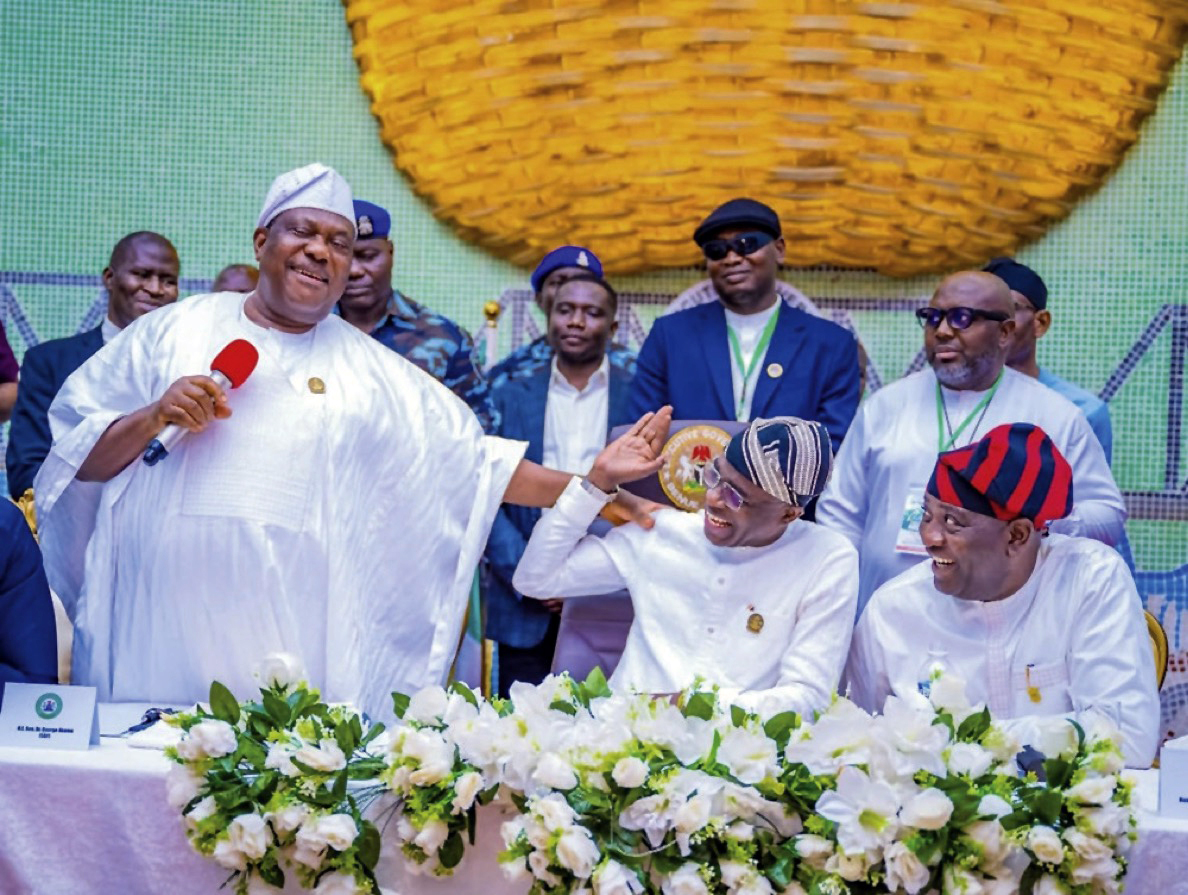
The breakthrough finally occurred on Sunday, 3 April 2023, during a high powered meeting at Government House, Makurdi. In a significant move, Governor Alia apologised for the previous friction, a gesture Akume described as “very good.”
Akume informed the press that the President’s message was clear: all elected officials on the APC platform must be protected and reintegrated into the fold. For his part, Alia stated that he apologised as a responsible leader to ensure citizens enjoy the dividends of democracy. However, a slight nuance remained, as the Governor noted that the national leadership had emphasised there would be no “automatic tickets” for any candidate, potentially countering the SGF’s earlier remarks.
The reaction from stakeholders has been overwhelmingly positive. Senator Gabriel Suswam commended the meeting as a vital step for the state, while Senator Emmanuel Udende expressed relief that the “divided house” had been reunited. Governor Alia, via his spokesperson Tersoo Kula, praised the spirit of reconciliation and described the outcome as a major step towards reconstructing trust and cohesion.
External groups such as the Kunav Progressive Academics (KPA) have also hailed the development. In a statement signed by several professors, the group described Alia’s willingness to express regret as a testament to his character and maturity. They also praised Akume for his role in embracing peace and his call for stakeholders to rally behind the Governor.
The implications of this truce are significant as the 2027 election cycle approaches. While the squabbles of the last three years have left the Benue APC battered, a faithful adherence to this agreement could foster a new era of unity. The crisis has highlighted a shift in the Nigerian political landscape, where governors increasingly seek independence from traditional power brokers.
Whether this calm is a permanent resolution or a temporary strategic alignment remains to be seen.
However, for now, the APC in Benue appears once again to be the party to beat, provided the spirit of the Makurdi accord is maintained.