Follow Us on Google
From Okwe Obi, Abuja
Chairman, Federal Civil Service Commission, Prof Tunji Olaopa, has said the implementation of the Oronsaye Report would reduce national waste drastically.
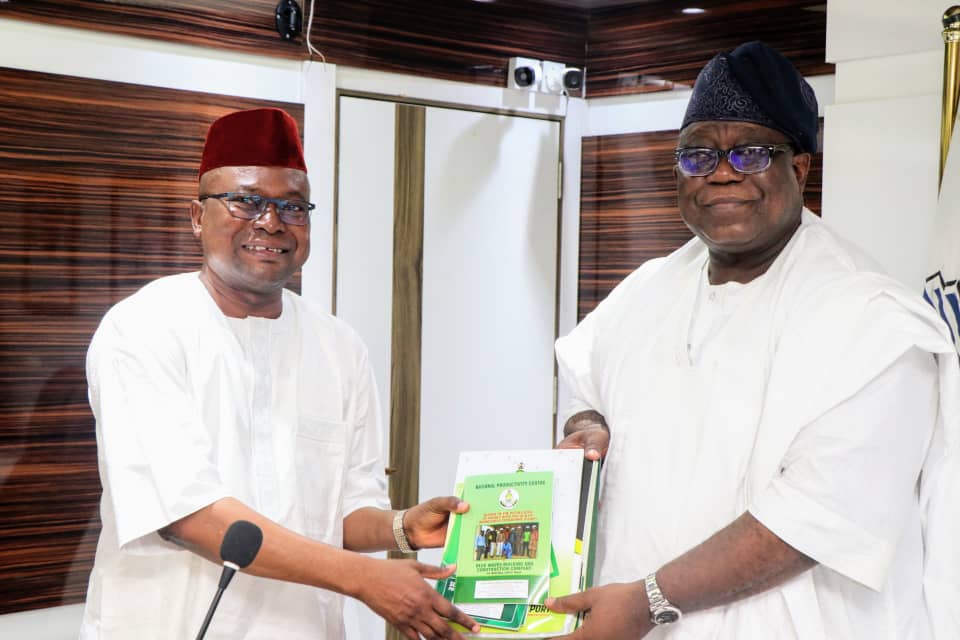
Prof Olaopa made the remarks on Friday, when the Director General, National Productivity Centre, Adejoh David, paid him a courtesy call in Abuja.
He said it was baffling how an average Nigerian shows off and celebrate funerals, birthdays, graduation, new houses, marriages, promotion, everything; and never in any way modest, but with unbridled extravagance.
He said: “Instituting a new national productivity culture happens to be a core pillar of my governance and institutional reform model.
“And the supportive argument and policy is one that His Excellency, President BA Tinubu has now made profoundly, starting with the implementation of the Oronsaye report.
“And the argument is this that: One, the challenge of the Nigeria project is that of a resource-dependent mono-cultural economy in harnessing resource efficiency to accelerate economic growth.
“Two, accelerating national economic growth will no more depend on the quantum of government spending on development programmes, it will require at once disciplined policy execution that balance the rate of investment on development projects with return on those investment.
“Three, even at the level of the national values in society, we are basically a very wasteful people.
“I refer to the pervasive culture where an average Nigerian like to show off and celebrate everything – funerals, birthdays, graduation, new houses, marriages, promotion, everything; and never in any way modest, but with unbridled extravagance
“In sum, it is so very clear that many drivers of the nation’s national productivity, be it service delivery, programme and project management, resource use efficiency, etc. require recalibration.
“The required national cultural adjustment must necessarily extend to the nation’s work culture and labour standard, work method, skills pricing, pay and reward system; productivity metrics, research and development, talent and knowledge management, and I can go on and so on
“At the level of the state system and the public service, the point cannot be overemphasized if one says that the Nigerian state cannot be developmental if it is so very capable of being the generator of institutional wastes, redundancies and pointless costs being carried as public finance and budget overheads by MDAs.
“What productivity can ever exist in a public service with a workforce structure where too many people are doing nothing, too many doing too little, while too few are doing too much.
“Indeed, the political science literature is replete with evidence of the magnitude of costs and redundancies that Nigeria has generated by its peculiar brand of federalism, presidentialism, electoral system and diversity management praxis.
“There is of course the opportunity costs incidental on how the dynamics of the implementation of the federal character has undermined meritocracy and the institutional capacity deficits and obsolescence incidental.
“There are redundancies created by the unconscionable practice whereby every agency irrespective of cost implication, must have offices in all the states of the federation and even LGAs, without consideration for how technology can be leveraged for ‘joined up’ cost saving governance cum institutional networking and outsourcing.
“All considered, the job of the National Productivity Centre is cut out for it, especially in generating ideas and models that could help the government in getting a handle on resolving the unsustainable cost of governance, while at once creating the narratives and scripts for institutions like the National Orientation Agency (NOA) in their national values reorientation drives.”
He also, proposed that, “there is the imperative need to launch a national waste reduction strategy that should necessarily commence with:
“the unbundling of the expenditure structure of government to free resources for investment in real development; this will require productivity audit of MDAs and deletion of very many revenue generating agencies and those that ought to be self-financing from budget, in measures that reinforce a cautious implementation of the Oronsaye Panel report;
“We must get MDAs to articulate their productivity cum waste reduction plans based on agreed national benchmark;
“And this should challenge the professionalism of the National Productivity Centre to refine and launch new set of productivity metrics and tools for holding MDAs accountable to national productivity targets which must be admitted into the national development plan; and In this regard, the launch of a complimentary new national assets cum facility management and national maintenance system will be core critical.”
Also, Adejoh David identified attitudinal gap as a challenge hampering productivity among young people.
He reiterated the willingness of the Centre to raise the bar of productivity by training and retraining young people to be productive.
“Our mandate is to lead a productivity movement in Nigeria. We now have 26 offices. Our mission is to develop the mindset and institutionalise productivity culture in citizenry for enhancement of service delivery and quality of life.
“One of our goals is to raise the productivity consciousness level and build the human capacity for productivity improvement for service delivery.
“We have realized that attitudinal gap is a major challenge for productivity improvement.
“To address this, we have what is called the productivity couching and mentoring scheme for students and youths.”
David added: “I have been in the system at the national productivity centre for 29 years now. I joined the centre in 1990. I was lucky to be among the 25 staff members that was trained and we had been able to train more than 100 of our staff since I came on board.”