Follow Us on Google
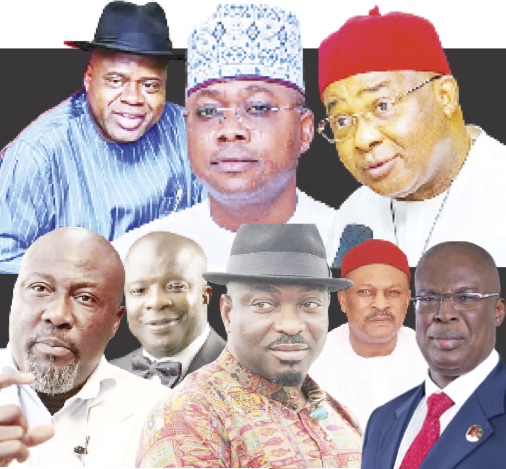
By Omoniyi Salaudeen
Nigeria is back again in the regular pattern of electoral malfeasance and the usual contestation.
Before the recent controversial off-cycle elections held in Bayelsa, Imo and Kogi states on November 11, the expectation was high that the process would be a departure from the immediate past experience of the last general elections.

But it appears that nothing has been learnt and nothing has been forgotten.
From Kogi in the Northern fringes to Imo and the far-flung Bayelsa State in the oil-rich Niger Delta region, the conduct of the election was characterised by voter apathy, violence, intimidation, vote-buying, and outright ballot snatching.
For all the wrongs that have happened, the Independent National Electoral Commission (INEC) has not been spared any harsh word by those who felt shortchanged in the process. With the current rage of anger, criticisms, condemnation, and agitation for the outright cancellation of the results declared by the electoral umpire, the political class is taking Nigerians through the arduous old path.
Curiously and intriguingly, the ruling parties in the three states still maintained their hold in their respective domain after the outcome of the elections, leaving the opposition candidates screaming blue murder.
In Imo State, the Labour Party and the Peoples Democratic Party (PDP) were quick to call for the cancellation of the results that gave victory to the incumbent governor, Senator Hope Uzodimma, citing irregularities as the reason for the demand.
INEC’s Returning Officer for the state, Prof Abayomi Fasina, had announced Uzodimma as the winner of the election after polling 540, 308 votes to defeat the other candidates.
At a press conference held following the announcement of the poll’s result, the Deputy Governorship candidate of the LP, Tony Nwulu, complained that security agents allegedly provided cover for some persons who subverted the will of the people.
He declared that the LP won with the actual votes cast in the election, saying that “democracy is under threat in this state.”
He said: “There was no election in Imo State on Saturday. What happened was the diversion of the electoral materials to the homes of people and the LGA council headquarters. In all this, the police, army and the DSS provided security to the actors.
“They came with huge sums of money to the polling units for votes buying, but the Imo people rejected them. They now resorted to snatching of electoral materials, diversion of the electoral materials to homes of individuals and to the LGA headquarters where they are currently rewriting the results.
“We have all the records. We are putting Nigerians on notice that there was no election in Imo State on Saturday.”
Also kicking, the governorship candidate of the Peoples Democratic Party, Senator Samuel Anyanwu, at a separate press conference, called for the outright cancellation of the election, claiming that INEC and security agents failed in their constitutional responsibility to deliver credible elections to the people of the state.
He said that security agents protected INEC staff and APC members to rewrite the results.
Anyanwu said that he and his party, the PDP, would not accept anything less than a total cancellation of the poll.
The situation is not so much different in Bayelsa State where Governor Douye Diri of the ruling PPDP won the election.
The Returning Officer, Prof Faruq Kuta, who announced the result, said that Diri polled 175, 196 votes to defeat his closet rival, Timipre Sylva, of the All Progressives Congress, APC, who garnered 110,108 votes whole the LP candidate, Udengs Eradiri, scored 905 votes.
However, Sylva and Eradiri, in quick reactions, rejected the result, demanding its cancellation.
Addressing newsmen after the declaration of the results by the INEC, the APC state Chairman and party agent, Dennis Otiotio, said: “Over 84,000 votes scored by APC in Nembe and Southern Ijaw were cancelled and so we will not be signing the result. In Nembe, over 29,000 votes were cancelled that APC scored. In Southern Ijaw over 55,000 votes were cancelled. If you put the total votes cancelled that APC scored in the field which is about 84,806 votes, if you add it to what APC scored, we clearly won the election.
“It is clear that INEC has colluded with the PDP to cancel our result in the INEC office, not at the field. The votes were brought from the EC8A and EC8B to the INEC office, they decided to cancel over 84,000 votes scored by the APC.
“It is unprecedented, it has never happened anywhere and we are totally rejecting these results. The electoral act allows INEC to review the results within seven days and so we have written the necessary petitions which we have submitted and we believe that INEC in good conscience will look at our petition and deal with it justiciably.”
Eradiri, who also rejected the results, said that the election was held against the cardinal principles, laid-down procedures, and ground rules that democratic elections to offices must be free, fair, credible, and peaceful.
Eradiri, in a press briefing at the State LP secretariat, said “the election was marred by massive and mind-blowing vote-buying,” adding that the state government converted all the polling units to market squares and business centres where votes were auctioned, haggled over, bargained for and purchased. The commission should investigate the massive monetary inducements that occurred in the Bayelsa election.”
The Kogi State chapter of the PDP and Social Democratic Party (SDP) also followed suit, calling for the cancellation of the results in five local government areas in the state.
SDP made the call at the gubernatorial election collation centre where the party’s collation agent, David Edibu, submitted a petition to the INEC, calling for the cancellation of results in Okene, Okehi, Ogori Magongo, Adavi and Ajaokuta local government areas, as well as some parts of Lokoja, over alleged corrupt practices, votes-buying and over-voting. He lamented that agents of the party were not allowed to get close to the polling units in the LGAs.
The PDP’s collation agent, Abubakar Mahmood, also corroborating the same claim, saying that the number of malpractices in the said LGAs was alarming.
Consequently, the governorship candidates of the PDP and SDP, Dino Melaye and Muritala Ajaka, respectively, rejected the declaration of Usman Ododo of the ruling APC as the winner of the election.
According to the results declared by the INEC, Ododo scored a total of 446,238 votes to defeat his opponents, Ajaka and Melaye who polled 259, 052 votes and 46,262 votes respectively.
Melaye, while calling for the cancellation of the election due to what he termed “irregularities that marred the election,” said: “The INEC, as a matter of urgency, must cancel the election. In many areas where I won, my agents were told there were no available result sheets to enter the result and we have evidence to back up these claims.
“As I speak to you, it is shameful that this is what our democracy has descended to. INEC has manifested ever than before, that it cannot be trusted, it is biased, it is compromised and it cannot be a neutral umpire.”
Similarly, Ajaka, in a statement, rejected the results of the poll, saying that it was against the electoral laws.
The statement issued by his media aide, Faruk Adejoh-Audu, reads in part: “Against all logic, laws and decency, the Independent National Electoral Commission is hurriedly progressing with the announcement of the results of an election it has hitherto and voluntarily declared as dubious and compromised in Kogi State.
“The INEC has suddenly turned an ostrich to pretend that the malpractices it uncovered can just be ignored and nobody, not even the victims of the electoral heist, is entitled to protest.”
However, Chief Chekwas Okorie, a notable leader of thought in the Southeast, while engaging in a telephone conversation with Sunday Sun, cautioned that it was not enough for political parties to allege irregularities, adding that such claims must be supported by convincing evidence through Form EC8A duly signed by their agents.
His words: “One of the things I said publicly before the election by way of advising political parties is that they should not rely on INEC and that trusting INEC will be a very big risk or political suicide because INEC has proved that it cannot be trusted.
“All parties should be sure that they have their agents at the polling units because these agents are supposed to sign form EC8A. If they have copies of polling unit results, it will not matter again what anybody puts together at the collation centres because it is form EC8A that is actually superior to either BVAS or IReV.
“And I cited two examples and those two examples still subsist till today. Those forms were what made Peter Obi win the governorship election tribunal in 2003; 20 years ago, after INEC had already declared Chris Ngige as the winner of the election.
“It was also based on the results at the polling units that Senator Natasha Akpoti-Uduaghan used to win her case both at the lower and appellate court in spite of the fact that INEC had declared the APC candidate the winner of the election. The results from the polling units showed that this lady won by over 3,000 votes.
“I am still watching the way things are going. Some of the candidates are claiming that election did not take place in some of these places. Those claims can only be supported if the agents of those parties did not sign any form to show that elections held. Without agents’ signature and that of the returning officers, I don’t see how INEC can sustain its declaration. But if agents are not available, I don’t see how results already declared by the INEC can be upturned.
“Whatever they are articulating in the social media, if they cannot prove it at the tribunal, they are just wasting their time.”
Okorie warned that Nigeria’s democracy might be heading for the rock, if the current trend of electoral malfeasances continue unchecked.
Hear him: “If we continue the way things are going, nobody will have confidence in our electoral process. And the next election will be so violent. This particular INEC chairman ought to resign. He has failed serially. His excuses are no longer tenable. That is the worst thing that has happened to Nigeria’s democracy.
“How could sensitive materials that INEC claimed had been protected get into the hands of politicians and they used them to write results?”
The Secretary of the Ijaw Elders Forum, Efiye Bribena, raised similar posers, saying: “Will you call this an election? The answer is no. It is just the survival of the fittest. It has nothing to do with popular votes.
“The fact that the ruling parties maintained their holds in the three states tells you that it is all about the use of force and funds. It is just like states running local government election. There is no independence in the electoral body any more. It is the incumbents that have the powers of coercion and money that determine who wins the election. It is no longer about the electorate any more.
“Yes, political class is responsible for some of these electoral infractions. But if the INEC is truly independent, the political class will not succeed in doing all these things. The truth is that there is no future for our democracy. Nothing good can come out of our democracy if this trend continues. The next set of election will be worse than this. Except the people are ready to take back their country, the trend will continue because INEC is not ready to do the right thing for the future of our democracy.”
Dr Abayomi Tunji, a renowned constitutional lawyer and human right activist, in his reaction, noted that unnecessary contestation at each turn of election cycle had become part of the greatest undoing of the political class and called for a sensible discussion of the trend.
“Why is it that we have never got any major competitor that will say the election is free and fair? Only one person will win an election at a time. We kill ourselves because of elections. The desperation, to my mind, is totally unwarranted.
“With the present trend, even parties that have no chance of winning elections have the tendency to work up the system. People should find job to do. While the election was going on, everybody said it was okay. But suddenly, it became another thing after losing the election.
“I think there is a need for sensible discourse about this trend. I ran for election several times and I lost each time. Each time I lose, second day I go back to my work. The problem is that a lot of these people are just busy bodies. They have nothing to do. I think we need to take some sensible positions against these losers,” he posited.