Follow Us on Google
From Aloysius Attah, Onitsha
Nnamdi Azikiwe University is keeping the Igbo culture alive, promoting the culture to the global world and nurturing the culture for successive generations to come. These bold statements were made and put in practice recently at the Awka main campus of the university during the 2026 Igu-Aro Festival of UNIZIK.
The Igu -Aro festival is one of the oldest surviving Igbo cultural festivals and one of the most colourful and celebrated festivals in Igboland. The festival, which has been in existence for so many centuries, has survived various cultural erosions. It is an annual event that signifies the beginning of the planting season and the proclamation of the 13 months Igbo lunar calendar by kings or traditional leaders. It is a significant cultural event focusing on spiritual blessing, communal unity involving traditional rites performed by the community leaders to invoke blessings for a fruitful agricultural year. The festival also features cultural dances, music, and communal feasting, fostering unity and cultural preservation. .
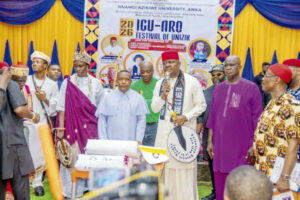
Hosted by the UNIZIK Directorate of Igbo Village and Institute of African Heritage Studies (IVIAHS), at the ASUU Secretariat, the event brought together, cultural enthusiasts, traditional rulers, academics, staff, students, and lovers of Igbo culture in celebration of the rich heritage and traditions of the Igbo people.
Declaring the event open, Vice-Chancellor of Nnamdi Azikiwe University, Prof. Ugochukwu Bond Stanley Anyaehie, described the event, which also featured the unveiling of the Igbo calendar and UNIZIK academic calendar, Igbo version, as a “landmark step in preserving and promoting our heritage”
Represented by the Dean of Student Affairs, Prof. Kingsley Ubaoji, the Vice Chancellor recalled that the Directorate of Igbo Village and Institute of African Heritage Studies (IVIAHS) was established to research, revive, and revitalise the Igbo language and culture within contemporary realities, while promoting African civilisation and values.
According to him, the Directorate has remained committed to its mandate through programmes such as the UNIZIK Ohazurume Igbo Festival and Igu-Aro UNIZIK.
Speaking on the Igbo calendar system, he explained that the traditional Igbo calendar is built around a four-day week known as Izu, comprising Eke, Orie, Afor, and Nkwo, which continue to serve as market days in many Igbo communities.
He further stated that seven Izu, making 28 days, form one lunar month known as Onwa, while thirteen Onwa make up one Igbo year, Afo. He outlined the 13 Igbo months and their corresponding Gregorian periods, stressing that the calendar is deeply rooted in Igbo cosmology and traditional belief systems.
The Vice Chancellor also acknowledged the presence of royal fathers at the occasion, including His Royal Highness, Obi Eze Uzu II of Awka, Dr. Gibson Nwosu, represented by the Prime Minister, Chief Benjamin Okoye, Otutu Awka II, as well as His Majesty, Ralph Obumneme Ekpeh, Eze Enugwu-Ukwu na Umunri among others.
“Today’s unveiling of the Igbo calendar and UNIZIK academic calendar, Igbo version is epochal, It is a bold attempt by IVIAHS to harmonise our traditional time-reckoning with modern academic life. I challenge our scholars to go further to work towards a standardised Igbo calendar that can guide cultural festivals like Igu-Aro, Iri-ji, Ofala, with Gregorian equivalents for global reference.
“Though we gather today at the ASUU Secretariat for the 2026 Igu-Aro, the spirit of this festival points us to the permanent home of Igbo heritage in this university. By institutionalising these events, we declare that Igbo language, culture and worldview have an enduring place at Nnamdi Azikiwe University” the Vice Chancellor stated.
Other News
The Keynote Speaker, Chief Valentine Ozigbo while delivering the keynote address titled “From Calendar to Civilisation: Reclaiming Time, Leadership, and Destiny,” said the Igu-Aro Festival is not merely a cultural observance, but “a declaration of continuity, identity, and a civilization that has refused to fade.”
“In the Igbo worldview,” he said, “time is not merely counted. It is interpreted, organised, and lived. It gives rhythm to work, meaning to seasons, structure to community, and direction to life.”
Explaining the philosophical depth of the Igbo calendar, Ozigbo noted that the traditional lunar system, structured around months, weeks, and market days, carried significance far beyond practicality. According to him, it represented an alignment of human activity with natural order — a framework in which the human, spiritual, and natural realms existed not in tension, but in harmony.
Drawing from scripture, including the Book of Daniel’s declaration that God controls times and seasons, and the Ecclesiastes’ reminder that there is a season for every purpose under heaven, and Genesis’ establishment of seedtime and harvest, Ozigbo argued that the Igbo ancestors, through their observation of the moon and the rhythms of the earth, were responding in their own cultural idiom to a deeper divine order.
According to him, Igu-Aro represents consciousness and an understanding that life must be lived in rhythm rather than randomness. He explained that the ancestors carefully studied nature, observed patterns, and recognised the interconnectedness between the cycles of the moon, the seasons of the earth, and human existence.
He further stated that time, in traditional Igbo society, was practical and purposeful, guiding farming, trade, spirituality, and community life. He added that the Igbo calendar provided a framework that aligned human activity with natural order, where the spiritual, natural, and human worlds existed in harmony.
Ozigbo noted that life operates in seasons and cycles, making the understanding of time both cultural and spiritual.
In his remarks, the Director of IVIAHS, Very Rev. Prof. Bonachristus Umeogu, described Igu-Aro as an important aspect of Igbo tradition. He emphasised the need for continued participation in the annual celebration to ensure that Igbo culture and heritage do not go into extinction.
Prof. Umeogu noted that the Directorate of Igbo Village and Institute of African Heritage Studies (IVIAHS) was created in the university to preserve and foster “Igboness” identity in relation to the people who regard Igbo land as their ancestral homeland and who think in and speak Igbo language and have their life and existence in Igbo tradition and culture .
“The idea is to expose the Igbo civilization to Igbo, Africa and the world at large. That is the deciding reason why the motto of the directorate is: “Enlightening the world through Igbo African Heritage. Since we are talking about ‘Igboness,’ that is what concerns the Igbo people. The term “Igwebuike which connotes the spirit of oneness, collectivism and communalism represents the ideology of which Igbo village as the centre of African Heritage Studies can be developed from a university as an ivory tower” Fr. Umeogu stated.
Traditional Ruler of Enuwu-Ukwu community, Igwe Ralph Obumneme Ekpeh,, Eze Enugwu-Ukwu na Umunri while performing the Igu-Aro declaration for the years 2026 , reflected on the practice of Igu-Aro in ancient times and stressed the importance of preserving and passing the tradition to future generations.
He disclosed that in Igbo culture, each lunar month of the Igbo signifies a particular season and also carries a particular task and blessings which include month of penance, month of sacrifice, month of expectation, and month of fruitfulness among others.
The festival was enlivened with cultural performances, Igbo mbem chant performance by Mrs Perpetual Attah and her troupe, Odenigbo dance group from Blessed Iwene Tansi Parish, Awada, Amawbia Women dance group among others.
Among dignitaries present at the event were the University Librarian, Prof. Jacinta Ukamaka Eze, Prof. Nkechinyere Nwokoye, Deans of faculties, HoDs , Chinese Director of the Confucius Institute, Prof. Yu Zhangbao, Nze na Ozo title holders, other staff members and students of the university.