Follow Us on Google
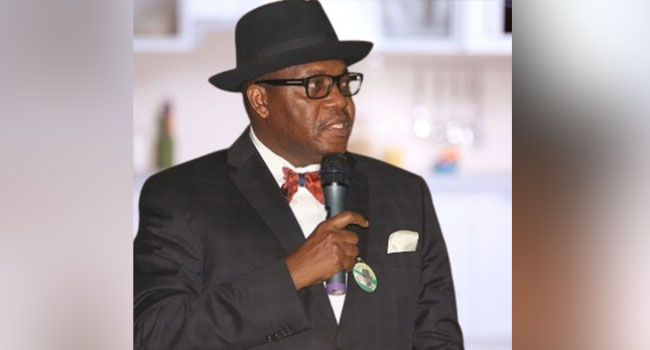
Says governors should stop regional ‘jamboree’ and build productive economies
From Adesuwa Tsan, Abuja
National Chairman of the Pan Niger Delta Forum (PANDEF), Ambassador Godknows Igali, has called for the restoration of true fiscal federalism and greater devolution of powers, arguing that Nigeria’s over-centralised system has weakened productivity, security and accountability.
Igali also took a swipe at state governors over what he described as their failure to translate regional cooperation into concrete economic development, saying governors’ regional meetings should move beyond ceremonies and “jamboree” to actual investments that benefit their people.
He spoke in Abuja at a Conference on Restructuring Nigeria organised by Citizens Rebirth and Awareness Initiative (C-RAIN).
The PANDEF chairman said restructuring should not be interpreted as a call for the disintegration of Nigeria, but as an attempt to strengthen the federation by returning meaningful powers and economic responsibilities to the states and regions.
“From the outset, let me state clearly, we from PANDEF are gathered here today not to divide Nigeria, but to save her. We are gathered not to weaken the centre, but to strengthen the federation.”
Igali said Nigeria’s founding fathers negotiated a federal arrangement that gave the regions sufficient autonomy to develop according to their resources, priorities and capabilities.
He recalled that the old Western Region established free primary education and built Cocoa House, while the Eastern Region developed industries and the Northern Region invested in agriculture and educational institutions.
“And it worked,” he said, stressing that the regions achieved significant development without depending on monthly allocations from the centre. “That was the dream: a federation of strong, productive units paying dues to a limited but effective centre.”
According to him, the military intervention of 1966 and subsequent decrees fundamentally altered the federal structure by concentrating powers and resources at the centre.
“We kept the name ‘Federal Republic’ but we buried the federal structure. We replaced production with allocation. We replaced responsibility with dependency,” he said.
Igali argued that the current Federation Account Allocation Committee (FAAC) system has encouraged states to depend excessively on federally distributed revenue instead of developing sustainable productive economies.
“FAAC has made governors CEOs of ‘allocation sharing’. Decree 43 made us lazy and dependent on oil. Fiscal federalism will make them CEOs of production,” he said.
The PANDEF leader urged governors to give practical economic meaning to the various regional bodies and associations they belong to.
He questioned the value of frequent regional meetings if they did not result in joint investments, infrastructure and economic opportunities. “Why can’t they operate as a region to invest in the centre? Not just going off eating, wearing the same clothes and all the other things.”
He called for stronger inter-state cooperation in infrastructure, electricity, transportation, security and industrial development.
According to him, the South-West, South-South and South-East, among other regions, possess sufficient economic resources and human capital to develop stronger regional partnerships capable of attracting major investments.
Igali also advocated the establishment of state police as part of wider restructuring.
He argued that Nigeria’s security challenges are too diverse to be effectively managed through a highly centralised security architecture operating largely from Abuja.
“Banditry in the Northwest, kidnapping in the Southeast, farmer-herder clashes in the Northcentral — all require local intelligence and local response. You cannot do that from Abuja,” he said.
He maintained that local policing would enable security agencies to understand the peculiarities of communities and respond more quickly to emerging threats.
Igali called for constitutional amendments to devolve powers from the Federal Government to states and other component units.
Among the reforms he advocated were greater fiscal autonomy, resource control, state police, local government autonomy and stronger regional economic cooperation.
He cited the United States, Canada, Germany, Switzerland and India as examples of diverse federations that have remained united while allowing significant powers to be exercised at sub-national levels. “If any country proves that size and diversity are not an excuse for centralization, it is India.”
However, Igali cautioned against interpreting restructuring through the prism of ethnic or religious separation.
“Let us not separate ourselves under ethnicity, let us not separate ourselves under religion, let us not separate ourselves under those lines. Those lines should be the basis for discussion,” he said.
He also called for wider public participation in discussions on the future structure of the country, saying constitutional and political reforms should not be left exclusively to elected representatives.
“The people must talk. The National Assembly can be that way, but the people must talk,” he said.
Igali maintained that despite the challenges confronting Nigeria, the country remained worth preserving and reforming for future generations.
“Some of us, by choice, don’t have our own country, and this is the country we have. It’s the country of our parents, it’s the country of our children, and we will continue to work hard for the future of this country,” he said.