Follow Us on Google

•How politicians bring live goats, chickens to see crocodile before elections •Native doctors use water from crocodile’s home to treat diseases •We don’t worship crocodiles, but we’ll love to make this place a tourist site –Delesolu Family
By Oluseye Ojo
Crocodiles, known as ‘Ooni’ in Yoruba, ‘Kada’ in Hausa, and ‘Agu iyi’ in Igbo, are native to tropical or subtropical regions. It is a large carnivorous reptile that lives near water, and has a long thick-skinned body and a broad head with strong jaws. It is native to tropical or subtropical regions.

The crocodile house
Wikipedia, a free online encyclopaedia, says the word crocodile comes from the an¬cient Greek ‘crocodilos’. Crocodiles do not have sweat glands and release heat through their mouths. They often sleep with their mouths open and may pant like a dog.

•The Delesolu compound in Oje, Ibadan
The animal is able to absorb heat through the amour, as a network of small capillaries allows blood through the scales to absorb heat. Crocodiles are polyphyodonts; they are able to replace each of their teeth up to 50 times in their 35 to 75-year lifespan.
The animal belongs to the lizard family and is extremely dangerous, especially to human beings because it can attack a person that moves close to it, which cm lead to permanent disabilities or death. At the mention of crocodile, people usually quake.

•L-R Gov Ajimobi, Mogaji Yesufu, Prof Osinbajo at Delesolu Compound Oje, Ibadan.
Though it is a dangerous animal, it is a source of protein to some people that eat its flesh. For those who know how to prepare it for human consumption and those who eat it, it is delicious.
Meanwhile, some families have been able to tame some crocodiles to the extent of becoming domestic pets. But the families are rearing the crocodiles with emplacement of calculated safety measures with a view to preventing a situation whereby the animals would attack human beings.

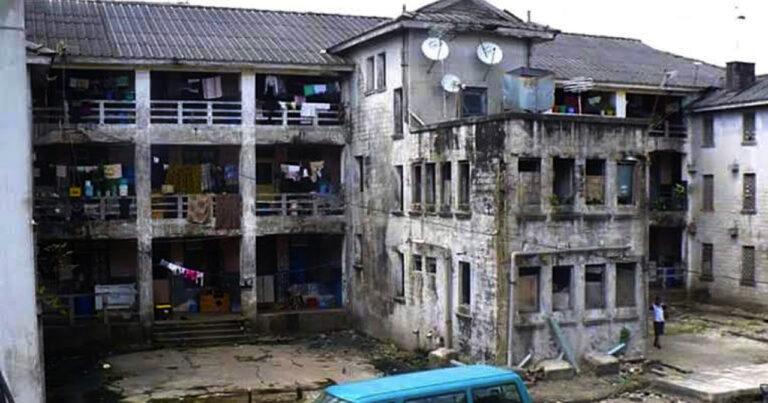
•The abandoned Crocodile’s House in Ajia compound
One of the families that have been rearing crocodiles in Nigeria is the Delesolu family at Oje, a community in Ibadan North-East Local Government Area of Oyo State.
Oje is a community in Ibadan. In times past, it was a centre of attraction for Nigerian politicians. It is surrounded by communities such as Oja’gbo, Labiran, Irefin, and Yemetu.
A frontline politician, Chief Adisa Akinloye, the late former chairman of the defunct National Party of Nigeria (NPN) that produced Alhaji Shehu Shagari as Nigerian President in 1979 and 1983, as well as former Governor of the Old Oyo State, Dr. Omololu Olunloyo, in 1983 as well, lived in the community. There is a popular place in Oje, known as ‘Ita Akinloye’, which is the open space in front of Akinloye’s house.
In those days, dignitaries from differ¬ent parts of the state and Nigeria used to visit Oje because of Akinloye.

•The Crocodile’s House, Adio Oloni compound, Agbeni
The crocodile in Delesolu Compound in Oje has attracted thousands of local and international tourists to Oje, a hub for the popular fruit market in the whole of Ibadanland, which spreads across 11 local government areas.
The Delesolu Compound is home to the legendary crocodile, which is believed by some set of people to possess spiritual powers. The tourists might have had the hopes of witnessing the mythical abilities
This becomes evident, as politicians at every circle of general elections in Nigeria usually visit Delesolu Compound in search of spiritual solutions to the seeming electoral challenges before them.
The crocodile residing in the Delesolu Compound was brought to the compound over seven decades ago and has since become an integral part of Ibadan folklore.

•The spot of Crocodile’s House at Ali-Iwo.
The crocodile is no different from its counterparts in the wild, with its unmistakable smooth belly, armoured dorsal surface, and strong jaws. As an attraction for both locals and tourists, the crocodile has bestowed fame and honour upon the Delesolu Compound.
While many may associate the crocodile’s presence with superstitious beliefs, it is important to separate fact from fiction. The compound’s inhabitants regard the crocodile as a part of their culture and heritage, the legacy left by their forefathers. Native doctors often direct their clients seeking fertility or wishing to heal ailments to make requests through the crocodile. However, these requests must be made with good intentions and not used for malicious purposes. The crocodile also plays a protective role against smallpox, a highly contagious disease prevalent in the past, it was gathered.
Visitors to the Delesolu Compound have been known to throw live chickens or goats to the crocodile, providing it with sustenance while observing its astounding ability to consume them.
Though some people perceive the act as a sacrifice, a number of other people see the gesture as a mere means of feeding the animal without any strings attached. It was argued that just as one might throw bananas to monkeys at a zoo, the crocodile’s feeding is unrelated to idolatry, rather a symbolic gesture of care and concern.
The Delesolu Compound does have a unique tradition related to the crocodile. It is said that every new wife who enters the family must fetch water and empty it into the crocodile’s water reservoir in the olden days.
But modernisation and religion, as gathered, have tinkered with strict adherence to the tradition. Saturday Sun was reliably informed that the reason stemmed from that fact that some members of the family are living in faraway places, including overseas. Religious beliefs have also waned down observance of the tradition.
In the same vein, the compound’s inhabitants used to observe masquerade festivals, when every woman in the family would gather and fill the crocodile’s house with water. It is also regarded as a taboo for members of Delesolu family to consume crocodile meat. But it could not be easily verified whether the descendants of Delesolu have strictly adhered to the custom.
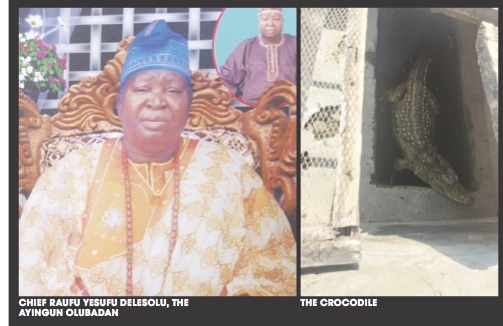
It was observed when Saturday Sun visited Delesolu Com¬pound earlier this week that the crocodile is not different from other crocodiles in their natural environment. It is housed in a rectangular brick structure. The house was built with blocks with four corners. A larger percentage of the floor of the house was cemented. A slightly deep water reservoir that has four corners was sighted at one side of the shed, which was designed in such a way that the crocodile could deep its whole body into the water completely. A net was used to cover the surface of the house on the top.
Visitors to the Delesolu Compound would only peep from the top of the rectangular house to behold the crocodile. When this reporter peeped through an open side of the net roof, the crocodile moved and raised its head. It moved and placed its head on the wall of the house, looking at its beholder suspiciously. The beholder moved and after a while, he went to look at the crocodile so that he could take pictures of it.
The small house where the animal is kept at the frontage of the Delesolu compound., is chest-tall and tourists usually look at the crocodile from the top of the wall. This time, the animal lay on the floor of its house with a gentle mien. It only opened its eyes and slightly raised its head when the camera was focused on it. But it did not move away from its position.
It was observed that the crocodile has a smooth skin on its belly and side. But the dorsal sur¬face in its back, which spread to its head and tail, is armoured with large osteoderms. An internet re-search on crocodile revealed that the animal can survive for months without food as a result of their slow metabolisms.
A former Vice President of Nigeria, Prof Yemi Osinbajo, and the immediate past governor of Oyo State, the late Abiola Ajimobi, were said to be among the tourists to the Deles¬olu Compound about nine years ago The duo jointly paid a visit to the compound during the electioneering campaign for the 2015 general elections by the All Progres¬sives Congress (APC).
The Ayingun Olubadan, Alhaji Raufu Yesufu Delesolu, who started his royal chieftaincy journey as Mogaji of Delesolu Compound, said: “They (Osinbajo and Ajimobi) arrived at our compound by 5p.m. Governor Ajimobi did not look at the crocodile, he just threw a live chicken at it. But Prof Osinbajo looked at it before he threw the live chicken at the ani¬mal. But they did not do it as a sacrifice, but as a way of feeding the animal. It is just like when you go to the zoological garden and you throw bananas at the monkeys without any strings attached to such action. The crocodile has brought good things to our compound. It has given us a good name. I thank God for this.”
In the same vein, the governorship candi¬date of the Peoples Democratic Party (PDP) during the 2015 general elections in Oyo State, Senator Teslim Folarin, who is a former Senate Leader, was said to have paid a visit to the Delesolu Compound before the April 11, 2015 polls to catch a glimpse of the crocodile. Folarin was re-elected into the Senate in 2019 on the platform of All Progressives Congress (APC). He represented Oyo Central in the National Assembly. He was the 2023 governorship candidate of APC in Oyo State.
Wife of a former governor of Oyo State, Alhaja Mutiyat Ladoja, according to Chief Delesolum was also attracted to the compound by the crocodile before the 2003 general elections in Nigeria. Her husband, Rashidi Ladoja served as governor of Oyo State from 2003 to 2007.
Speaking on the speculations that many political office seekers usually visit the Delesolu Compound to make special requests to the crocodile to assist them on their ambitions, Mogaji Yesufu said: “It is true that many of them do come. Before the previous general elections, they came. But I did not see their coming as something that has to do with idolatry or that you would always get desired answers once you ask the crocodile for something.
“Many political office seekers came before the 2015 general elections and made requests to the crocodile, but they eventually lost the elections. Where do you want to place that? This also boils down to the fact that the people who visit the crocodile for any request must do so with good intentions, not to harm their fellow human beings. Anyone who comes with evil intention would pray amiss.”
Chief Delesolu continued: “The last time political bigwigs came to our compound to catch a glimpse of the crocodile was 2015. The well known politicians did not come to visit the compound in 2019 and 2023 when general elections were held n this country.
“The only person I can mention his name is our son in Ibadan, who is playing football in Germany, Karim Adeyemi. He came with his father. Of course, Delesolu Compound is not new to his father. He looked at the crocodile in its house and our compound. Then, he promised that he would help us turn the compound to an international tourists centre.
“Of course, it is a welcome development for us. We are ready to cooperate with him. When he develops the place, it will attract more people to Ibadan from far and near. This will boost the economy on Oyo State and Nigeria at large. We can only pray for him that Almighty God will strengthen him to fulfil his promise.”
The Ayingun Olubadan, Alhaji Raufu Yesufu Delesolu, who started his royal chieftaincy journey as Mogaji of Delesolu Compound, told Saturday Sun that many of the visitors to the compound usually throw live chickens or live goats to the crocodile and they would watch as the animal de-vour the meals.
He explained that the current crocodile at the compound was bought by his father, Alhaji Laisi Delesolu in 1942 from Akeukereke Compound at Oke-Ofa Baba Isale, Ibadan. But it is not the first crocodile in the compound. The first one captured by their progenitor, he said, died in 1939 after living for more than 100 years. The first crocodile, he noted, was captured at Owobale Village near Erunmu in Ibadan. Both crocodiles, according to him, attracted local and foreign tourists to the Delesolu Compound.
He said breeding of the animal did not have anything to do with idolatry, but a sort of promoting the culture and tradition of the family. Apart from that, he noted, the crocodile also has spiritual protection for the family against smallpox, which is a highly contagious disease caused by a poxvirus and marked by high fever and the formation of scar-producing pustules.
“Native doctors usually direct their clients, looking for the fruits of the womb to come and make a request to God through the crocodile and many of them have received answers to their prayers. Also, native doctors usually request for water from the crocodile’s house for special concoction to bathe those that are sick. Apart from that, we don’t worship the crocodile. It is just a culture in the family right from the time of our forefathers,” he said.
But how have they been collecting water from the crocodile’s house without the animal attacking them? The Mogaji said: “In the past, we would tie a cup to a long stick and we would throw a live chicken to the other side of the house for the crocodile. When it was devouring the chicken, we would quickly collect the water with the device. But on some occasions, the animal would wrestle to collect the stick from us.
“But we have made it easier to collect the water now. We have fixed a pipe to the croco¬dile’s house. It is like a tap. We can lock and unlock it. We now collect the water for visitors that need the water from the tap.”
The Ayingun Olubadan, who was born in 1943, also said the crocodile lays eggs at regular in-tervals. The eggs, he said, are usually bigger than duck’s eggs. But he said it was a mystery to him that the crocodile lays eggs despite the fact that it is the only one in the house and no other crocodile has been mating it. The crocodile lays up to 10 or 15 eggs, and it started laying eggs some 50 years ago, he said.
Saturday Sun also sought clarifications from him on the insinuation that members of Delesolu family usually place their newborn babies in the crocodile’s house in order to know if the child is a bastard or not. It was said that if the animal does not eat the baby, the child is not a bastard.
But the Mogaji burst into laughter when the question was thrown at him, describing the insinuation as a blatant lie. He contended that a member of the family, who contested the stool of Mogaji with him, actually peddled the rumour, saying the contender also claimed that the crocodile came to greet his mother the day he was born. He noted that it would be a suicide mission for any member of the family to engage in such practice, while saying such a thing never happened and it would not.
“The practice in the family is that every new wife into the family must fetch water and empty it in the water reservoir in the crocodile’s house. Also, when we used to observe masquerade festivals, every woman in the family would gather and fill the crocodile’s house with water. But we don’t observe the festival again.”
But who founded Delesolu Compound and how did the family start breeding crocodile? Raufu provided answers to the questions. He stated that the progenitor of the family, Delesolu and his younger brother, Ladefe, migrated from Ijeru in Ogbomoso zone of Oyo State to Ibadan close to 200 years ago. The family also has a compound in Ijeru, where another crocodile is being bred.
The duo, he said, hailed from Oje-Ile. But the community got desolated after a war that rocked the area. The desolation caused Delesolu and Ladefe to migrate to Ijeru in Ogbomoso. They were warriors. They also left Ijeru close to 200 years ago on a war expedition to Ibadan. On getting to Ibadan, they first settled at Balogun Oderinlo Compound at Oja’ba. The duo also fought at the warfront with Balogun Oderinlo, one of the greatest war generalissimos of Ibadan.
“But whenever Delesolu came back from the warfront, all the children in the family would have been dead as a result of a strange disease attacking them. After consulting with his native doctors, he planned to relocate from Ibadan to another part of Yorubaland. He told Balogun Oderinlo his plan and he asked him why.
“Delesolu explained that the death of his children informed his decision to relocate from Ibadan. Then, Oderinlo advised him not to go far as a parcel of land would be given to him in Ibadan. They gave him a place called Oke Oje. He settled at the place and it remains so till today.
“But the land was not given to Delesolu free of charge. The Ibadan elders then collected from him 11 horses, 11 slaves and a lot of cowries. Some of the elders present at the handing-over of the land to Delesolu, as gathered, included Chief Opeagbe, Iba Oluyole, Chief Foko and Chief Babalola.
Investigation revealed that Delesolu quarters used to be the headquarters of the 131 quarters in Oje neighbourhood. It also served as a payment centre for tax pay¬ers when payment of taxes was introduced by the colonial masters before Nigeria’s independence.
The Ayingun Olubadan also stated that the crocodile had escaped from its house once within the past 80 years. But it was recaptured in a ditch at Ojo’badan quarters and brought back to its house.
He recalled that an incident occurred many years ago that could have put an end to breeding of crocodile in the compound. A boy entered into the crocodile’s house. But to their utmost surprise, the animal did not attack the boy and has not attacked anybody till date.
But it is a taboo for those that hail from Delesolu Compound to eat crocodile meat. It was, however, not in the record that anyone of them had defiled the taboo. When the first crocodile at the compound died in 1939, it was buried in a special way. The Ayingun Olubadan said another crocodile would be acquired for the family whenever the current one dies.
“It is only one crocodile that must be in our family compound at a time and only one road must lead to the Delesolu Compound. It is my duty to take care of the crocodile as the Mogaji of the compound. I must say that there are other two families in Agbeni, Ibadan that also breed crocodiles. There was one at Ali-Iwo Compound. But the family no longer breeds the animal. Even, the crocodile’s house in Ali-Iwo Compound has been demolished after donating the animal to the University of Ibadan. There is also Ajia Compound after Ita Akinloye here in Oje. The family used to breed crocodiles too. But the family does not breed crocodiles again.”
The incumbent Olubadan of Ibadanland, Oba Moshood Olalekan Balogun, Alli Okunmade II, hails from Ali-Iwo Compound, which is less than one kilometre from the popular Agodi Gate in Ibadan. The reporter contacted the Personal Assistant on Media to Olubadan, Mr. Oladele Ogunsola. He said his enquiry within the family showed that the crocodile in Ali-Iwo Compound was donated to the University of Ibadan many years ago.
“The crocodile was donated to U.I when people were attaching spiritual powers to the crocodile and they wanted to turn the animal to an idol. It will surprise you to know that the donated crocodile was put in the Zoological Garden of the University of Ibadan. But the family has been informed that the crocodile died sometime ago. It was embalmed and was put in a natural museum of UI, with the name of the family as its label.”
Ayingun Olubadan, Al¬haji Raufu Yesufu Delesolu, stated further: “The first crocodile at Delesolu Compound died in 1939, four years before I was born. I was born in 1943. I was told that gunshots were used to announce its death by the hunters. It was later shrouded in white clothes, necessary sacrifices were made, and it was buried like a human being. The place it was buried is known as ‘Laka’.
“Laka is a place where stillborn babies were buried in those days. If you get to the place where the first crocodile was buried, a storey building has been erected on it. If you are not told, you would not know that it was the resting place of the first crocodile. Whenever the present crocodile also dies, we will just bury it without any fanfare and acquire another one.”
The move by Karim-David Adeyemi, playing the round lethal game in Germany, to give a face-lift to the Delesolu Compound was further explained by the Babaloja of Oje, Chief Saliu Ayinde Delesolu.
He said Adeyemi promised to rebuild the crocodile house with other complements in order to make the place truly an international tourists centre. Adeyemi was born in Munich, Germany on January 18, 2002, to a Romanian mother, Alexandra Adeyemi, and Abbey Adeyemi, a Nigerian father, who hails from Ibadan. He plays German professional football for Bundesliga club, Borussia Dortmund and the Germany national team.
Babaloja of Oje, Chief Saliu Ayinde Delesolu, said further: “It is true that Karim Adeyemi came to this compound. He came with his father, who is a childhood friend of mine. I also knew his grandfather. He came with his father from Germany to Nigeria. So, he followed his father to see me. We went round our Delesolu Compound. It was during the tour of the compound that he made the promise. We believe that he will fulfil the promise. It is a good thing for us and Ibadan.”
More crocodile-rearing families
Investigation by Saturday Sun revealed that out of the four families that were reputed for rearing crocodiles in Ibadan, only one family among them still has the animal in their family compound. The four family compounds are Delesolu in Oje, Ajia also in Oje, Ali-Iwo, and Adio Oloni in Agbeni.
The head of Ajia Compound, Mr. Isiaka Olayiwola, said the crocodile in his family compound died many years ago. He could not remember the age of the animal or the year it died.
The crocodile, according to him, buried itself when it died. He explained that long before its death, the crocodile had dug a long whole within the artificial pond in the house made for it.
“The crocodile would come out from the hole to eat and would return into the hole. But a time came that the crocodile did not come out of the hole for more than a month This made us to conclude that the crocodile had died. Up till today, the crocodile has not come out. The house for the crocodile is already falling off and there has not been water in the place for my years. Since it died, we did not get another one. Religion is playing a role on why we did not get another one.”
At Adio Oloni Compound at Agbeni, Chief Abdulaziz Yusuf, told Saturday Sun that the crocodile in the compound died in December 2023. He said: “The crocodile was very old. But I don’t know its age. I got to know the crocodile when I was growing up. It died in December last year. We buried it normally. We are planning to get another crocodile to this compound.”
Saturday Sun also visited Ali-Iwo to know the spot of the house built for the crocodile before it was donated to the University of Ibadan Zoological Garden. As gathered, the crocodile was donated to the institution between 1999 and 2003, when the incumbent Olubadan, Oba Lekan Balogun served as a senator for Oyo Central Senatorial District in the National Assembly.
Three individuals attended to the Saturday Sun enquiries at the Ali-Iwo Compound. They are
Prince Taiye Ayuba from Jimadu section, Chief Mukaila Bello from Oseni Section, and Imam Sadiq Bello from Suliat Section. They showed the spot where the crocodile’s house was built. They said the Olubadan, then a Senator, facilitated the construction of a borehole to the Ali-Iwo Compound, which was dug on the spot the crocodile’s house was demolished. The spot is at the centre of the family compound at present.
A visit was also paid to a museum for dead animals in the Zoological Garden of the University of Ibadan. Many dead animals, including the popular gorillas, known as Haruna, and Imade, were seen in the museum as well as Arnold, a dead lion donated by the former Aare Musulumi of Yorubaland, Alhaji Abdul-Azeez Arisekola Alao, to the zoological garden. Two crocodiles were seen in the museum. One is an African dwarf crocodile, which is placed on a shelf. But the big crocodile, believed to be the one donated to the zoological garden by the Ali-Iwo family, is in a glass cage. It is labelled ‘Crocodilus Niloticus’, with the date of its death written as March 21, 2011 (21-03-2011).