Follow Us on Google
By Chukwuma Umeorah
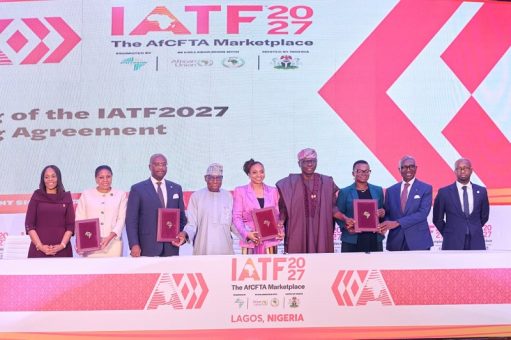
Nigeria has formally signed the hosting agreement for the fifth edition of the Intra-African Trade Fair (IATF 2027), with organisers projecting that the event could generate more than $50 billion in trade and investment deals when it takes place in Lagos from November 5 to 11, 2027.
The agreement was signed in Lagos on Monday with the Africa Export and Import Bank (Afrexim) and other continental partners, confirming Nigeria as host of the next edition of the trade fair, one of Africa’s largest platforms for intra-continental commerce.
President of Afreximbank, George Elombi said the event has historically generated significant trade activity across the continent, noting that previous editions have averaged about $40 billion in trade and investment deals.
“I’m confident that the event here in Nigeria will surpass the $50 billion in business generated and foster even more successful partnerships, boosting intra-African trade and investment, and create jobs for our people,” Elombi said.
He added that beyond the announcement of deals, the focus would be on translating commitments into executable transactions. “It is now our duty to convert the $50 billion in deals into opportunities, into $50 billion in executable transactions,” he said.
According to Afreximbank, the four previous editions of the trade fair have generated more than $167 billion in trade and investment deals, with the most recent edition in Algeria recording transactions valued at about $48.3 billion.
Elombi stated that the 2027 edition in Lagos is expected to attract more than 100,000 participants, including government officials, investors, manufacturers, traders and service providers from across the continent.
Chairman of the IATF 2027 Advisory Council and former Nigerian President, Olusegun Obasanjo, said hosting the fair in Lagos carries historical significance for Africa’s economic integration efforts.
Obasanjo noted that Lagos was the venue where African leaders adopted the in 1980, which sought to promote industrialisation and reduce reliance on raw material exports.
“Bringing IATF 2027 to Lagos also has historic relevance because this is where African leaders signed the Lagos Plan of Action for the Economic Development of Africa 1980 to 2000 which sought to reduce reliance on raw material extraction, promote industrialization and global equality and equity in trade relations and increase Africa’s self-sufficiency and self-reliance,” he said.
Nigeria’s Minister of Industry, Trade and Investment, Jumoke Oduwole, said the upcoming IATF 2027 would provide an opportunity to deepen continental trade integration under the African Continental Free Trade Area.
Oduwole said the trade fair comes at a time when African countries are reviewing the progress of the continental trade agreement and identifying reforms needed to unlock its potential. She noted that Nigeria had recently completed its five-year implementation review under the AfCFTA framework.
“Indeed, this review exercise reminded us that our AfCFTA is expansive, covering goods, services, investment, intellectual property rights, competition policy and digital trade,” she said.
She said the fair would serve as a platform for expanding trade in goods and services across sectors including manufacturing, agriculture, infrastructure development, digital services and the creative economy.
Oduwole also cited steps taken by Nigeria to strengthen intra-African trade links, including the launch of an air cargo corridor to facilitate exports to eastern and southern Africa. “In May 2025, I had the pleasure to launch a dedicated AfCFTA air cargo corridor with Uganda Airlines for Nigerian goods exports. This corridor ensures that Nigerian goods exports to eastern and southern Africa reach buyers quickly and cost effectively,” she said.
In addition, Nigeria is working with other African countries to pilot digital trade solutions aimed at simplifying cross-border commerce. “As co-champion of the protocol on digital trade, Nigeria convened an innovative mechanism with Egypt, Ghana, Kenya, Rwanda and South Africa to pilot solutions for seamless cross-border trade and mobility of digital services,” Oduwole said.
The minister said regulatory coordination was also being strengthened through customs cooperation initiatives aimed at harmonising border procedures and improving trade facilitation across the continent. “This continental regulatory initiative is harmonizing border procedures and building trust with the business community, and is a model for continental public private cooperation,” she said.
She added that the trade fair would also reflect Africa’s growing creative industries, noting that the sector contributed about $310 billion to the continent’s gross domestic product in 2022 and employed nearly 12 million people, more than half of them under the age of 35.
According to her, Nigeria’s creative economy was estimated at about $25 billion in 2025, with the government targeting an expansion of the sector’s contribution to $100 billion in gross domestic product and the creation of two million jobs by 2030.