Follow Us on Google
By Ngozi Nwoke
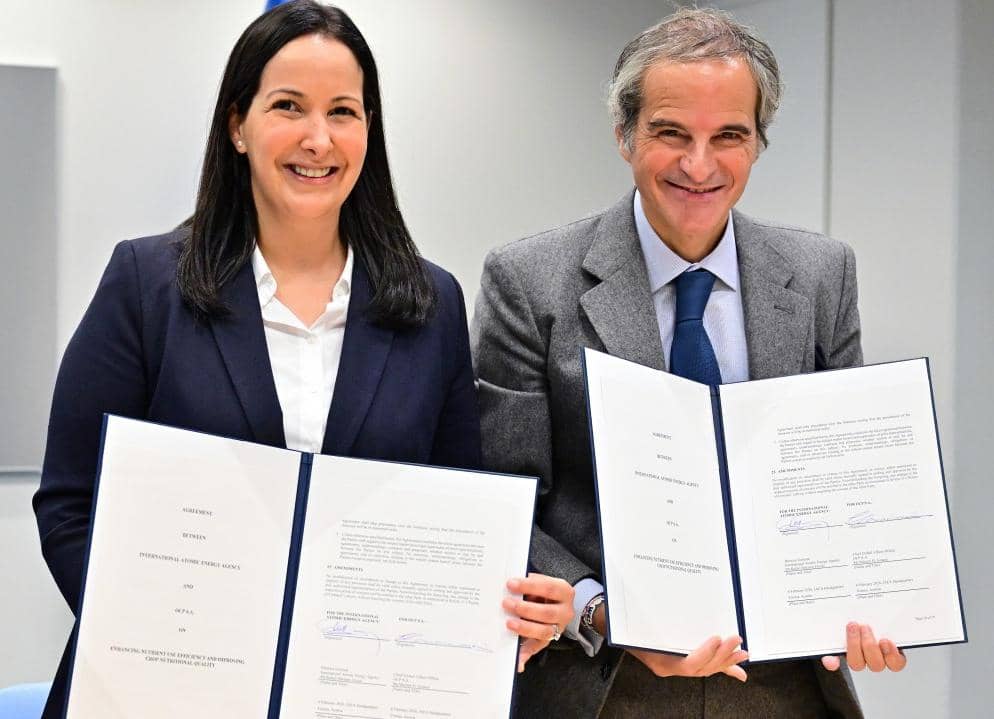
The International Atomic Energy Agency (IAEA) and Morocco-based OCP Group, a leading player in plant nutrition solutions, have sealed a five-year partnership to drive innovation in sustainable agriculture and food systems.
The collaboration, announced on Monday, aims to leverage nuclear and isotopic techniques to improve fertiliser efficiency, enhance crop nutritional quality, and promote sustainable food systems, directly supporting the Atoms4Food initiative.
IAEA Director General Rafael Mariano Grossi described the partnership as a significant step forward in amplifying the impact of the Atoms4Food initiative.
He said: “OCP’s expertise, combined with the IAEA’s unique capabilities in nuclear techniques, will translate advanced science into practical solutions for farmers, particularly in regions facing acute food security challenges.”
The partnership will focus on optimising the management of key macronutrients and micronutrients, using isotopic techniques to generate data supporting the “4Rs” of nutrient stewardship: right source, right rate, right time and right place.
Other News
Meriem El Asraoui, Chief Global Affairs Officer at OCP Group, said the collaboration marks a strategic milestone in the company’s mission to strengthen global food security.
He noted: “We will generate transformative knowledge, support researchers and farmers, and advance agricultural practices that deliver higher yields, better nutrition, and long-term environmental stewardship.
“The partnership will generate high-quality data to inform public policy, guide fertiliser innovation, and support climate-resilient agriculture, reinforcing scientific cooperation between Africa, the IAEA, and global research networks.”
The IAEA, an autonomous organisation under the United Nations, promotes the peaceful use of nuclear technology, while OCP Group is a global leader in plant nutrition and phosphate-based solutions, operating in over 50 countries.
This partnership is expected to have a significant impact on global food security, particularly in Africa, where food security challenges are acute.