Follow Us on Google
• Protests as hard time bites harder in region
From Desmond Mgboh (Kano), John Adams (Minna) and Timothy Olarenwaju (Maiduguri) , Lafia
At a local kiosk, Shago–Tara Junction, Ungogo Local Government, Kano State, last week, a simple conversation ensued among a few early morning customers who were mostly bricklayers.

• Protesters
It was prompted by the cost of a cup of sugar that had shot up from N250 to N300, a mudu of flour, that went up to N4,000, negatively impacting on the price of bread and a bag of local rice, sold three weeks ago at N45,000, that rose to between N60,000 and N70,000.
That morning, these local bricklayers could not buy a good loaf of bread that they were used to and did not fail to express their huge disappointment at the eight- month administration, which emerged on a promise of hope and relief but has made things worst for the common man.

• Another group of protesters
To say that things are hard is a gross understatement of fact. The latest figure by the National Bureau of Statistics (NBS), put Nigeria’s inflation rate at about 30 per cent, with the rate mostly driven by the spiraling price of food items.
The bite is felt much more in the ancient city of Kano because of its huge population and its sharp divide – between a few rich ones and a majority poor.
The truth of the hardship was not lost on Governor Abba Kabiru Yusuf. During his meeting with the leaders of the markets and stakeholders on Monday, he acknowledged that the people were passing through hard times due to the rise in the cost of foods and basic amenities. He, however, pledged to take their plights to the Presidency in Abuja while promising to adopt measures at the state level to ameliorate the situation.
Observers believe that that was a smart move to douse the growing agitations over the hardship. Before the Monday meeting, many traders, had gathered in their markets to bemoan their plights and pray against the ailing situation.
At the Kantin Kwari Textile Market, Kano, last week, scores of traders closed their shops and set forth to pray. They sought God’s intervention on the economy in the face of the challenge. One of the traders, Hamisu Sani, said the situation has become unbearable for them.
About the same time, a group of women local (Garasa) bakers at Chediyar Yangurasa in Dala Local Government took to the street to protest the increasing cost of flour. The protesters displayed in Hausa and English languages, they averred that the souring prices were affecting their businesses and livelihoods. Their leader, Fawal Auwal, indicated that more than half of their members had been rendered jobless as a result of the high cost of flour.
Nkechi Akachi, a resident of Sabon Garri and trader at the Abubakar Rimi Market, blamed government for the untold woes: “Since the removal of the subsidy, Kano streets has welcomed much more beggars, old and young, sick and aged, including almajiris.
“More children are unable to go regular schools due to high fees, many had fallen ill due to hunger and many homes had resorted to one or two meals per day. Governor Yusuf’s promise to go to Abuja on our behalf was a simple political statement of no concrete value. Only God will save the poor in Nigeria.”
Minna
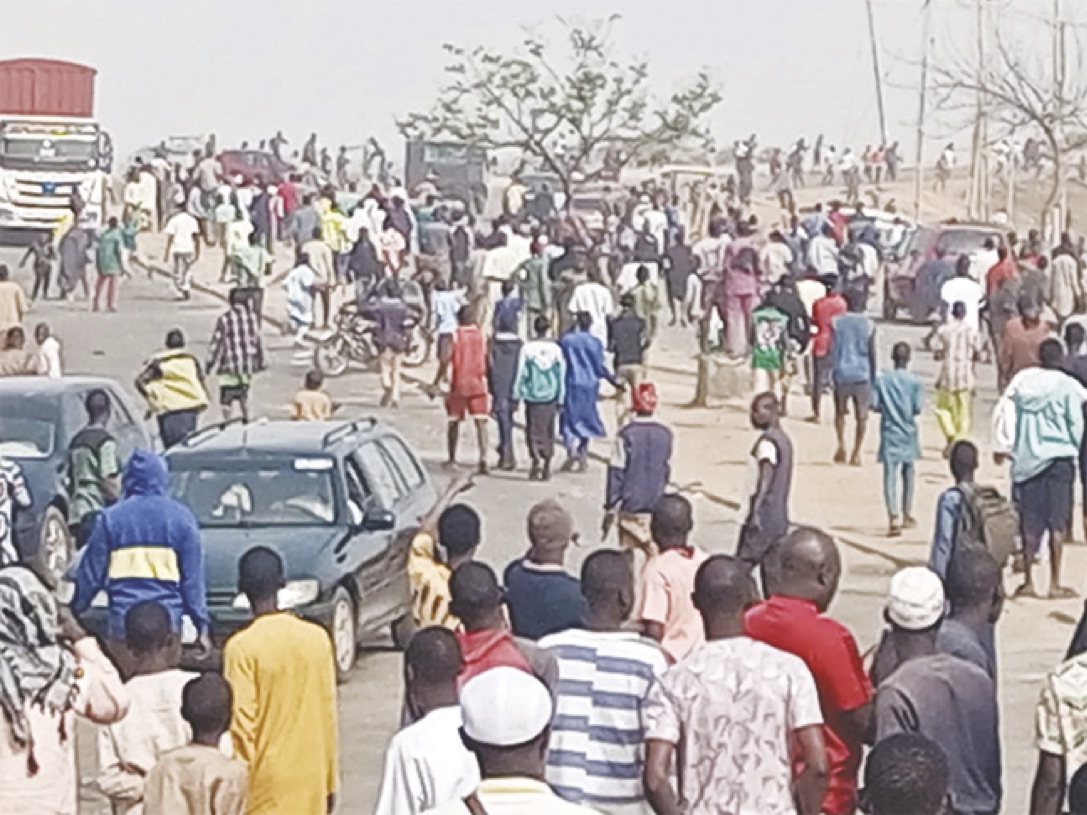
In Minna, Niger State, the economic hardship took a different turn on Monday as hundreds of women and youths poured onto the highways to protest the times.
The protest brought businesses and commercial activities to a standstill for hours.
Protesters carried placards with various inscriptions, including, “We are dying in hunger”, “Food stuff no longer affordable for the common man”, “APC government has brought hardship to Nigerians” and “Bandits have taken over Nigeria.”
Though the protest was largely peaceful at the beginning, with women and children blocking highways only, the situation degenerated when the anti-riot policemen attempted to disperse the protesters by force.
The youth, who later took over the protest from the women, engaged the security agents in a fierce battle, forcing them (security agents) to retreat for possible reinforcement.
Several gunshots were fired into the air to scare them off but the youths remained resolute. Not even the intervention of the Deputy Governor, Yakubu Garba could change their minds
For several hours, the protesters courageously held sway, forcing road users to make a U-turn and abandon their journey, especially those on inter-state journey. Students, civil servants, making way to their schools and offices, including other business owners were turned back by the protesters who blocked the highways with heavy stones, empty drums and woods.
Although the rising cost of foodstuff remained the major concern of the protesters, the increasing level of insecurity in the state contributed to their frustration. A protester, Bello, said: “You cannot travel freely, our children have been forced out of boarding schools and farmers can no longer access their farms for fear of being kidnapped or even killed by bandits”
Mohammed Ibrahim told Daily Sun: “Anybody who is feeling the current hardship in the country does not need anybody to mobilise him or her before embarking on a peaceful protest like we are doing today.”
Governor Umar Mohammed Bago alleged that the protesters women laid siege on the highway with the intention to loot a trailer suspected to be carrying foodstuffs from the South.
“They were told that a trailer loaded with some essentials was heading towards Minna and had planned to loot the items hence the decision to block the roads.”
He disclosed that some arrests were made: “Government is looking at various ways to addressing the current hardship and the rise in the prices of foodstuffs.” He attributed the rise in the prices of foodstuffs to the activities of middlemen who go to the village markets to buy and hoard these foodstuffs and possibly, take them out to neighbouring countries.
However, the state House of Assembly, which resumed plenary on Tuesday after its one-month recess, said the economic hardship was real but that the situation was not peculiar to Niger State:
“The protest is real and we must speak the truth, the current situation might take a different dimension if nothing is done about it. The protest was meant to draw the attention of the government to the suffering of the people.”
Maiduguri
Borno State, previously reputed for its heritage of high production of grains, rice, melon, onion, tomatoes, pepper and livestock is not excused from the hardship.
Since the Boko Haram violence escalated in 2014 and forced many farmers to flee their farmlands and farming communities, the state has been experiencing food shortages.
Experts say food insecurity in the state is exacerbated by the high cost of transporting foods from other states to Maiduguri attributable to the subsidy removal and inflation
Malam Bukar Ali, a retired civil servant in Maidugiri painted an ugly index: “We cook in my house once daily, usually dinner. Warm the remaining food for breakfast. Sometimes, we do pap for breakfast. I can’t afford bread and tea again. It’s beyond my reach.”
For Halima Ibrahim, a widow and resident of Maiduguri, begging for food daily was the only surviving measure on her card:
“I lost my husband to Boko Haran attack. People have been helping us with food in the past, but we no longer get enough food support from helpers because they are also experiencing the same hardship.”
Samaila Maina, a teacher in Damaturu, Yobe State, said: “The food shortage and high cost of essential needs and services may continue to rise till next year, except the Federal Government tackles the security challenges facing the region and encourage massive farming across the geo-political zones.
“Thousands of farmers in most northern states can’t get to their farms because of attacks and incessant cases of kidnapping.”
Minister of Information, Mahammed Idris, said President Bola Tinubu directed the Presidential Committee on Emergency Food Intervention to work out immediate measures to ease the pains: “The measures included unlocking the foods available in most of the storage facilities (National Food Reserves) around the country.
“Government is also talking to major millers and major commodity traders to also see what is available in their stores. Government is aware that some persons are creating the food shortages because of its high cost and the depreciation of naira.
“Government will not fold its arms and see the way Nigerians are suffering in terms of the availability of these food items.”
Niger police nab 20 suspected bandits, kidnappers, others
Niger State Police Command has arrested 20 suspected armed robbers, kidnappers, bandits and rapists, rescued seven victims and recovered millions of naira paid as ransom and weapon at their hideout at Paiko, Paikoro Local Government.
Commissioner of Police, Mr Ebenezer Dan Mamman, said: “This year will be too hot for bandits in the state. I want to commend my officers for their determination in fighting bandits. The command remains resolute, focused, dedicated, ready to fight crimes and criminality and ensure preservation of the law and order.
“Police operatives arrested four suspected kidnappers. Armed men invaded Isana village via Nasko in Magama LG and kidnapped two victims. They were intercepted while requesting for ransom. The suspects confessed collecting N1, 600,000, which was recovered together with two locally fabricated guns, one single barrel gun and five handsets.
The crack squad arrested one notorious armed bandit in Tungan-Mallam Market area of Paiko, Paikoro LG. They confessed to be members of Muware bandits camp terrorising Beji, Maikunkela, Bosso, Gawu–Babangida, Sanseku, Bangi, Gulu and Lapia. Patrol team attached to Paiko Division arrested two suspects at Gbaiko, Minna, with a stolen Toyota corolla vehicle red colour along Minna Suleja highway.”