Follow Us on Google
From Bimbola Oyesola,
The fact that the Artificial Intelligence (AI) is disrupting global workspaces at the speed of light is not a myth but stark reality. From boardrooms to factory floors, hence the message from Nigeria’s labour leaders, employers, policymakers, journalists and other stakeholders is loud and clear: The future of work must be shaped by humans, not hijacked by machines.
This formed the fulcrum of the message that echoed throughout the 2025 Workshop of the Labour Writers Association of Nigeria (LAWAN), held at the weekend in Ibadan, where labour icons, unionists, policymakers, and journalists gathered to discuss the theme, “The Future of Work in the Era of Artificial Intelligence: A Wake-Up Call for Stakeholders.”
From fiery warnings against unchecked automation to bold policy suggestions and passionate calls for worker-centered innovation, the workshop served as a national clarion call for ethical, inclusive, and proactive adaptation to AI’s rising influence.
The workshop provided a crucial platform to examine how AI and emerging technologies are reshaping the workplace, and what must be done to ensure that the dignity, security, and welfare of Nigerian workers are not sacrificed on the altar of innovation.
In his address that set the tone for the gathering, the General Secretary of the Non-Academic Staff Union of Educational and Associated Institutions (NASU), Prince Peters Adeyemi, who was the chairman of the workshop and represented by the union’s former president, Ivor Takor, urged workers to embrace AI as a productivity tool rather than fear it.
Labour’s verdict: Shape AI or Be Shaped by It
Peters Adeyemi described AI as a double-edged sword, capable of boosting productivity but also of displacing workers if left unchecked.
“I do not share the belief that AI has come to displace workers or destroy jobs,” Adeyemi said. “On the contrary, I believe AI is here to enhance productivity, save time, and empower workers who are willing to embrace it.”
However, he warned workers not to be complacent. He emphasized that responsibility for work outcomes still lies with humans, not machines. “AI cannot think for us, nor can it take responsibility for our work,” he noted. “Workers must remain vigilant about the quality and accuracy of AI-generated outputs.”
Prince Adeyemi didn’t stop at technological warnings, he condemned what he called the “policy of corruption” in Nigerian governance, noting that widespread graft has institutionalized injustice and impoverished workers.
He lamented the continued “compression of wages” and declining living standards, and called on labour journalists to expose anti-worker practices despite mounting pressures from political and corporate quarters.
“The future of work is not to be feared, but to be shaped,” Adeyemi concluded. “Artificial Intelligence, if embraced wisely, can be a tool for liberation rather than oppression.”
Echoing those sentiments, President of the Nigeria Labour Congress (NLC), Joe Ajaero, represented by the Lagos State NLC chairman, raised an alarm about how capitalist interests could weaponize AI to undermine collective bargaining and erode hard-won labour rights.
“In the hands of big capital, AI becomes a tool to deepen inequality and undermine labour,” Ajaero said. “The challenge is not just about jobs, but about power, about who controls the narrative and who benefits from the so-called future of work.”
He warned that digital surveillance, de-skilling, job casualisation, and algorithmic exploitation could become the new normal if labour unions do not act decisively and proactively.
“The future of work in the era of Artificial Intelligence is a pivotal battlefield in the ongoing struggle between workers and those who want to exploit them,” Ajaero emphasized.
Adeleke’s Labour-first governance
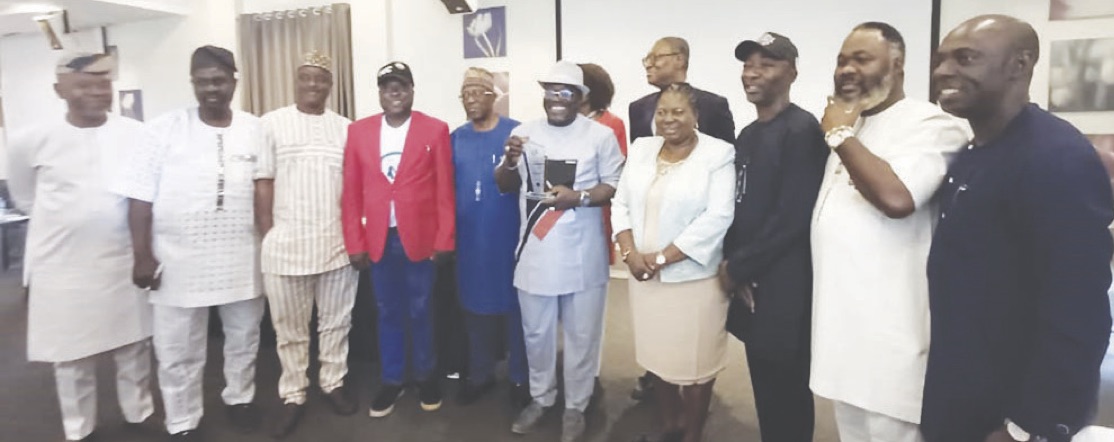
Proving that ethical leadership can match technological change, Osun State Governor, Ademola Adeleke was honoured as LAWAN’s “Most Outstanding Governor of the Year” for his strong pro-labour record. In his acceptance speech, Adeleke represented by the state commissioner for Goverment House Affairs and Protocol, Soji Ajeigbe dedicated the award to Osun’s workers and pensioners, declaring them “the backbone of every success we have recorded.”
“This award is not just a recognition of my person,” he said, “but a celebration of the workers of Osun State whose trust, cooperation and resilience continue to inspire our administration every day.”
Adeleke recalled that upon assuming office in 2022, he inherited a backlog of 30 months’ half salaries and pension arrears. Today, he said, those debts have been cleared, and his administration now pays a new minimum wage of ₦75,554.28, one of the most generous in the country.
His government, he added, has ensured regular promotions, gratuities, annual leave benefits, and timely salary payments, while enrolling all Osun pensioners under the state’s health insurance scheme.
“In Osun, we believe that the welfare of workers should never be delayed or politicised,” Adeleke declared. “Technology should never erase humanity from governance.”
Other News
He also noted that the state had introduced flexible work arrangements and digital training to help civil servants cope with the economic impact of fuel subsidy removal and prepare for a tech-driven workplace.
“AI is not the enemy—Ignorance is”
Delivering a hard-hitting keynote, the Managing Director of the Nigeria Social Insurance Trust Fund (NSITF), Barrister Oluwaseun Faleye, warned that the country’s current social protection frameworks are inadequate to handle the AI revolution.
Speaking from the social insurance angle, Faleye emphasized the need to redesign Nigeria’s social protection system to cope with the pace and scope of technological change.
“The future of work is already here,” Faleye said. “And the real danger lies in not preparing, not adapting, and not protecting.”
He argued that AI is already influencing how businesses operate, but Nigeria’s social safety nets are not evolving fast enough to provide adequate cover for informal and gig economy workers.
Faleye proposed five urgent reforms: extending social insurance coverage, investing in digital literacy, leveraging AI for transparent benefit delivery, fostering tripartite dialogue, and ensuring all innovations serve workers’ well-being.
“No machine can feel hunger, anxiety, or hope,” he warned. “We must ensure that every innovation serves humanity—not replaces it.”
Unions must modernize or fade
The President of ASSBIFI, Olusoji Oluwole, at the Workshop issued a sharp warning to trade unions to adapt or become obsolete.
According to him, “AI is not just a disruptor of jobs; it’s a disruptor of unionism itself.” Noting that “Without reinvention, many unions may soon be relics of a past era.”
He called for a radical transformation of the labour movement, including organizing tech workers, engaging gig economy players, and adopting AI-driven tools for advocacy.
He recommended that unions align with global labour bodies and actively participate in AI policymaking to prevent exploitation and surveillance.
Pension system must be futuristic
Representing the pension sector, the Director-General of PenCom, Ms. Omolola Oloworaran, highlighted the Commission’s “Pension Revolution 2.0”—a comprehensive reform to digitalize Nigeria’s pension administration.
“Just as AI is changing work patterns, we are changing how pensions are delivered smarter, faster, and more responsive,” she said.
She called on government, industry, and labour to deepen collaboration, noting that pension security is a critical pillar in safeguarding workers amid automation.
The role of employers: Leading with empathy and action
Speaking on behalf of the private sector, the Executive Secretary of Chemical and Non-Metallic Products Employers Federation (CANMPEF), Mr. Femi Oke, made a strong case for employers’s responsibility in AI adoption.
Citing World Economic Forum data, he noted that 30% of global tasks may be automated by 2030.
“AI will not replace humans,” Oke said. “But humans who use AI will replace those who do not.”
He called for ethical AI deployment, robust worker training, transparent dialogue with employees, and partnership with unions.
Stressing digital infrastructure and education reform, Oke added:
“Winning hearts is as crucial as upgrading systems. AI is a cultural shift, not just a technical one.”