Follow Us on Google
By Fred Itua, Abuja
As Jigawa State approaches a new phase in its development journey, Governor Umar Namadi had an exclusive interview with Daily Sun to review the progress made under his administration’s 12-point agenda, a blueprint he says was drawn not from years of direct experience within the state’s political and administrative machinery.
From a scholarship scheme that has rescued thousands of secondary school leavers from academic dead ends, to solar powered streetlights and hundreds of kilometres of new roads, the governor speaks candidly about what has been achieved, why human capital sits at the heart of his vision, and what he still wants the public, and the press, to understand about his government’s work.
Your administration has spoken often about a 12-point agenda. Could you tell us what has informed it, and what it has achieved so far in health, education and infrastructure?
The 12-point agenda has guided significant achievements in health, education and infrastructure development. I really need to address something, and I think this is part of our modest achievement in terms of improving the lives of children. Even though we haven’t covered all sectors, I believe this is a fair representation of what we have been doing, especially in the health and education sectors.
What informed your decision to settle for the 12-point agenda?
We believe the 12-point agenda is something that we crafted, not in isolation, but with a clear understanding of what Jigawa entails. I served as a commissioner for four years, and I have also been a deputy governor for four years. So, I felt I should be able to know what Jigawa truly represents and my position within it. Based on that knowledge, we were able to craft this 12-point agenda, and I think, fundamentally, we examined the situation and what is present here.
How far would you say the agenda has actually been implemented, rather than simply remaining a document?
I am happy to say that the 12-point agenda is not just a document; it is something that we believe is being implemented, and indeed, that is what we are implementing. I am happy to say that, as of today, no part of that 12-point agenda has been left untouched. All of it has been addressed, and I am happy to say that it is making a world of difference to the people of the state.
You have consistently emphasised human capital development. Why does that matter so much to you personally?
You see, manpower is incredibly important. Human capital. Whatever you are doing, without human capital, you are simply wasting your time. This is particularly true in the social sector, encompassing education and health.
Other News
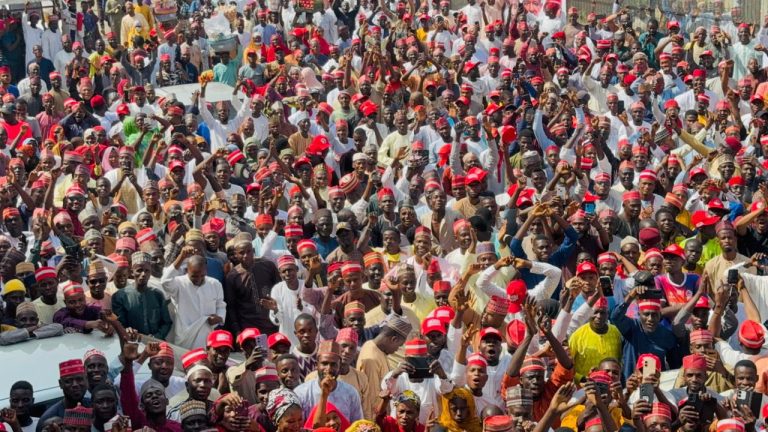
- Massive turn-out as pro-Tinubu, Namadi rally holds in Dutse
- Boat mishap claims four lives in Jigawa community
- Uzodimma, Alia, Namadi, Sani, Oborevwori, Nwifuru, Zamfara First Lady, DSS DG, Flavour, Bamidele, Daniel, Yari, Benjamin Kalu, Idris, Alausa, Maida, Ajose, Benson-Idahosa, Teju Phillips, Uba GMD, Access Bank, NADDC Win The Sun Awards 2026
Let’s talk specifics. What has your government done in the health and education sectors, particularly around scholarships?
In the health sector, yes, we have made significant progress. These are specifically areas that our student care initiative is tackling. In fact, for their first intake, they secured 400 students. These 400 students were vulnerable, in the sense that they had met all the requirements for admission into university, in excellent courses such as medicine and engineering, but unfortunately their parents were unable to sponsor them. So, this initiative goes into the hinterland, identifies these individuals and brings them forward. In addition to our normal scholarship, they have a special package. In 2024, we sponsored 400 students, and all 400 are now either studying medicine, engineering or undertaking special admission courses.
What about students who finished secondary school but did not qualify for higher education at all? Has anything been done for them?
Just last year, in 2025, we felt we needed to assess the situation. So, we conducted a census across schools throughout the entire state to find out who had finished secondary school but lacked the necessary qualifications to pursue further education. We identified 9,980 students who had finished secondary school but had deficiencies in their academic performance that prevented them from proceeding to higher education. With all 9,980 of them, we brought them in. We established training centres in each local government area, and some in remote locations. In fact, we established 54 training centres. We employed teachers for all the main subjects, and they taught these individuals for a good six months, providing them with training and coaching. My aim was for all of them to reach a certain academic level.
What was the outcome of that programme?
At the last count, over 9,914 of the 9,980 students passed with five credits or more, including English and Mathematics. This programme represents a significant achievement, and it also accounts for a substantial number of these 9,914. Because of this number, we have been able to support them, and this same group is now working to gain admission into these allied fields.
Why the particular focus on fields such as medicine, and on female students specifically?
As I told you, if you want to recruit a medical doctor, or if you are looking for a significant number of medical doctors, they are not readily available. So, we organise specialised programmes for them. This is the foundation here for female students; our target is purely female students. So, we try as much as possible to reach them. If you have deficiencies, we will provide you with training to help you pass your qualifying exam, and when you pass, we will secure your admission into any of these training institutions. And by the time you finish, you will return to your local government and your community, and serve them. Each of the girls, once she starts the scholarship scheme, will be employed at Grade Level 3 and will be paid a salary until she finishes. When she finishes, she will be upgraded to the next level, and she will continue. So it is a complete scholarship. All girls’ education in the state is one hundred per cent free.
Beyond health and education, what would you point to on infrastructure, particularly roads and power?
These are some of the things I am sure you need to go and update; it is very, very important. If you look at road construction, we have actually completed over 1,340 kilometres in the last three years. And in terms of energy, a lot has begun. We have converted all the local government diesel streetlights to solar. All of them have been converted to solar. We have also undertaken numerous other initiatives.