Follow Us on Google
By Moses Akaigwe
Three months ago, the Gov. Babajide Sanwo-Olu-led admiration in Lagos announced a ban on commercial motorcycles, otherwise known as okada, in the state. The recent ban made it the fifth time the measure was introduced since 1999.
The ban announced on May 18, 2022, was only effective in Eti-Osa, Ikeja, Surulere, Lagos Island, Lagos Mainland, Apapa, and all LCDAs under the listed councils, as well as all major roads, highways and bridges, many.
Clamping down on commercial motorcyclists has always been a contentious issue that reoccurs from time to time with the riders succeeding in evading the enforcement teams even as many get impounded, and in recent times crushed.
That was why to some residents, the recent ban in May this year sounded like the previous announcements by the government.
For instance, 2007, former Lagos state governor, Bola Tinubu, banned commercial motorcyclists from operating in the state. His successor, Babatunde Fashola, also did same in March 2012.
Fashola’s successor, Akinwunmi Ambode, also banned commercial motorcyclists from operating in the state in 2017.
It, therefore, did not surprise many a Lagosian when the government of Gov. Sanwo-Olu also announced a total ban in some areas, especially considering the insecurity concerns across the country and the unprecedented rise in the number of okada riders that have swarmed to Lagos in the past few years.
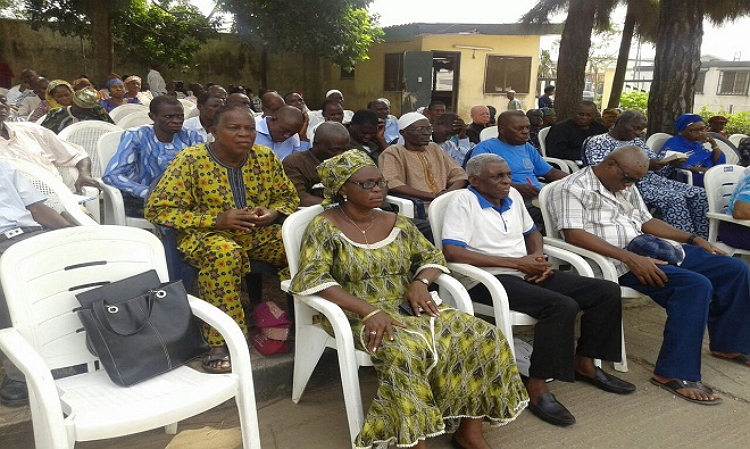
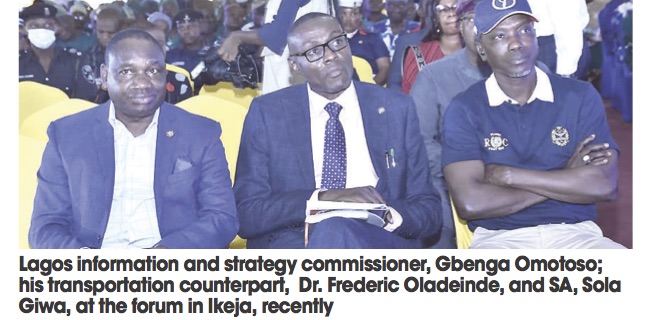
It was in an effort to assess the level of compliance and enforcement of the recent measure that the Lagos State government recently held a one day brainstorming session tagged “Stakeholders Forum on Okada Ban; What Next”, held at the Marque, LTV Complex, Ikeja.
The forum organised on August 16 was well attended by stakeholders in the Lagos state transport sector, including government agencies, traditional leaders, religious leaders, businessmen and women, transporters, youths and the organised private sector.
At the forum, participants commended Gov. Sanwo-Olu for his efforts in sustaining strict enforcement of the ban of the commercial motorcycle operators in some parts of the state.
They also urged the governor to extend the ban to all the Local Government Areas and Local Government Development Areas (LCDAs) in the state.
Commending the governor for taking the bold step against the commercial riders, the stakeholders insisted, that the enforcement should be sustained so that the gains of the ban, including considerable reduction in rate of crimes and accidents, were not reversed.
To some officials of the Lagos State Government, this hardly came as a surprise, because, barely three months after the May 18 announcement, stakeholders had started clamouring for a state-wide prohibition.
Not surprisingly, in a communiqué issued at the end of the one-day brainstorming session, participants resolved that the enforcement of the ban should cut across all the Local Government Areas and LCDAs across the state.
According to the communiqué, there is need to fish out those who are still flouting the ban, especially on the highways, just as it called for the arrest and prosecution of the perpetrators – insisting that they deserve to face the consequences of their actions.
Part of the stakeholders’ recommendations was robust partnership the military, police, other armed forces and the Lagos State Government in areas of enforcement of the ban.
The Lagos State Government was also advised to deploy cutting-edge technology to address the issues of both enforcement and security.
In his presentation titled “Okada (Commercial Motorcycle Ban), What Next” Prof. Bamidele Badejo of the Department of Geography, Olabisi Onabanjo University, Ago-Iwoye, Ogun State, stated that, there was the need to ensure that the ban was permanent and other areas of the state yet to be covered by the ban should be considered.
Prof Badejo, however, pointed out that, there was also an urgent need to respond to the vacuum and gap created by the absence okada, through improved public transportation system, urgent intermodal and integrated transport infrastructure development response.
“The fear by okada riders concerning unemployment should be addressed through robust public enlightenment and engagement strategy, because the response from government to improve transportation from an intermodal and integrated point of view is an inroad for employment opportunities as well as improved health situation and social sustainability,” Badejo said.
In his remarks, Commissioner For Information and Strategy, Gbenga Omotosho, stated that the essence of the stakeholders forum was to take stock of the government decision to ban the operations of commercial motorcycles in the state.
“We are gathered here today to take stock of the government’s
six local governments and local council development areas on decision to ban the operations of commercial motorcycles in June 1, 2022.”
“At the time Gov. Sanwo-Olu announced the government’s decision, there were criticisms from various segments of the State. Those complaints were based largely on sentiments of those who had not witnessed the havoc some of the Okada riders caused in the areas of health and security”.
“Residents were being robbed of their belongings by robbers who used motorcycles to flee scenes of crimes; our public hospitals were being filled with victims of Okada accidents. (doctors had their hands full at Emergency wards), and hoodlums who rode unregistered motorbikes posed great ecurity risks”, Omotosho said.
Also speaking, the Commissioner for Transportation , Dr. Frederic Oladeinde, presented facts and data about the changes documented after commercial motorcycle operation was outlawed in the state.
“The review will provide everyone with the opportunity to make unbiased contributions which will help the government determine the next steps to address the challenges posed by commercial motorcyclists in Lagos,” ladeinde said.
According to the Commissioner, Go. Sanwo-Olu was determined to make Lagos habitable and safe at all times.
Also supporting the total ban LSCDAC Chairman, Alhaji Azeez Amusat urged that all the local government areas be included in the ban.
Alhaji Amusat asked, “Why should other LGAs not be included in the ban? What is happening in places where okada is banned also happens in those LGAs. As parents, we have a lot of responsibilities to tell our children to shun okada riding. When we were in school, we walked long distances. Everybody now wants to take okada which is dangerous. We are in firm support of the total okada ban in Lagos across all the LGAs”.
A youth leader in Lagos, Lekan Sulaiman, applauded the state for the ban, but advised “before you ban, you must ensure that no LGA is issuing riders card or permit in the state”.
“Politicians should stop buying okada for gifts as empowerment tools. We have to separate governance from politics because this is election period. The youths don’t know we have vocational centres. They therefore, see okada as escape route. The government should sensitise them”, he said.
A representative of the Christian Association of Nigeria (CAN), Mr Abel Asubiaru also threw its weight behind the ban, warning that any delay will be counter- productive.
Another participant, Sanya Oni, was equally worried that youths of 25 to 35 years of age bracket which should be occupied with skilled jobs have now taken to okada riding.
“When the ban was announced, I was wondering whether Lagos State would be able to enforce it. However, I commend the Lagos State government for the good job well done. Our youths have lost the virtue of walking. We should encourage Lagosians to be walking”.
According to Asubiaru, “Lagos State government has started, let them continue with the ban because it will be dangerous to delay”.
To Raji Oye, 50 per cent of Okada riders in Lagos are foreigners, advising that “we allow foreigners to live in our midst. Sometimes, they sleep in the market and they don’t pay tax. They make money and disappear to Ogun State. We therefore, need to stop okada in Lagos”.
Human Rights activist, Nelson Ekujimi, said that we are all direct victims of Okada menace in the state.
Ekujimi therefore, advised that “people take bikes on a journey of 200 metres instead of doing walk exercise. Exercise is critical to our health. Our pedestrian corridors have been taken over by traders. My advice is that we should go to our neighbourhoods and become anti okada Ambassadors. A lot of our young ones want to get quick money.”
Predictably, only two days after the stakeholders’ forum, precisely on August 18, the Transportation Commissioner, announced the extension of the ban to four more LGs and their respective five LCDAs.
Oladeinde said at a press briefing that the four LGAs and the LCDAs covered in the second phase were: Kosofe Local Government, including Ikosi-Isherri LCDA and Agboyi-Ketu LCDA; Oshodi-Isolo Local Government {Isolo LCDA and Egigbo LCDA}; and Shomolu Local Government {Bariga LCDA, Mushin Local Government and
Odi-Olowo LCDA}.
The Transportation Commissioner stated: “Data shows that the operation has significant gains and compliance rate in the concerned areas as available records’ shows that crime and accident rate has reduce astronomically by 86 percent and 63.7 percent, respectively, within the period under review and a total of 7,500 motorcycles have been impounded and crushed accordingly, hence, the need to sustain this achievement.
“Based on the apparent positive impact of the ban and the resolution of the stakeholders’ forum, Mr. Governor has approved the ban of Okada in another Four(4) LGs and their respective Five (5) LCDAs for the 2nd Phase of the total ban, in addition to the on-going ban in the Six (6) LGs and their respective LCDAs.