Follow Us on Google

By Steve Agbota [email protected]
With its over 200 population and numerous sectors of its economy, Nigeria’s transport system has raw potential to generate over N7.5 trillion annually if it is well regulated by professionals in the industry.
Around the world, every nation has found a means to develop a sustainable and robust policy regulations to achieve a robust, effective and affordable transportation system because it is critical to life, and it is central to any economy.
With effective regulation, sustainable transportation is any means/mode of transport that impacts positively on the society and enhances economic growth, promotes trade opportunities, and improves access to basic facilities.
Even as the United Nations (UN) describes it as a transport means that better integrates the economy while respecting the environment. However, for a transport system to be reckoned with as sustainable, it must be economically, morally, and environment friendly.
However, policy regulation has been one of the major factors causing a setback for the nation’s transportation system in spite of huge opportunities embedded in it.
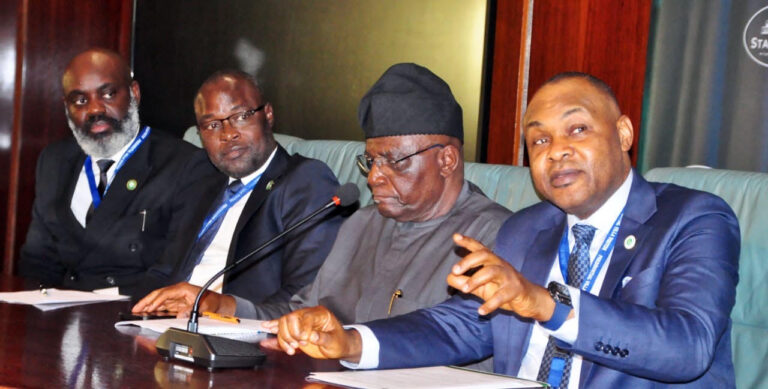
At the 2021 National Transportation Summit of the Chartered Institute of Transportation of Nigeria (CIoTA) with the theme, “Regulating the Transport Sector in Nigeria: The State of the Art and the Years Ahead, stakeholders issued a clarion call to relevant authorities to take the enforcement of transport sector regulations seriously.
Conversely, at the summit, it was established that critical regulatory obligations such as transportation safety, quality control, documentation and licensing, information sharing and data mining, professional education and public enlightenment; enforcement of the rules and standardisation of procedures for seamless collaboration among statutory institutions with mandates are imperatives for the making of a sustainable and economically viable transport sector in Nigeria.
For Nigeria to have sustainable and affordable transportation sector, there is need for the Federal Government to find the recommendations of the CIoTA worthy of implementation because transport is critical to life, and it is central to any economy.
Speaking at the summit, Vice President Yemi Osinbajo, who was represented by the Minister of Transportation, Rotimi Ameachi, said there could not be economic development without transportation, adding that transportation cannot serve its purpose unless it is available in a safe, affordable and secure environment.
However, he said the Federal Government is looking up CIoTA as a professional body on which the country can rely for direction in transport policy planning and administration.
According to him, the Federal Government would adopt the recommendations of the summit as a critical document for future planning, saying that given the quality of professionals in CIoTA, the Federal Government trusted the institute as a worthy partner in its economic recovery drive.
“You have a role to produce transport professionals who will drive the economy from the point of view of transport and logistics. Therefore, government would look up to your Institute for guidance in policy formulation and implementation. Your role in the transportation sector of the economy is enormous. It is a lead role.
“As the Institute carries out its statutory mandate of training and certifying transport professionals, as you exercise your statutory powers to regulate and control the practice of professional transport management and administration, your training curriculum and the quality of your graduates are very significant, as the global supply chain goes digital and the world of transport and transportation management thrives on ever-evolving technology and innovations,” he added.
He said that the investment the Federal Government is making in the transportation system especially in the areas of rail, road, air and maritime sectors is aimed at achieving the potential transport huh status.
Meanwhile, the President of CIoTA, Dr. Bashir Jamoh, said that that transportation is the livewire and lifeblood of any nation’s economy, adding that the nation’s economic livelihood and social life depend on transportation.
“The military and indeed national security would grind to a halt without transportation; the backbone of our oil and gas mainstay also rests on transportation; where would we be without transportation? Nowhere,” he said.
According to him, transportation is everywhere and it is everything, adding that transportation is on the ground, whether by road or by rail; it is under the ground whether by pipelines, cables or tubes; it is on the water whether by boats or large vessels; it is under the water whether by submarines; it is in the air whether by planes.
He advocated that it is also time to take stock nationally of all the transportation assets of Nigeria, adding that CIoTA pledges to play a supportive role in this regard.
His words: “We are officially assuring the Government at Federal and State levels that the institute’s professional base is ready and at your disposal. We believe that proper inventory of our national transportation assets will address the following important concerns: What is our exact national requirement in terms of transportation assets in order to avoid duplication, underproduction or under-investment? We must first ascertain what we need to enable us fill in the gaps.”
“As the professionals saddled with the duty of manning and managing these potentially huge investments in the transportation sector, we must also extend the conversations and engagements at this summit to ourselves. What should our roles be? What sort of requirements should qualify us as worthy and competent custodians?
“Even in the area of the core practice of the profession itself, regulatory expectations must begin to take root. CIoTA by virtue of its enabling Act provides for the professionalization of the function through the Council for the Registration of Transportants. This also is a regulatory matter. As the only chartered body for the practice of transportation, we must shine the light for others to follow.
“We must look at regulation across the professional, operational and commercial dimensions. Most of the transportation disasters on our major roads are symptoms of weak or failed regulatory mechanisms at various levels,” he added.