Follow Us on Google
From Priscilla Ediare, Ado-Ekiti
When Professor Adenike Oladiji read out the results in Ado Ekiti in the early hours of Sunday, she was not only declaring a winner, she was closing a chapter of Ekiti political history that had run, unbroken, since 1999. No incumbent had won re-election since the state elected Adeniyi Adebayo as its first governor in 1999, and Adebayo himself served a single term.
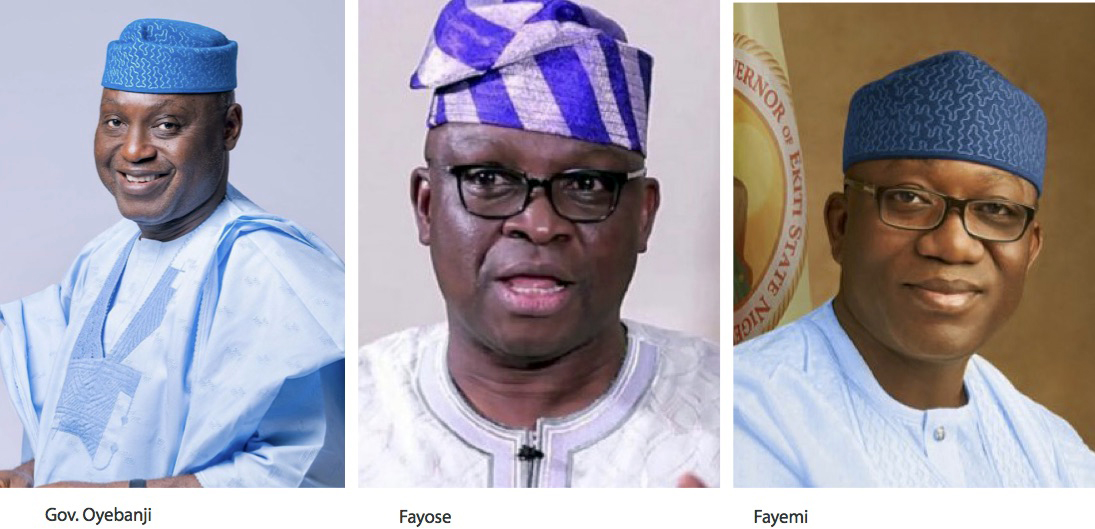
Governors Ayo Fayose and Kayode Fayemi each went on to serve two terms apiece, but neither term ran consecutively, while Segun Oni did not even complete his term after the courts voided his 2007 election. Although Fayemi did win a second term in 2018, he did so after leaving office and returning through another election cycle rather than through immediate re-election as an incumbent.
Against that history, Governor Biodun Oyebanji’s victory, with 319,224 votes to a distant 40,543 for the PDP’s Wole Oluyede and 12,872 for the ADC’s Dare Bejide, is not just a strong result. It is the breaking of a pattern that had outlasted six governments and nearly three decades of the state’s existence.
The scale of the ambition behind this result was clear long before polling day. The director-general of Oyebanji’s campaign organisation, Senator Cyril Fasuyi, had told journalists in Ado Ekiti weeks earlier that the party was poised to break what he called “the long-standing second-term jinx,” citing the governor’s record in infrastructure, education, healthcare and agriculture, and setting a target of half a million votes across the state’s 177 wards.
Fasuyi was also explicit that the campaign would run on record rather than rancour, insisting that the APC would “deal in facts, not fights” and instructing members not to abuse opponents. For observers, what makes this particular jinx interesting is that it was never really about policy failure. It was about fracture, the tendency of Ekiti politics to turn on itself just as an incumbent prepared to seek a second mandate. This time, the fractures ran the other way, and they ran in Oyebanji’s favour.
The clearest evidence of this came from men who, on paper, had every reason to sit this election out or even work against him. Fayemi, his predecessor and a figure whose relationship with Oyebanji had reportedly cooled at points, openly endorsed the governor’s second term bid, describing the act of helping him become his successor as his greatest achievement.
More strikingly, Fayose, the PDP’s own most famous son in the state and a man not known for restraint when it comes to political rivals, predicted an overwhelming victory for Oyebanji and expressed confidence in his success after casting his own vote in Afao Ekiti. When a sitting governor’s polling unit, his own ward, his own local government all return landslide margins, as Ekiti West did, that is organisation. When his predecessor’s chief rival is publicly tipping him to win, that is something closer to consensus.
The endorsements were not confined to Ekiti’s own political family. Lagos State Governor Babajide Sanwo-Olu, speaking at the commissioning of the Ado Ekiti Ring Road months before the vote, commended Oyebanji for entrenching what he called a “culture of purposeful governance” and urged Ekiti voters directly to “vote massively for him in 2026,” arguing that the state “cannot afford to reject” Oyebanji for a second term.
The traditional institution lent its own weight too: the Ewi of Ado Ekiti, Oba Rufus Adeyemo Adejugbe, praised the governor’s humility and administrative acumen, saying his economic policies had united all segments of Ekiti society behind his re-election bid. Even faith leaders mobilised in numbers rarely seen in the state’s politics: Muslim leaders across all sixteen local government areas pledged to deliver no fewer than 150,000 votes for Oyebanji, citing his inclusive style of governance and his championing of religious harmony in the state.
The APC’s own messaging picked up on exactly this theme of alignment. The party’s state spokesperson, Segun Dipe, framed 2026 as a year in which, in his words, “alignment replaces confrontation; the script has flipped,” noting that the APC now controlled the presidency, the state government and all sixteen local government areas simultaneously, a level of vertical alignment Ekiti had not previously had behind a governor seeking re-election. Dipe drew a deliberate contrast with the party’s 2014 defeat, when, in his telling, the PDP “relying on the federal might and the sagacity of Ayo Fayose, overwhelmed the APC to secure the victory.”
By 2026, he argued, that equation had reversed entirely: “PDP is out of power at the centre and fragmented at the state level, with no incumbent, no federal backing, and no project record to campaign on.”
None of this happened by accident, and Dipe was candid that the party had learnt its earlier lesson the hard way. Recalling the 2014 defeat, he conceded that the APC had the right policies at the time but lacked grassroots communication, and that the PDP had weaponised “stomach infrastructure” in the campaign’s final 72 hours, with rice, cash and daily handouts beating long term plans at the polling unit. That lesson, he argued, had been absorbed; in 2026, Oyebanji ran on what Dipe called a performance based incumbency.
The opposition rejected that framing outright. Idowu Adelusi, spokesperson for the PDP’s campaign organisation, insisted the party could repeat what it had done in 2003 and 2014 by unseating the incumbent, pointing to the crowds that had greeted Oluyede’s campaign tours as evidence that history would repeat itself.
A civil servant in Ado Ekiti, David Bamidele, told reporters before the vote that the PDP was suffering from fractures inflicted on it by its own leaders at both federal and state level, and suggested a miracle was what the party needed to win.
No miracle arrived. The PDP’s 40,543 votes, alongside a scattering of low hundreds and even single digit totals for several of the fourteen minor parties on the ballot, reflects an opposition that never coalesced around one credible alternative.
The governor’s record itself was not above scrutiny during the campaign. A fact check by Dubawa of Oyebanji’s own election broadcast found a mixed picture: claims about the completion of the state’s Independent Power Plant, the new Revenue House and the Ekiti Knowledge Zone tech hub were verified as true, while a claim of 5,000 youths “employed” in government positions was found to be misleading, since the figure referred instead to participants in an agricultural youth engagement scheme.
Such discrepancies, however, did little to dent the broader narrative of visible, large scale infrastructure delivery, from the new Ekiti Agro-Allied International Cargo Airport, which began commercial flights in December, to the first phase of the Ado Ekiti Ring Road and a new flyover commissioned by President Tinubu himself days before the vote.
There is another point worth making too. Ekiti has been one of Nigeria’s most competitive political battlegrounds since 1999, frequently producing leadership changes, which made this election an important test of the APC’s standing in the South West ahead of 2027. That Oyebanji passed that test as comfortably as he did, sweeping all sixteen local government areas and recording particularly strong margins in Ado Ekiti, Ekiti West, Irepodun/Ifelodun, Ikole and Ekiti East, will not go unnoticed by other incumbents nationally watching how a second term can be secured in a historically hostile environment.
In his own remarks after the declaration, Oyebanji struck a tone closer to duty than triumph, promising to govern “with courage, with compassion, with humility and with the fear of God” and committing himself to the state’s 30 year Development Plan rather than a personal agenda. He had said much the same months earlier, when launching the Ring Road project: “with your support, I will break the jinx of continuity in Ekiti in 2026. The era of four-year governments being sent packing is over.”
Whether that tone survives the comfort of a landslide remains to be tested. Governors who win this decisively often find that the harder discipline lies not in winning but in resisting the temptation that scale of victory tends to bring. But the jinx, at least, is gone, and it was broken less by any single masterstroke than by something rarer in Nigerian state politics: a ruling party that, for once, did not fight itself on the way to the polls.