Follow Us on Google

The Nigerian National Petroleum Company Limited (NNPC) posted a record N7.2 trillion profit after tax in 2025, but the company says the figure was not driven by higher revenue or crude prices alone.
Rather, it came from tighter cost control, recovery of debts, improved efficiency and a renewed focus on its workforce.
NNPC’s profit after tax rose by 33 per cent, from N5.4 trillion in 2024 to N7.2 trillion in 2025, even though revenue fell to N34.5 trillion amid lower crude oil prices and reduced sales of petroleum products following deregulation of the downstream sector.
At the same time, taxes, royalties and other payments to the government increased by 39 per cent to N22.3 trillion, while earnings per share rose to N35.9.
The combination of lower revenue and higher profit points to a major change in the way the national oil company is being run, with greater attention now being paid to cutting waste, collecting money owed to the company and ensuring that its businesses generate value.
Group Chief Executive Officer, Bayo Ojulari, said the performance reflected a new culture of discipline across the company.
“Profit grew because we improved the way we operate, and we maintained discipline across our businesses,” Ojulari said.
He also stressed the importance of the people behind the numbers.
“Our ambition depends on people as much as the oil wells and the pipelines,” he said. More than 1,000 young professionals were recruited, trained and deployed across NNPC during the year, while women now occupy more than 23 per cent of leadership positions, above the 17 per cent global industry benchmark cited by the company.
The workforce strategy is part of what NNPC calls “The NNPC Way,” built around four principles: Enterprise First, Execution Excellence, Profitable Growth and Partner of Choice.
The idea is to make the company more commercially focused and accountable, rather than relying on its status as a state-owned enterprise.
One of the less visible factors behind the improved profit was tighter control of expenses.
According to NNPC’s Group Chief Financial Officer, Segun Adedapo, the company kept its cost of sales broadly at the same level as a percentage of revenue despite the fall in revenue.
General and administrative expenses also fell by about a quarter, with the ratio dropping from eight per cent of revenue in 2024 to seven per cent in 2025.
NNPC also recovered significant amounts of money owed to it. The recovery of old debts enabled the company to reverse some provisions made in previous years, thereby improving its bottom line.
The company said the approach reflects the commercial discipline required under the Petroleum Industry Act (PIA).
Under the new framework, NNPC cannot simply depend on government funding when customers fail to pay for crude oil or gas supplied to them.
Ojulari said companies buying NNPC’s crude or gas must meet their financial obligations.
“NNPC is no longer a place where everybody thinks it is just the government and everybody does not pay back,” he said.
The change is also important to NNPC’s plan to become a publicly listed company, because investors are likely to demand stronger financial controls, transparency and accountability.
NNPC’s management believes that financial discipline alone cannot sustain the transformation.
The company has therefore placed greater emphasis on developing its workforce through its Talent-to-Value programme.
More than 1,000 young professionals joined the company during the year and went through a one-year internship and training programme before being deployed across different parts of the organisation.
The company is also seeking to combine the experience of older employees with the technological skills of younger workers, including exposure to digital technology, artificial intelligence and international business practices.
Women now make up more than 23 per cent of NNPC’s leadership, according to the company.
“Our people delivered the 2025 result,” Ojulari said.
The company’s new commercial approach is also being applied to Nigeria’s refineries. Rather than relying solely on government-funded rehabilitation, NNPC is pursuing a Technical Equity Partnership (TEP) model under which technical partners would have an ownership stake in the refineries.
The thinking is that a partner with its own money invested in a refinery would have a stronger reason to ensure that the facility operates efficiently and remains profitable.
NNPC initially considered more than 50 potential partners before reducing the number to about 20. The shortlisted companies subsequently carried out detailed inspections of the facilities, involving more than 30 senior technical experts.
Ojulari said one of the problems with previous rehabilitation efforts was that the parties involved did not have enough “skin in the game.”
The new approach is intended to make partners share both the risks and benefits of the business.
Other News
Ojulari also said technology could help Nigerian refineries perform beyond their original design capacity. During a recent visit to China, he said he saw petrochemical facilities operating at 120 per cent and even 140 per cent of their original capacity through improved technology, monitoring and removal of production bottlenecks.
For NNPC, the goal is therefore not merely to restart the refineries but to make them commercially sustainable.
“We are not going to embark on a refinery journey that will lead to lots of money,” Ojulari said, stressing that investments must have a clear path to generating sustainable revenue.
NNPC is also targeting a major increase in oil and gas production.
The company wants to raise crude oil production to two million barrels per day by 2027 and three million barrels per day by 2030.
Gas production is expected to increase to 10 billion standard cubic feet per day by 2027 and 20 billion standard cubic feet per day by 2030.
To achieve these targets, NNPC plans to mobilise more than $60 billion in investment across the energy value chain.
Crude oil and condensate production reached a five-year high of 1.77 million barrels per day in 2025, while Nigerian gas supply rose to a three-year high of 7.2 billion standard cubic feet per day.
But increasing production to three million barrels per day will require more drilling, infrastructure, security, financing and cooperation between NNPC, international oil companies, indigenous producers and oilfield service companies.
Projects including Bonga Southwest and Bonga North are expected to contribute to future production growth.
NNPC is also considering strategic partnerships and other ways of raising capital to finance the expansion, as the company acknowledges that it cannot achieve the targets alone.
The company is equally looking beyond oil to Nigeria’s gas sector.
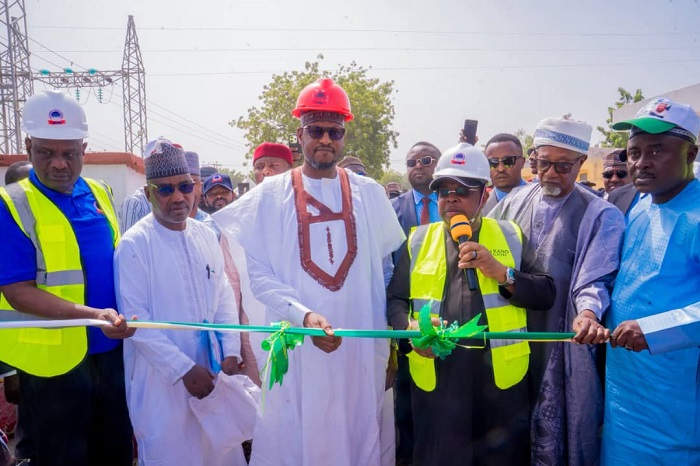
The completion of the Ajaokuta-Kaduna-Kano (AKK) and Obiafu-Obrikom-Oben (OB3) gas pipelines is expected to strengthen the country’s gas infrastructure.
The real test, however, will be whether the pipelines help increase economic activity.
The AKK pipeline is expected to connect gas supplies to power plants and industries across parts of northern Nigeria, while OB3 will improve the movement of gas between major supply sources and markets.
NNPC hopes increased gas availability will support power generation, manufacturing, fertiliser production, petrochemicals and other industries.
The transformation is also linked to NNPC’s ambition to become a globally competitive energy company and prepare for a possible listing on the stock market.
The company has begun listing-readiness work covering the group and its subsidiaries. The process involves identifying weaknesses in governance, financial reporting, transparency and other areas that would need to be addressed before a listing.
However, no date has been fixed for an initial public offering.
Ojulari said management’s responsibility is to prepare the company, while the final decision on whether and when to list rests with the shareholders.
He said the broader ambition is to make NNPC a company that can attract investors and lenders rather than continually having to chase funding.
“Capital should be looking for you, not you looking for capital,” he said.
The company has pointed to stronger relationships with banks and improved access to financing as signs of growing confidence in its commercial direction.
NNPC’s N7.2 trillion profit has provided evidence that the company can improve its bottom line even when revenue is under pressure.
But sustaining the performance will be more challenging as the company simultaneously seeks to increase oil and gas production, rehabilitate refineries, develop gas infrastructure, attract more than $60 billion in investment and strengthen its workforce.
Its targets are ambitious: three million barrels of crude oil per day and 20 billion standard cubic feet of gas per day by 2030, alongside commercially viable refineries and greater transparency in preparation for a possible listing.
Ojulari acknowledged that the improved performance has also raised expectations.
“For us, having a good performance is not just easy. It means that the bar has been set one level higher. So we now need to focus on building the capacity to deliver.”
The next phase will therefore determine whether NNPC can turn its stronger finances into higher production, functioning refineries, expanded gas infrastructure and sustainable growth.
The N7.2 trillion profit may have changed the perception of what NNPC can achieve. The bigger challenge is whether the people, discipline and strategy behind the result can sustain the momentum.
Tamuno, an investment analyst, writes from Port Harcourt.