Follow Us on Google
By Rita Okoye
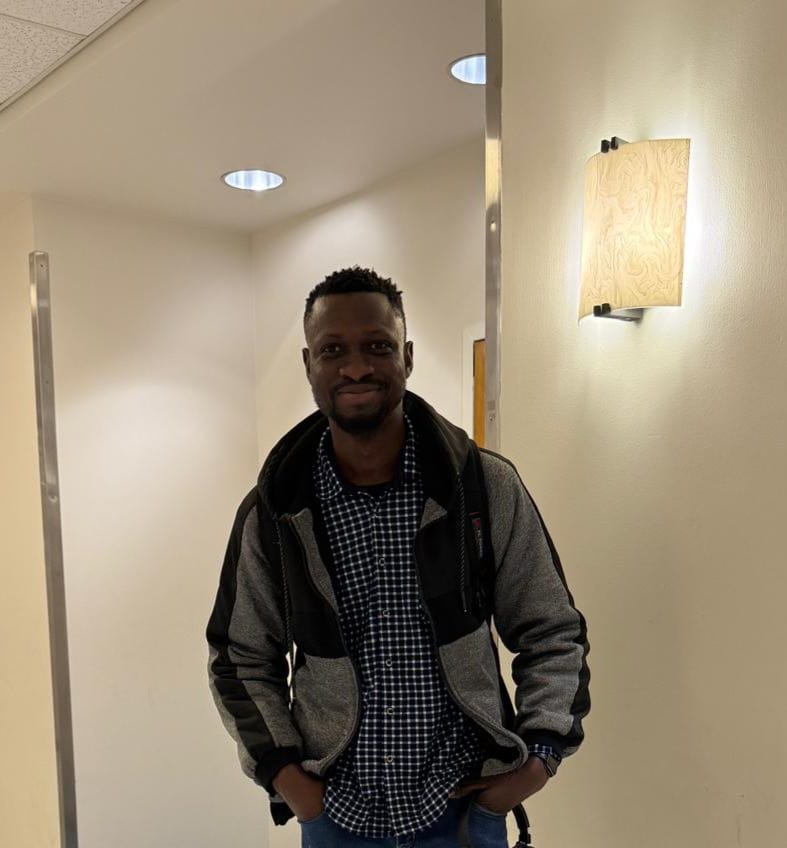
In the corridors of Georgia State University, tucked inside a modest statistics lab humming with the quiet intensity of academic pursuit, a Nigerian scholar is helping reshape the way America tackles one of its longest-standing public health battles: HIV/AIDS.
His name is Olasehinde Omolayo, a statistician, data engineer, and graduate assistant whose work with Bayesian models is breathing fresh life into epidemiological analysis.
Born and trained in Nigeria, Olasehinde is now applying advanced statistical programming to support the determination of optimal drug treatments for HIV/AIDS patients in the United States, a contribution that blends scientific rigor with cross-continental relevance.
While public health innovation in the United States is often associated with major federal agencies and pharmaceutical corporations, a significant share of foundational work occurs within academic research environments.
These university-based laboratories serve as critical incubators for the development of mathematical models and simulation frameworks that underpin clinical decision-making and inform treatment policy.
Within these settings, emerging scholars such as Olasehinde play a pivotal, though frequently unheralded, role in advancing data-driven public health solutions.
Olasehinde’s path began in Akure, Nigeria, where he earned a Bachelor of Technology in Statistics from the Federal University of Technology.
His early academic work focused on the theoretical foundations of statistical inference, but it was his passion for real-world problem-solving that guided him toward applied data science.
After several years working as a data engineer for international tech firms, he returned to academia with a focused intent: to harness the full analytical power of statistics to solve pressing social issues.
At Georgia State University, where he is currently completing a Master’s degree in Statistics, Olasehinde holds a competitive graduate assistantship position, one that allows him to collaborate directly with faculty and researchers on applied biostatistical problems.
Among these, one project stands out: a study on HIV/AIDS prevalence and pharmaceutical efficacy, aimed at evaluating and improving drug regimens for vulnerable populations in Georgia and beyond.
His primary responsibility? Writing R programs that implement Bayesian statistical models, a class of algorithms particularly suited to inference under uncertainty.
These models don’t just crunch numbers; they incorporate prior knowledge, learn from new data, and update probability distributions in a way that mimics human reasoning, making them ideal for analyzing clinical data, where randomness, confounders, and limited sample sizes often obscure clear trends.
The stakes of such work are high. Despite advances in antiretroviral therapy (ART), the United States still faces regional disparities in HIV treatment outcomes, particularly in Southern states where socioeconomic inequality and healthcare access gaps remain. By simulating the effects of different treatment pathways and comparing drug efficacies across diverse population groups, Olasehinde’s code helps identify which pharmaceutical combinations perform best under specific clinical contexts.
These insights can inform physicians, policymakers, and public health agencies in real-time decision-making.
“When we write these models, we’re not just looking for statistical significance,” said one faculty advisor familiar with the project. “We’re looking to save lives, allocate resources smarter, and give communities the tools to fight back against a disease that disproportionately affects them. Isaac brings a rare combination of mathematical insight and practical problem-solving.”
What makes Olasehinde’s journey particularly noteworthy is the context in which he operates. As a Nigerian national working in a U.S.-based public health research ecosystem, he carries with him a global perspective that enhances his analytical lens.
He is deeply aware of how socioeconomic factors, like poverty, stigma, and healthcare infrastructure, can distort disease outcomes.
In Nigeria, these issues are palpable; in the U.S., they are often hidden behind data silos and fragmented health records. Olasehinde’s experience bridges both realities, allowing him to ask the right questions, not just run the right models.
“Statistical modeling isn’t just about fitting curves,” Olasehinde shared in a quiet moment between coding sprints. “It’s about understanding systems, people, behaviors, constraints. Coming from a place where every data point has a story, I’ve learned to listen to the numbers more carefully.
That perspective has not gone unnoticed. Colleagues speak of his diligence, clarity of communication, and relentless pursuit of accuracy. He has become a go-to resource for students needing help with coursework and professors needing technical support for complex analytical problems.
His work with Bayesian modeling is also gaining traction outside the university. Public health nonprofits have expressed interest in collaborating on similar projects, particularly in modeling co-infections like HIV and tuberculosis or analyzing access gaps in rural communities. One initiative under discussion involves building an open-source toolkit that adapts Olasehinde’s codebase for community health clinics with limited technical capacity.
This trajectory, however, has not been without challenges. Like many international scholars, Olasehinde has had to navigate cultural differences, and academic pressures, often simultaneously. But he credits his resilience to years of professional experience, and a grounded sense of purpose shaped by his roots.
“The journey from a statistical bureau in Ibadan to a public health lab in Atlanta wasn’t straightforward,” he says. “But every step taught me something about what data can and cannot tell us, and how much more it can do if we listen closely.”
That humility, coupled with technical excellence, is what sets his story apart. In an era when cross-border collaboration is more important than ever, Olasehinde’s work is a testament to the global nature of scientific progress. His hands may be on the keyboard in Georgia, but the impact of his models reverberates across borders, bridging the statistical divide between continents and reminding us that talent knows no geography.
As his program at Georgia State University nears completion, there is little doubt that Olasehinde’s contributions will continue to resonate, whether in the publication of academic papers, the expansion of his HIV modeling work, or the next public health challenge that demands clarity from complexity.
For now, he remains focused on his immediate goals: finishing the next iteration of the HIV treatment simulation, training undergraduates in applied statistics, and making sure that every line of R code speaks as clearly and accurately as the data demands.
Because in Olasehinde’s world, numbers are more than values; they are voices. And he’s determined to make sure those voices are heard, understood, and used for good.