Follow Us on Google
…Landlords, agents capitalise on shortage
By Maduka Nweke
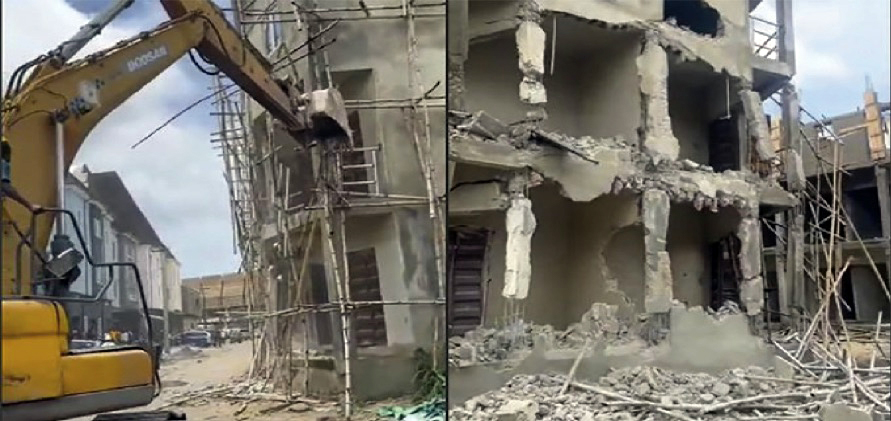
As Nigeria battles an estimated housing deficit of more than 22 million units, the increasing rate of building demolitions, particularly in Lagos State, is compounding an already critical housing challenge.
While governments insist that many of the affected structures violate planning regulations, encroach on public infrastructure, or pose safety risks, critics argue that the manner in which demolitions are carried out has intensified homelessness, driven up rents, displaced thousands of residents, and eroded public confidence in urban renewal programmes.
Lagos, Nigeria’s commercial capital, bears the heaviest burden of the country’s housing shortage. With millions of people migrating to the city in search of economic opportunities each year, the demand for affordable housing continues to outstrip supply. Against this backdrop, every wave of demolition further shrinks the available housing stock, leaving many low- and middle-income residents scrambling for alternative accommodation.
The immediate consequence is often a sharp increase in rental demand in surrounding communities, leading landlords and property agents to raise rents significantly. Families displaced by demolition exercises are forced into emergency housing searches, creating fierce competition for the limited number of available homes. In many cases, tenants are compelled to relocate to distant suburbs where housing may be cheaper but infrastructure and social amenities remain inadequate.
Urban planning experts maintain that governments have a constitutional responsibility to enforce building regulations and prevent illegal developments, especially on drainage channels, road alignments and environmentally sensitive areas. However, they argue that enforcement should be transparent, humane and predictable.
Architect and former Lagos State governorship candidate, Gbadebo Rhodes-Vivour, believes the government must adopt a more people-centred approach to urban renewal.
According to him, “the government must commit to a more transparent and accessible means of securing titles, getting permits and clarifications on sites or locations considered illegal.”
He further urged the authorities to create a transition framework that protects innocent property owners.
“It should introduce a robust transition process that does not criminalize building owners who have relevant papers and have demonstrated good faith by engaging the government for resolutions. If people must be relocated, the process should preserve the dignity of the property owners and compensation or a path to homeownership should be immediately extended to the victims.”
Rhodes-Vivour also stressed the need for greater investment in affordable housing.
“Finally, the government must deliberately invest in social housing and create a path to homeownership for millions of hardworking Lagosians. Saving Lagos from flooding is important and must be undertaken as it is investing in a resilient environment. However, what is more important is a compassionate state that is committed to property rights and the dignity of every citizen.”
He warned that unless the trend is reversed, the housing deficit could become far worse.
“If Lagos State continues to demolish houses added to ones eroded by denudation, collapsed by poor foundation and destroyed through disputes, then the deficit that will visit the state in the nearest future will be a tip of the iceberg to what we are feeling currently.”
Despite commissioning 233 housing units, the Lagos State Government has continued demolition exercises in locations including Ikate-Elegushi, the Lekki-Ikoyi corridor and parts of Amuwo-Odofin. Similar exercises have also occurred alongside major infrastructure projects such as the Lagos-Calabar Coastal Highway, while the Federal Capital Territory Administration has undertaken its own enforcement actions against illegal structures and property fee defaulters.
Although governments insist that these exercises are necessary to restore order and safeguard public infrastructure, housing experts believe the pace of demolition has not been matched by adequate replacement housing.
Other News
Former Minister of Housing and Urban Development, Ahmed Dangiwa, acknowledged the enormity of the country’s housing challenge during an oversight visit by the Senate Committee on Lands, Housing and Urban Development.
Providing updates on the Renewed Hope Cities and Estates initiative, he said: “This initiative, designed to reduce Nigeria’s housing deficit, is being executed through public-private partnerships. Our engagement with the Senate Committee included discussions on our collaborations with reputable developers, particularly the Karsana site, where 3,112 housing units are under construction. We provided insights into the Slum Upgrade and Urban Renewal Program, which covers 28 locations nationwide.”
He noted that developments are ongoing across 13 sites nationwide under the programme, funded through the 2023 supplementary budget.
Lagos State Governor Babajide Sanwo-Olu has also repeatedly highlighted the growing global housing crisis.
Speaking during the presentation of the Memorandum of Understanding between the Lagos State Government and Access Bank Housing Scheme in Ikorodu, the governor said:
“The global housing challenge, especially the socio-economic task of providing affordable housing for millions of low-income individuals, is real and pressing.”
Quoting United Nations projections indicating that more than three billion people could be affected by inadequate housing by 2030, Sanwo-Olu described the situation as a call to action.
“This is not just a statistic but a call for action. It is well established that shortages of land, lending, labour, and materials are exacerbating this crisis, making it increasingly difficult for individuals and families to afford low-income homes. Addressing this requires bold interventions, innovative solutions, and collaborative efforts.”
Property developer Obiora Okeke, who operates in Amuwo-Odofin, said the impact of demolitions on Lagos residents cannot be fully appreciated without experiencing the city’s housing realities firsthand.
According to him, low-income earners bear the greatest burden as displaced households compete for scarce accommodation, pushing rents beyond the reach of many workers.
Industry stakeholders identify several consequences of the frequent demolitions.
The first is skyrocketing rents. With housing supply shrinking, rental prices in neighbouring communities such as Surulere, Ikotun, Ajah and parts of Lekki have continued to rise as displaced residents search for available apartments.
Another consequence is mass displacement and homelessness. Abrupt demolitions often leave families without immediate alternatives, forcing many to squat with relatives or move into overcrowded apartments.
The exercises also inflict heavy financial losses on both landlords and tenants. Property owners lose valuable investments, while tenants frequently forfeit advance rent payments and money spent on renovations or improvements to their homes.
Many affected residents are equally compelled to relocate to outlying suburbs such as Ibeju-Lekki and Epe, where housing is relatively cheaper but transportation costs, commuting time and inadequate infrastructure reduce their quality of life.
Perhaps most damaging is the growing trust deficit between citizens and government. Many residents now approach property transactions with uncertainty, fearing that homes purchased or rented today could be marked for demolition tomorrow.
Urban development experts insist that while illegal structures must not be tolerated, enforcement should be accompanied by greater public enlightenment, fair compensation where appropriate, improved planning approval systems and large-scale affordable housing projects. Without balancing urban renewal with housing expansion, they warn that Lagos risks deepening a housing crisis that is already among the worst in Africa.