Follow Us on Google
By Henry Uche
The fear of retirement is one silent killer that many active Nigerian employees are battling in their subconscious mind. The consequences of this syndrome are graver and have multiplier effects on the economy than the government’s campaigns on corruption.
No doubt the perpetual plight of pensioners in Nigeria has aggravated instincts for sharp practices across board, particularly in government establishments. The apprehension breeds dishonesty, stealing, avarice and cheating on employers’ time and other resources.
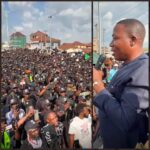
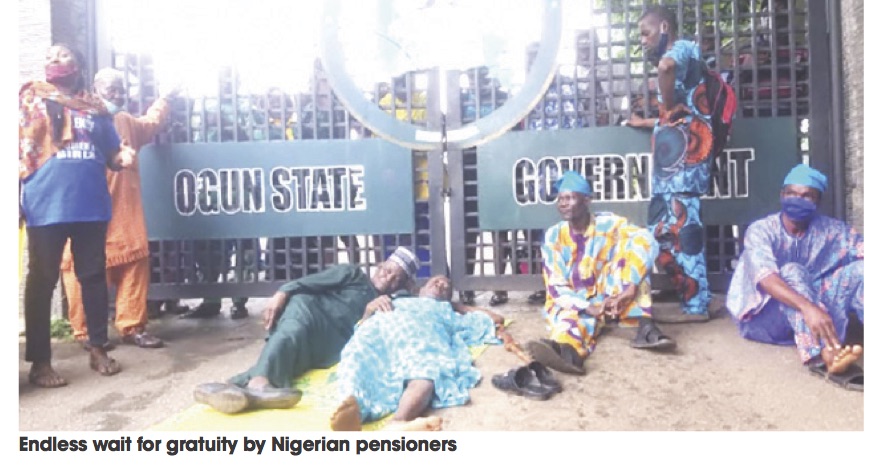
With the recent protest in Ogun State by Pensioners in the South-West region of Nigeria under the aegis of the Association of Contributory Pension Sector, South-West zone, over alleged unpaid gratuity by the Federal Government, one wonder why employers- especially the government would choose to relegate the senior citizens who had contributed to the growth and development of the country in diverse ways.
The pensioners, comprising workers from the University College Hospital, Ibadan; University of Ibadan, University of Ife (now Obafemi Awolowo University, Ile-Ife), the University Teaching Hospital, Ife; Ilorin Teaching hospital, University of Ilorin; the federal medical Centres in Lagos and Ogun states, and Nigerian Postal Service, among others, alleged that top officials of the National Pension Commission (PenCom) were holding on to their hard-earned allowances.
Cases abounds where these senior citizens slum while some die in the process of fighting for their Rights. For the fear of the unknown after retirement, many employees had engaged in various dubious acts just to save for the rainy days.
The case of the 30-year-old driver, Duke Harry (name withheld) in a government parastatal at one of the state secretariats readily comes to mind.
Harry was employed at Level 05 when he was 24. By the time he was 30 years, he was still expecting his first promotion to Level 06, but contrary to expectations and calculations, Harry has amassed so much wealth that he brags to his ‘not-so-fortunate friends’ that he is ready for retirement anytime. Everyone around him often wondered why he was always lousy and brazen. Soon, the story broke that Harry was a member of a money-sharing racketeer group in the parastatal.
The team he worked with before his present position was headed by a Level 15 officer, an assistant director, who did not look down on the driver but included him in the sharing of loots. What was the loot about? The racketeers were members of a 10-man committee assigned by the government to oversee the disbursement of long-held allowances of medical doctors in the state. The money involved ran into billions of naira, which were legitimate allowances owed to medical doctors for over five years.
The leader of the disbursing committee, a director, had ensured that every member of the committee made millions of selfish gains before completing the assignment. The driv was not left behind because of his uncanny and duplicitous loyalty to his boss. This was how Harry ran into his ill-gotten wealth that made him bold and insolent as a junior civil servant.
Cases like Harry’s story are numerous across government establishments and private sector where workers manipulate government’s/management’s plans, policies and programmes in the name of what they describe as “saving for the rainy days’. But who will you blame?
The chronicles of pensioners’ agonies date back to the 1950s. The issue of pension administration has been a conundrum to many government regimes; it is critical that if handled tactlessly, it often gives rise to public brouhaha and criticism on the sie of government.
In Nigeria, pension administration is characterised by multiple and complex problems at all levels of government. Nigeria received a pension administration that is entirely bizarre and modelled after the British structure. The pitfalls of this structure led to many inglorious actions and inactions, which gave birth to the 2004 Pension Reform Act (PRA). This reform also was plagued with myriads of flaws; for instance, some workers at the state and local government levels were ostracised; most state governors were unable to key into the scheme and the reform suffered implementation problem which is a major challenge in public administration. Hence, agitations for another amendment.
To stem this tide, Nigeria’s National Assembly passed the amendment bill, which was assented to by the former president, Dr Goodluck Jonathan, on July 1, 2014. This Act seeks, among other things, to painstakingly examine the lapses, irregularities and other flaws in the old act and to suggest better ways to improve the scheme. All efforts were geared towards bettering the lot of these weak and frail-looking ‘senior citizens’.
With the enactment of the scheme, a transparent, prudent and responsible pension administration was expected to restore the trust and confidence of pensioners and the entire labour force on their pension administrators.
Industry watchers observed with dazed bewilderment that the Nigerian government is known for “administrative negligence, poor planning system, poor policy implementation, poor social security system, poor sustainability plans and other management pitfalls in pension administration.
Experts also observed with disdain that these elder statesmen who appear vulnerable at old age are being relegated, especially at the local government level. Sad to note that westernisation has eroded our traditional manner of taking care of our aged ones, especially in the face of the current economic realities.
With the acquiescence of the 2014 pension reform, the Act was not left without flaws which aggravated the plight of these elder statesmen. The flaws were indications that the changes made were not well thought -through, hence, the ambiguities and inconsistencies within the extant laws.
On implementation, poor funding, political influence and control are impediments – -a situation where political appointees mess up with pensioners’ funds; state governments inability to receive counterpart funds due to their failure to pay state workers to the letter, inflated records made disbursement of fund a hard nut to crack. Evident, among others, was the corrupt practice that was exposed when a verification exercise in the military revealed over 23,000 fake pensioners in the army in the past.
Another major agony of pensioners was the tardiness of pension disbursement. Industry watchers also observed how these senior citizens are ill-treated. Most PFAs and Pension Funds Custodians (PFCs) conduct prepayments verification exercise for retirees, sometimes under inclement weather conditions for two to four days. As a result, some pensioners slump in the queue while others die in the process.
Similarly, the apex pension body, PenCom, has not done so much in its duties to enforce regulatory compliances. For instance, by compelling PFAs to report in a timely manner the value of their Retirement Savings Account (RSA) to enable pensioners evaluate the pros and cons of investing in different PFAs.
People behind their agony
The worse deed one can do is to steal or deny “the golden handshake” from those who have spent most of their useful life working for another. Many factors and people at different segments of pension administration are instrumental to the exacerbation of pensioners’ agony. First and foremost is government at the three levels.
Unarguably, the government set out the framework/structures through which the objectives of the pension administration and reforms are set and the means for regulations and implementations are achieved. But it is seen that the structures, machineries for controls, the monitoring system, performance management techniques and other principles of quality corporate and public management and administration are lacking in Nigeria’s pension administration.
The integrity of persons sailing the ship of pension and disbursement overtime has been abysmally questionable. A heartrending act is when persons in high places deny the beneficiaries and next-of-kins (NOKs) what is due to them.
The case of Abdullahi Abdulrasheed Maina, former chairman, of the defunct Presidential Task Force on Pension, who allegedly diverted N2 billion in pension biometric scam in November 2015, during Goodluck Jonathan’s administration, still has so many hearts bleeding till date.
Financial institutions like the PFAs and PFCs, Office of the Accountant General, Office of the Auditor General, Ministry of Finance have worsen the plight of these retirees by the stressful protocols, subjecting them to aching bureaucratic processes before they collect their stipend.
In the same vein, employers of labour should not be in the league of those inflicting pains on retirees. They should be proactive regarding pension matters to avoid the story of “insufficient funds” for retirees at their exit from active service. The Nigerian Labour Union (NLU) and Trade Union Congress (TUC) are striving to be at the vanguard to persuade the government to live up to its responsibilities in this regard since more attention is on active take home of the workforce, however, there seems to be a lacuna between active work life and the retirement world.
Way forward
Solutions to ameliorate the agony of retirees are not far-fetched if only we can do the right things at the right time and right places. We know that everything rises and falls on leadership. Political leaders have a lot to do across the three tiers of government. There will never be transparency, prudence, responsibility and accountability in pension administration if persons with dark and dubious hearts keep piloting pension administration.
At all levels, people with clean track slates in integrity, compassion, empathy and godliness must be appointed to the pension administration. Major cankerworms that have bedeviled Nigeria are “nepotism cum cronyism”, but if the right persons are given the right jobs, the right things would be done without fear or favour of any kind. For instance, if the federal and state governments live up to expectations, there won’t be any need for bailout funds.
The Federal Government used to play Father Christmas by paying outstanding salaries owed by state governments that who in their moral and legal obligations to their employees, even in the midst of huge security votes unaccounted for.
With the ongoing Bill for an Act to exempt the Nigeria Police Force from the CPS and a Bill for an Act to further Amend the Pension Reform Act 2014 to, among other things, provide for a retiree to withdraw a lump sum of at least 75 per cent from the Retirement Savings Account, RSA, and to criminalise undue delay in the payment of pension and for related matters, all parties in this two pension-related Bills in the NASS should be rectified in a way and manner that at the end, no body would be victimised.
A senior citizen who gave his name as (Uwadiegwu Balogun Adenyika) said it is an evil act to deny anyone his due. His words: “The Holy Book says, “Withhold not good from them to whom it is due when it’s in the power of your hands to do it. Do not say to your neighbour, go and come again, tomorrow I will give you when you have it with you.”
He added, “There should be a continuous “training and education (in form of orientation and enlightenment programmes)” for workers; from “engagement to retirement” for in-depth knowledge and understanding of their fate after retirement. This will help them make wise decisions in this regard.”