Follow Us on Google
From Scholastica Hir, Makurdi
There is no gainsaying that the state of public health care services in Benue State leaves much to be desired. This appalling situation could be attributed to the prevailing economic crunch in the country, coupled with years of neglect and poor funding by successive governments.

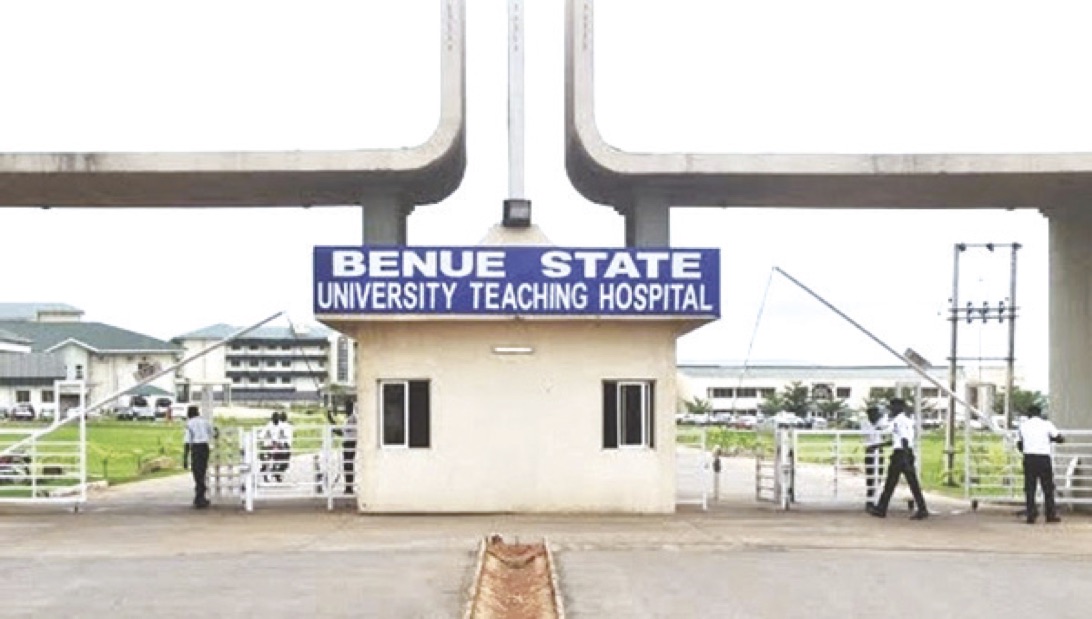
•The university gate
From the primary to secondary and tertiary healthcare centres, the disheartening state of healthcare service delivery has become a source of worry and concern for all, which has necessitated medical ‘tourism’ with residents going to neighbouring states for treatment.
The physical outlook of most of the hospitals in the state presents a picture of befitting health facilities but in actual sense they are mere glorified shells lacking medical personnel and equipment. In the rural areas, for instance, some hospitals have either one nurse or one doctor, and the general hospitals are not exempted from this appalling service delivery.

•One of the hospital’s toilets
Even at the Benue State University Teaching Hospital (BSUTH), Makurdi, the structures appear enthralling but they lacks the desired equipment, personnel and medication to function optimally. The befitting physical structures of the hospitals is as a result of the intervention of the Central Bank of Nigeria (CBN) loan obtained by the immediate past administration of Governor Samuel Ortom.
The ex-governor had intimated citizens shortly before exiting office that N900 million was taken out of the loan allocated to various general hospitals in the state to upgrade medical facilities to enhance health care service delivery for the people.

Gov. Hyacinth Alia
The former governor disclosed that the comprehensive renovation of the Gbajimba General Hospital in Guma Local Government Area and its doctors’ quarters and other hospitals (including the state-owned teaching hospital) across the state cost N1.2 billion and that was his administration’s modest commitment to ensuring quality healthcare delivery in the state.

The ‘japa’ syndrome has also not helped the situation as most doctors and nurses have either left the state for greener pastures outside the country or elsewhere within the country. This is as a result of poor renumeration considering their kind of work, coupled with the attendant hazards.
A case in point was that of Mrs. Janet Onah who was delivered of a set of twins at a private hospital in Aliade, Gwer West Local Government Area of the state. It was a moment of joy for the family as the husband quickly called to inform family and friends of the arrival of the new babies. However, barely two hours after delivery, the wife and one of the babies developed some complications, which were way beyond what the hospital could handle.
They were referred to BSUTH, Makurdi, with the hope that they would get the best treatment. After spending two days at the teaching hospital, she lost one of the twins and her condition worsened. She needed dialysis but the hospital said their dialysis machine was not working and she was again referred to neighbouring Ebonyi State.
“It was not a good experience. I practically took my family to Ebonyi in tears that day. A few days old baby and an almost dying wife. I don’t wish that to happen to anyone,” Onah told this reporter.
Onah and his family are not in this alone. In the recent past, several residents have told a tale of woe of how they left the state to places like Keffi in Nasarawa State, Jos in Plateau State and Abuja, FCT, for medical attention for as little a thing as conducting a CT scan, among others. As a result of the japa syndrome, doctors in Benue hospitals are also overworked, as many are called back to duty even after working their schedule.
Chairman, Nigerian Medical Association (NMA), Benue State, and immediate past president of the Association of Resident Doctors, Benue State branch, Dr. Ushakuma Anenga, said that during emergencies, particularly during herdsmen’s attacks on communities, the hospital is always full and, sometimes, they have to mobilize even doctors who are not on duty as well as doctors on leave to attend to the patients and save lives.
“There are pressures on consumables, bed spaces and health workers, because we don’t have enough health workers in the state,” he said.
But stakeholders say Governor Hyacinth Alia has started well, especially with the allocation to health in the 2024 budget and other initiatives like the payment of new harzard allowance, timely payment of salary and implementation of the Medical Residency Training Fund (MRTF) 2023 at an increased rate.
“We are confident that these measures and many others would encourage and beef up manpower in the state’s health sector.”
Another staff of the hospital who didn’t want to be named complained that the relocation of health workers posed serious challenges to the running of the hospital.
“Most of our staff left, so beefing up manpower and training them again and again would be great, and addressing infrastructure, especially the ultrasound, would good,” she said.
Even the General Hospital located at North Bank, Makurdi, the state capital, looked neat when this reporter visited at the weekend. It was, however, observed that the toilets were not in good shape or they are not enough, based on the response of a doctor who declined to speak on the state of the equipment, drugs and manpower.
The doctor told our reporter to call back on another day so that appropriate persons would be on seat to give more comprehensive reports because they were responsible for receiving supply.
He, said: “There are toilets around. But I think, recently, somebody came to make some donations for some toilets there. So, I don’t know if there will still be demand.”
He refused to grant our reporter access to the toilets to see the conditions, insisting that she should go and come back on another day.
Also visited was the Family Support Programme (FSP), located in Makurdi. Although the toilets at the FSP appeared old, they were decent and kept neat hence without stench and flies.
On whether FSP had challenges of equipment, manpower and drugs, Nurse Irene Aule who spoke with our correspondent at the facility explained that the Centre for Disease Control (CDC) had taken over the management of the facility and was providing all that was needed.
“For now, we thank God; most of the equipment are there. But this place is being controlled by the Centre for Disease Control and Prevention. So, they are the ones supplying most of the equipment. They also bring their drugs. There is a pharmacy that produces the clinical drugs they use”, Aule said.
On the time of visit, there were no patients in the hospital. Aule said they used to treat patients at all times when the FSP was under the Ministry of Health, “it was like a mini general hospital and it was so busy, but it’s now under Primary Heath Care and Primary Health Care doesn’t have many programmes to cover. They only deal with pregnant women and children. So, the work is less as it’s limited to family planning.
“Work is not much anymore, like before when there were many of doctors with patients on the beds. Now, pregnant women come and deliver and go back. It’s only when they deliver and have an issue that they have to wait. One woman delivered today and left. We may have another one in the evening”, Aule added.
When contacted, the Commissioner for Health and Human Services,Dr. Yanmar Ortese, said the general hospitals with beautiful structures have reasonable health facilities but lack manpower.
“We have this beautiful structures with some reasonable facilities in general hospitals in Benue State. Recently, I went to inspect the General Hospital in Okpoga. It has befitting structures but the problem was that of manpower.
“Manpower has been a problem in the health sector across the nation. Recall that recently five wards at the Lagos State University Teaching Hospital were closed down because of manpower. But the state governor, Rev. Fr. Hyacinth Alia, is doing his best to ensure that we have adequate manpower in our health sector in this state.
“The governor has commenced a special package of N100,000 for all doctors in the state. This is outside what they are being paid as their NYSC allowance and what they are being paid in the place of their primary assignment. This is meant to enable them come to Benue, stay and render service to the Benue people.
“There was also a bond scheme, a programme where clinical medical students of Benue extraction will be paid an amount of money not less than N100,000 and above monthly with an agreement that after NYSC they will come back and work for the state for at least two years.
“This has been granted by the governor and it is going to begin in January because it has been captured in the budget. So, with that our primary health care and general hospitals especially would have 10 to 12 medical doctors because we have started graduating young doctors and with that the manpower aspect will be sorted out.
“Shortage of manpower cuts across all categories of workers. For the nurses, the last administration scrapped the School of Nursing and Midwifery, the state Assembly has been directed to repeal that law that abolished the School of Nursing and Midwifery so that we can bring it back.
“We need those categories of people back because they are the ones that work in the nursing section. These are some of the things the governor is doing to revive the health sector.
“Also, when we came, there was disparity in payment of health workers at the teaching hospital. Many doctors complained that there was disparity in the payment of hazard allowance, compared to other health facilities like the Federal Medical Center, Makurdi, and some of the hospitals outside Benue State.
“The new hazard allowance was implemented by the Federal Government in December 2021 and Benue State is still paying the old allowance of N5,000 until the last three months when the governor approved the payment for two months. So, right now, the pay is the same with every other health institution in the country and these are the ways Governor Hyacinth Alia wants to keep and maintain the doctors we have and every other health worker in this state,” Ortese said.
He further said that the governor has improved on most of the facilities, especially at the State University Teaching Hospital: “We have a new MD at the teaching hospital right now and when you go there now that smell at the Accident and Emergency and other wards is no longer there; the sewage has been cleaned and chemicals have been used.
“It is no longer business as usual. I assure you, this is the beginning of great improvement in the state’s health sector and the end of medical tourism by residents.”
Meanwhile, Alia has vowed to end medical tourism in the state, especially by making the teaching hospital a medical tourist attraction in the country. He spoke when he inaugurated the 250KVA solar infrastructure and the renovated Mental and Psychosocial Rehabilitation Centre at the Benue State University Teaching Hospital, Makurdi, recently.
The 250KVA solar infrastructure was donated to the state by the federal government through the office of the Vice President, Kashim Shettima. Alia appreciated the federal government for bringing the project to Benue, saying it would go a long way in solving the energy need of the hospital.
“We will continue to be good collaborators with the federal government and development partners in enhancing healthcare delivery in the state,” the governor promised.
He said the project was the beginning of greater things to come to the hospital and Benue in general, adding that the choice of the chief medical director, Dr. Stephen Hwande, was not a mistake as he was sure the hospital would experience transformation.