Follow Us on Google
When President Bola Ahmed Tinubu recently tapped Governor Hope Uzodimma to serve as the Director General and National Coordinator of the Nationwide Renewed Hope Ambassadors Project, it came as no surprise to discerning observers. For a man whose capacity to mobilize people, design functional structures and drive strategic mobilization is well established, the assignment fits with almost mathematical precision. It is a role that demands credibility, composure, organization and results — qualities Uzodimma has demonstrated over time.
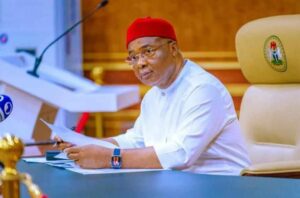
Uzodimma’s political and governance trajectory has never relied on noise or theatrics. It has been defined by structured thinking, problem-solving and a quiet resolve to deliver. As chairman of the Progressive Governors’ Forum, he emerged as a steady hand in moments when the party and the country required calm, negotiation and clarity. In tense transition periods and during sensitive internal realignments, he consistently played the role of mediator, rather than agitator — a solution-finder with a reputation for listening carefully, thinking strategically and acting decisively.
Yet, he is not just a negotiator, he is a builder. His work in Imo State reflects a deliberate focus on infrastructure, economic renewal, governance reforms and investor confidence. One of the most visible pillars of his administration has been the aggressive rehabilitation and construction of critical roads. The reconstruction of the Owerri-Orlu and Owerri-Okigwe roads, for instance, has significantly improved connectivity, reduced travel time and unlocked economic corridors that are vital to trade and commerce within and beyond the state.
In urban infrastructure, the delivery of the Assumpta Flyover at the Assumpta Roundabout in Owerri stands out as both a functional and symbolic achievement — easing congestion at a major traffic node and signalling a commitment to modern city design. Complementing this is the rebuilding and upgrade of the Emmanuel Iwuanyanwu International Conference Centre and improvements around the State House of Assembly complex, helping position Owerri as a credible destination for high-level dialogue, conferences and institutional events.
On the transport and logistics front, the revival and upgrade of the Sam Mbakwe International Cargo Airport has further anchored Imo as a gateway for commerce, investment and connectivity in the South-East. These are not abstract projects; they are tangible assets that residents, traders, investors and visitors can see and use.
Most recently, Governor Uzodimma convened the Imo Investment Summit, held last week — a strategic forum aimed at repositioning Imo as an investment destination of choice. The summit brought together local and international investors, development partners, financial institutions and private-sector leaders.
They gathered to explore opportunities in infrastructure, industry, tourism, energy, agriculture and services. It was not an event for optics; it was an intentional effort to chart a pathway towards a more diversified, investment-driven Imo economy, with commitments and follow-up mechanisms embedded into the state’s broader development agenda.
Beyond physical projects and economic initiatives, Uzodimma has also pursued governance and fiscal reforms: tackling legacy debt, improving internally generated revenue, prioritizing workers’ welfare, clearing pension backlogs and advancing initiatives like “Light Up Imo” to support productivity and public safety. These decisions underscore a mindset that sees governance as a long-term management responsibility, not a short-term performance for headlines.
There is, however, another layer to his profile that is often underappreciated — his intellectual and reflective side. Recently, Uzodimma authored and presented a book, titled “A Decade of Impactful Progressive Governance in Nigeria,” a serious contribution to Nigeria’s contemporary political and governance literature. The work goes beyond partisan commentary; it situates the experience of progressive governance within a wider historical, institutional and policy context. That a sitting governor takes the time to think, write and document at that level says something important: Uzodinma views governance not just as administration but also as part of Nigeria’s unfolding historical narrative.
It is this blend of strategic political skill, governance delivery, developmental ambition and intellectual grounding that makes his appointment as helmsman of the National Renewed Hope Ambassadors (NRHA) Project both logical and instructive.
He has been one of the most vociferous promoters of President Bola Ahmed Tinubu’s policies and programmes, always exploring ways both the federal and sub-nationals can work together towards achieving good governance.
The NRHA is not a campaign platform. It is not designed for electioneering or partisan sloganeering. Rather, it is a structured mass mobilization and public enlightenment architecture conceived to bridge the gap between government reforms and citizen understanding. Its mandate is to translate policy into plain language, to carry accurate information down to the ward level and to channel feedback from communities back up to the institutions that make and implement decisions.
Other News
In many ways, the Renewed Hope Ambassadors framework is civic education meeting mass mobilization — a nationwide network of trained ambassadors, mission officers and coordinators who will engage markets, communities, faith institutions, youth groups, traditional authorities and other stakeholders with facts, programmes and opportunities, not rumours and speculation.
This project needs a leader with:
• Organizational intelligence – to design structures that work from the national level down to the wards.
• Strategic communication sense – to ensure messages are clear, consistent, and credible.
• Consensus-building skills – to align party structures, public institutions and community actors behind a shared objective.
• Intellectual depth – to understand the policy content behind the messages and not just the sound bites.
His Excellency, Hope Uzodimma, fits this profile. His experience chairing the Progressive Governors’ Forum, his record of delivery in Imo, his convening of the Imo Investment Summit and his authorship of that seminar governance work together project a public figure who is both practitioner and thinker.
By assigning him this role, President Tinubu has sent a signal: the awareness of the Renewed Hope Agenda will not be left to chance. It will be systematic, evidence-based and anchored on verifiable progress. The NRHA under Uzodimma’s leadership will function as a national interface — carrying government to the grassroots and bringing the grassroots back to government.
In a season where misinformation travels faster than facts, where cynicism often drowns out genuine progress, and where citizens demand not just promises but proof, the choice of Governor Hope Uzodimma to “preach the gospel of Renewed Hope” is more than mere political patronage. It is a strategic deployment of a problem solver, a solution provider and a capacity-builder to the frontlines of national communication of policy outcomes.
Renewed Hope, after all, is not just something to be said. It is something to be organized, explained and demonstrated. And in that assignment, Uzodimma now carries a mandate that is as heavy as it is critical.
God will help Nigeria to succeed.