Follow Us on Google

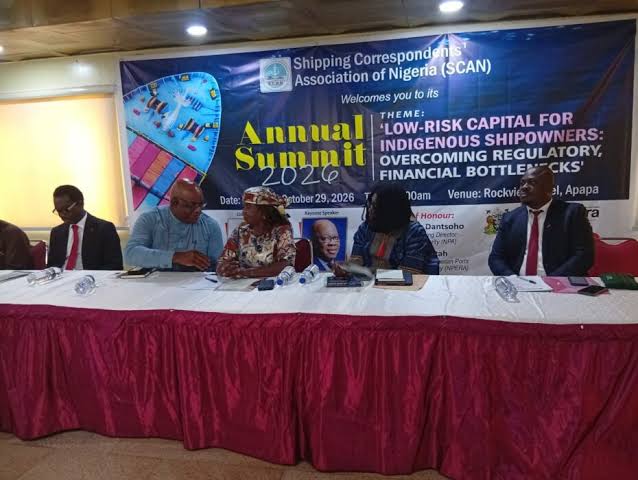
High interest rates, inadequate access to long-term financing and delays in the disbursement of the Cabotage Vessel Financing Fund (CVFF) are hindering the growth of Nigeria’s indigenous shipping industry, stakeholders have warned.
The experts who spoke at the 2026 annual summit of the Shipping Correspondents Association of Nigeria (SCAN), urged the Federal Government, financial institutions, and maritime regulators to address funding and regulatory challenges that prevent local shipowners from expanding their fleets.
They called for a review of the CVFF guidelines, improved access to cargo contracts and stronger collaboration between banks and industry operators to make vessel financing more accessible.
In his goodwill message, the Regional Manager, Apapa, United Bank for Africa Plc, Mr. Nelson Edoye said United Bank for Africa (UBA) pledged to support indigenous shipowners through tailored financing, trade facilitation, and advisory services.
Edoye stated that he acknowledged the capital-intensive nature of shipping and the regulatory complexities confronting operators, stressing the need for financing solutions suited to the sector’s long-term investment requirements.
The Minister of Marine and Blue Economy, Adegboyega Oyetola, said the administration remained committed to developing indigenous shipping capacity despite high borrowing costs and the substantial capital required to acquire vessels.
The Minister who was represented by the Director of Press, Anastasia Ogbonna, disclosed that NIMASA had been directed to commence CVFF disbursement to qualified beneficiaries.
Oyetola also cited the launch of a dedicated application portal in January 2026 and the expansion of primary lending institutions participating in the process.
He said that NIMASA was further directed to work with the lending institutions to accelerate application assessment and fund disbursement, with due diligence and transparency guiding the process.
“Government is also exploring a commercially driven national shipping line under a public-private partnership arrangement, alongside efforts to develop local seafarers, ship-repair facilities and marine engineering capacity” he added.
Delivering the keynote address, Dr Olisa Agbakoba said the government did not need to finance every vessel directly but should create the conditions for private capital to support viable shipping projects.
Agbakoba who is also a former President of the Nigerian Bar Association (NBA) was represented by Akunne Nzube, who identified cargo certainty, enforceable contracts and predictable regulation as critical to attracting investment, urging the government to improve access to cargo through effective implementation of cabotage and local-content laws.
Agbakoba also called for better coordination among maritime agencies, stronger private-sector participation and a clear implementation framework with measurable timelines.
Other News
He said lenders needed reliable information on vessel ownership, insurance, technical condition, regulatory compliance, charter agreements and projected revenue before committing funds to shipping projects.
A former Director General of NIMASA Temisan Omatseye argued that Nigeria’s cargo base could support a stronger indigenous fleet if cargo owners, including government agencies and major industrial operators, provided credible information on their shipping needs and long-term contracts.
He cited cargo generated by government ministries, international oil companies, the Dangote refinery, Nigeria LNG and the solid minerals sector as potential opportunities for local shipowners.
“However, high domestic borrowing costs and the long repayment periods required for vessel acquisition remained major obstacles” he added.
He noted that financing an LNG carrier could require an investment of about $250m, with repayment extending over 15 years or more.
The stakeholder also questioned aspects of the existing CVFF lending framework, arguing that banks could be discouraged from participating if they were expected to bear substantial credit risks while operating under restrictive lending conditions.
“A review of the guidelines, which date back to 2006, was proposed, alongside alternative financing arrangements such as vessel leasing or ownership structures that would allow operators to use vessels without receiving direct cash loans” he said.
During the question-and-answer session, participants raised concerns about the pace of CVFF disbursement, the status of applications and the need to clarify lending conditions.
They also sought information on the fund’s balance, NIMASA’s engagement with participating banks and whether applicants would be required to secure cargo contracts before qualifying for financing.
The questions underscored stakeholders’ demand for greater transparency and a financing framework that reflects the current cost of capital and the commercial realities of the shipping industry.
In his welcome address, the President of SCAN, Moses Ebosele, stated that Nigeria has the human resources, maritime potential and commercial opportunities to develop a strong and competitive indigenous shipping industry.
“What is required is the political will, access to capital, effective regulation and sustained collaboration to turn this potential into reality”.