Follow Us on Google
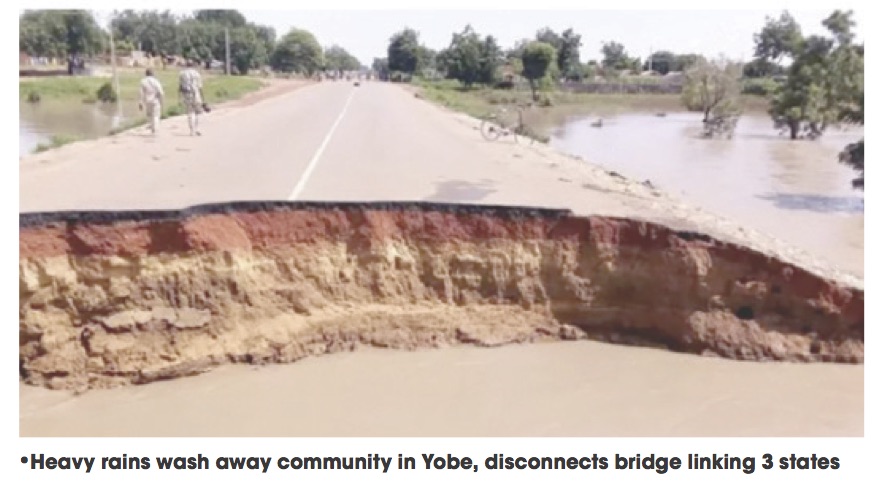
•Experts advise govt, insurers, farmers on mitigation steps
By Henry Uche [email protected]
Early January, this year, the Director General, National Emergency Management Agency (NEMA), Mustapha Ahmed, alerted Nigerians to brace up for severe flooding in 2023. He gave this warning following the Seasonal Climate Prediction (SCP) released recently by the Nigerian Meteorological Agency (NiMET), which forecasted that there would be ‘normal to above normal rainfall’ in some states of the federation, hence the need for the government and citizens to take steps to mitigate the impact of the expected floods.
NEMA’s boss said NiMet’s seasonal climate prediction helps NEMA conduct analysis of disaster risk implications and produce disaster early warning messages for the protection of lives and assets, adding that the unprecedented flood disaster in 2022 was an eye-opener, thus the agency intends to be proactive and intensify inter-agency collaboration to forestall any negative impacts.
His words, “The negative impacts of the annually recurring flood disaster in Nigeria could have been more devastating without the early warning information developed out of the NIMET SCP and downscaled to the various end-user agencies and the general public.”
With the hindsight of last year’s flood that devastated many communities across various states, Ahmed said it was imperative for states government to support their Emergency Management Agencies (SEMAs) to be operationally ready and also establish Local Emergency Committees (LEMCs) for grassroots participation in disaster management.
For the Director-General of NiMet, Mansur Bako Matazu,, “Flood is a natural event and with the increase in climate change activities there will be more floods. This is because climate change is due to increasing temperatures. With increased temperature, the atmosphere will be more pregnant with more water vapour.”
According to him, the rainfall onset date would likely be from March 2 in southern states while other parts could delay till around July 7, stressing that the annual rainfall amount was expected to range from 420 mm in the northern region to 3,253 mm in the coastal areas. Matazu called on everyone to embrace early action to maximise success and de-risk our human activities. He noted that with the NiMet new Act of 2022, “We are optimistic of effective collaborations going forward.”
NiMet report translated into three major languages: Hausa, Yoruba and Igbo, provides increased access and encourage wider uptake in the country. Part of the highlights is that the rainfall onset date is predicted to be earlier than the long-term average in most parts of the country. However, parts of Katsina, Zamfara, Kano, Jigawa, and Yobe in the north and Cross River, Ebonyi, Imo, and Rivers in the south are likely to experience a delayed onset.
It added that the Onset is expected to become established in early March from the coastal states of Bayelsa, Rivers, and Akwa Ibom; in April for the Inland States of the South; in May around the Central States and around July in the northern States. The onset dates will range from 2nd March to 7th July 2023. An early End of Season (EoS) is predicted over parts of the South (especially in Osun, Ondo, Edo, Delta, Imo, Bayelsa, Rivers, Akwa Ibom, and eastern parts of Ogun and Lagos) and parts of Yobe, Adamawa, Niger, Nasarawa and Kogi.
More so, part of the highlights was that the rainfall onset date is predicted to be earlier than the long-term average in most parts of the country. However, parts of Katsina, Zamfara, Kano, Jigawa, and Yobe in the north and Cross River, Ebonyi, Imo, and Rivers in the south are likely to experience a delayed onset.
The Onset is expected to become established in early March from the coastal states of Bayelsa, Rivers, and Akwa Ibom; in April for the Inland States of the South; in May around the Central States and around July in the northern States. The onset dates will range from 2nd March to 7th July 2023.
An early End of Season (EoS) is predicted over parts of the South (especially in Osun, Ondo, Edo, Delta, Imo, Bayelsa, Rivers, Akwa Ibom, and eastern parts of Ogun and Lagos) and parts of Yobe, Adamawa, Niger, Nasarawa and Kogi.
Speaking with the Head, Enterprise Risk Management, Compliance and Control, at Sanlam General Insurance Nigeria Limited, Modupe Akinwande, she advised the company’s policyholders, State governments and Nigerians at large to prepare for the foreseen natural incident.
According to her, Nigeria, like other countries has had its share of flood of varying degrees with serious impacts on the people, infrastructures, and economic activities.
The risks management expert said the warning issued by NEMA was apt as such one of the measures put in place towards effective flood risk management. “As stated by the Director General, it takes the cooperation of all stakeholders for the flood risks to be well managed as a country.
“Access to relevant Information to a risk event is the foundation to taking informed risk decisions. We all need to keep monitoring NEMA, NiMET and all relevant agencies as they provide information and guidance in this regard.
As an organization, she revealed that planned responses to various crisis has been documented in its business continuity plan, should any unplanned event/crisis occur. Her words, “With this early warning on flood, our response plan shall be further reviewed and updated, while needed precautionary exercises will be carried out to the extent possible in preparation for such incident,”
Akinwande maintained that as a backdrop to the contingency planning, the flood risk assessment with consideration for the hazards, possible exposures of our business, processes, and obligations to Sanlam various stakeholders in conjunction with its current vulnerabilities, shall be reviewed and updated accordingly.
“Sanlam General Insurance Nigeria limited, as a risk carrier, shall continue to maintain necessary reinsurance facility, to ensure we keep our promises to all our policyholders while being a trusted partner should they be impacted by the flood risks,”
To its policyholders and Nigerians at large, she advised that they pay attention to the warning, assess their current location based on past incidences and future predictions as may be indicated.
“Following the above mentioned, if you think that your home may be flooded, consider your personal safety first and whether it is necessary to evacuate your home as soon as possible. Then, stay informed of latest developments by following the news as issued by various agencies, especially NiMET and NEMA.
“Develop and maintain an emergency preparedness kit that will get you through the first 72 hours of an event. Move valuables, or essential items to a high place and consider moving your car to an area less likely prone to flood.
“Fit any property level resilience measures you have such as flood gates or raising the barriers above the expected water level, where possible. Ensure strict adherence to all warnings and follow all advisory as issued by the government agencies from time to time for your safety.
“If your home and valuables are at risks, ensure you have adequate building or content insurance. You can check with your Insurance Agent / Broker or directly from your Insurer.
She added that Sanlam offers homeowners / householders comprehensive Insurance, as well as Fire and Special perils cover, depending on the need of policyholders and desired scope of cover. “Our comprehensive motor Insurance cover is also available for your vehicles. Should there be damage, you shall be duly compensated, in line with the terms and conditions of your policy as agreed at the time of incepting the cover”
She advised State government to work with insurance experts in planning against the flood and other risk management. “State governments collaboration with NEMA will set the tone for the coordinated response that each state will get. It is in the interest of the state government to work with NEMA to put in place all necessary measures to prepare the good people of Nigeria for the imminent flood crisis.
“Both human and financial should be dedicated to this course. Consideration should also be given to careful risk assessment within their various jurisdictions considering the hazards, the exposures, and their vulnerabilities.
“In the immediate, they can start by reviewing structures impeding free flow of water, mark them for demolition and the affected citizens compensated.
Given the effect of blocked drainages on severity of flood, immediate action should be taken to ensure free flow of the drainage system. A special task force that will be saddled with the responsibility of keeping the states clean, can also be inaugurated.
“Overall, they should be deliberate this time around and have a proper and well-resourced contingency plan to mitigate the impact of flood, when it occurs. The dedicated state department should act as the champion for the state to disseminate and coordinate the planning and response during the season. Recall Benjamin Franklin ‘s popular quote ‘By failing to prepare, you are preparing to fail” she asserted.
Similarly, the Assistant General Manager, Technical Operations, Sovereign Trust Insurance Plc, Tajudeen Rufai, affirmed that there was need for stakeholders to approach NEMA to find out what they are planning towards the prediction with the aim of mitigating the effect of the flooding.
According to him, this was necessary to know where to focus attention on and at the same time shape action plan to deal with the situation.
In preparation for the imminent floods, he confirmed that its members of staff will be immediately sensitised to be aware of the challenges and be prepared to support policies geared towards dealing with same.
The Technical Operations expert noted that training program may be organised to further enlighten members of staff on the causes, effects, prevention, and mitigating measures to adopt to enable them be in a good position to advise existing and prospective clients.
The risk management expert noted that it was imperative to identify all agencies of government that will be involved in dealing with this issue and the area of activities of each agency, saying that such would enable insurers to know who to contact and for what to assist in planning towards the envisaged flooding.
Nevertheless, he said, “We can prepare for this by Identifying insurance policies/ covers covering flood damage for review of terms and conditions of cover. We can Identify the clients and /or property located in the areas already marked to be affected by severe flooding for the purpose of offering them advice that will suit the manner of dealing with the peculiar nature of flooding challenges to be faced by each client separately.
“We need to identify the agencies of government that will be monitoring the climate situation to enable the company get firsthand information about the development in the flooding situation with a view to change or amend already detailed plan of engagement.
“We need to identify the agencies that will be responsible for provision and or upgrade of flood prevention infrastructure towards the intending severe flood situation.
“We should escalate the issue of severe flooding to industry level (Nigerian Insurers Association (NIA) and Nigerian Council of Registered Insurance Brokers (NCRIB)) for purposes of deliberation and fashioning collective measures to tackle the situation in view of how insurance transactions are structured.”