Follow Us on Google

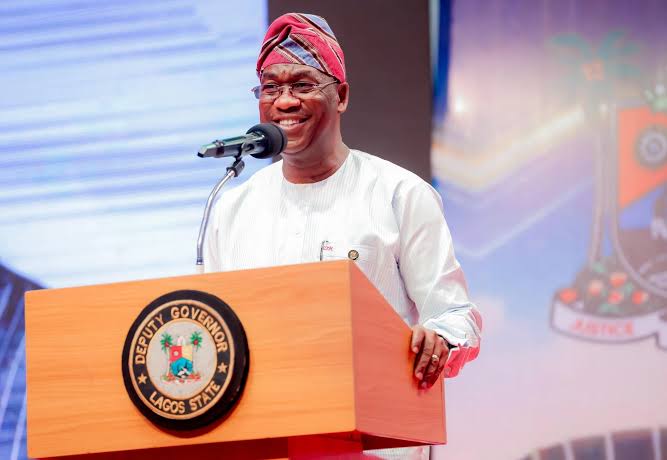
Lagos State Deputy Governor, Obafemi Hamzat, has called for the integration of moral education into the learning experience of students at all levels, warning that academic excellence without integrity, discipline and ethical values cannot deliver the national transformation Nigeria desperately needs.
Hamzat also advocated increased investment in teachers’ welfare and professional development, stressing that the quality of education could not be separated from the competence, character and motivation of those responsible for imparting knowledge.
He made the call on Wednesday while delivering the maiden convocation lecture of the Lagos State University of Education (LASUED), Oto-Ijanikin, Lagos, on the theme, “Education Without Character: The Missing Link in Nigeria’s Quest for National Renewal.”
The deputy governor argued that moral education should not be treated as an isolated subject or occasional classroom discussion but incorporated into the curriculum and daily experiences of students to produce graduates who are not only intellectually competent but also socially responsible.
“It should not be confined to a single subject or an occasional lecture. Values such as honesty, fairness, empathy, discipline, respect, and responsibility should be reinforced across the curriculum and through the daily experiences of students.”
Hamzat maintained that teachers must be adequately equipped to impart ethical values alongside academic knowledge, urging educational institutions to provide specialised training that would enable them to address contemporary moral and social challenges.
He said teachers should be prepared to facilitate discussions on ethical dilemmas, social responsibility, diversity and citizenship, while demonstrating the values expected of their students.
The deputy governor also called on universities and other tertiary institutions to strengthen mechanisms for enforcing academic integrity, warning that dishonest practices were undermining public confidence in educational qualifications.
“Plagiarism, exam malpractice, fraudulent research and the improper award of qualifications undermine the credibility of education,” he warned.
Hamzat stressed that educational institutions must demonstrate the principles they seek to instil in students, insisting that transparency, fairness, accountability and respect for human dignity should guide their administrative and academic activities.
He also advocated stronger collaboration between parents and schools, explaining that character development required consistency in the values taught at home and reinforced within educational institutions.
Other News
“Parents should be engaged in conversations about discipline, digital behaviour, academic honesty and the responsibilities of citizenship,” he said.
On the growing influence of technology, Hamzat urged schools to incorporate digital citizenship education into their programmes to prepare students for the ethical challenges associated with modern communication and artificial intelligence.
He identified privacy, consent, intellectual property, cyberbullying, misinformation, responsible artificial intelligence use and the consequences of digital misconduct as critical issues students must understand.
According to him, technological advancement without corresponding ethical responsibility could expose society to new forms of dishonesty, exploitation and abuse.
Earlier, Vice-Chancellor of LASUED, Bidemi Lafiaji-Okuneye, said the maiden convocation lecture provided an opportunity to examine the deeper purpose of education beyond the award of certificates and academic qualifications.
She explained that while convocation ceremonies celebrated academic achievement, the accompanying lecture challenged graduates and society to reflect on the responsibilities that came with knowledge.
“The ceremony honours achievement; the lecture asks what we intend to do with the achievement. It is therefore fitting that, on the eve of the first harvest of our institutional vision, we devote ourselves to the question: What should education make of the human person, and what should the educated person make of society?” she said.
Lafiaji-Okuneye maintained that Nigeria’s development required graduates who combined professional competence with honesty, integrity and a strong sense of public responsibility.
She said the country needed engineers who would not compromise public safety, professionals who would resist the diversion of public resources, communicators who would reject misinformation and teachers who would recognise the dignity and potential of every child.
The vice-chancellor stressed that the theme of the lecture extended beyond the university and the education sector, as the country’s future depended on the moral choices made by educated citizens in positions of responsibility.
She commended Lagos State Governor, Babajide Sanwo-Olu, and the state government for their vision and sustained support in transforming the former college of education into Lagos State University of Education.