Follow Us on Google
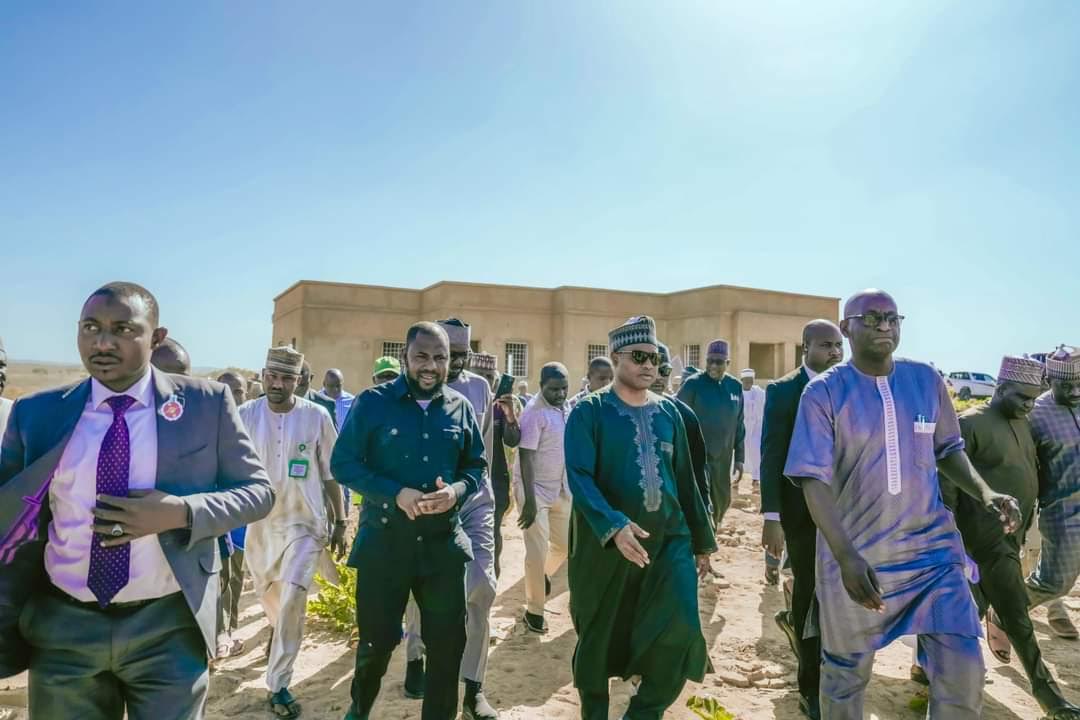
From Sola Ojo, Kaduna
Kaduna State Governor Uba Sani has been urged to use the existing social register to allocate the ongoing Qatar charity mass housing upon completion if truly they are meant for the masses.
The governor alongside his predecessor, Nasir El-Rufai had on June 9, 2023, visited the Ambassador of the State of Qatar, which led to a tripartite agreement with the Embassy of the State of Qatar to provide 500,000 mass housing for the less privileged and the construction of an Economic City in Kaduna.
On August 15, 2023, the doubting residents were disappointed when the Governor performed the groundbreaking of the Qatar Sanabil Project, initiated by Qatar Charity for the construction of the Kaduna Economic City and provision of mass housing for the less privileged in Kaduna State.
On January 21, 2024, the Governor inspected the ongoing construction of the first phase of mass housing (100) for the less privileged at Millennium City, Chikun Local Government area of the State.
One of the active citizens in the State and Team Lead, Coalition of Associations for Leadership, Peace, Empowerment and Development (CALPED), Mr. Yusuf Ishaku Goje, noted that shelter alongside food and clothing are the three most basic needs of life, hence, it was a welcome development.
Interestingly, he said, many people did not still believe that social housing was a key part of social protection, “what usually comes to mind when they think of social protection is only social assistance, social insurance and labor market interventions’.
To Goje, a look at the Multidimensional Poverty Index Survey by the National Bureau of Statistics, in 2022, shows that the State has 8.04 multidimensional poor, with 73 percent of households deprived of sanitary facilities and 39 percent of households by deprivation in housing materials-roofing.
He argued further that many did not know that section 16 (2,d) of the 1999 Constitution of the Federal Republic of Nigeria (as amended) mandates that the State shall direct its policy towards ensuring: that suitable and adequate shelter, suitable and adequate food, reasonable national minimum living wage, old age care and pensions, and unemployment, sick benefits and welfare of the disabled are provided for all citizens.
While State-specific data is not readily available, there are conflicting figures about Nigeria’s housing deficit. However, experts often quote between 17 and 21 million”, Goje said.
“The question before the administration is when the project is completed, will the less privileged be the real beneficiaries?
“Will the projects be equitably distributed to promote ethnoreligious social integration? What modalities are in place to ensure the process of distribution is not hijacked by the rich as well as politicised? He queried.
He continued, “the social register, which has a database of the poor and vulnerable in the State, should be used in targeting the beneficiaries to mitigate abuse of the allocation process.
“If the register is inadequate, rather than abandon it, it should be updated before time. This will ensure transparency in the allocation process. Likewise, it will show if there is equity in the process or not.
“In view of this and recognition that the State over the years has been polarised along religious lines, to enhance social integration, the allocation should ensure beneficiaries of the same faith are not next-door neighbours.”