Follow Us on Google
•Prison congestion, delayed access to justice dominate Enugu workshop
From Magnus Eze, Enugu

Administration of Criminal Justice in Nigeria has been riddled with hiccups leading to perennial congestion of custodial centres. It might not be safe to claim that there is any custodial facility in the country that is not overcrowded. Many inmates on the awaiting trial register have had to languish for no cause of theirs such that, in many cases, an inmate stays in prison for 15 years over trivial offences that could ordinarily have been addressed through non-custodial means or attracted a two-year jail term.

It was this development that led to the replacement of the Criminal Procedure Law (CPL) with the Administration of Criminal Justice Law (ACJL), following the enactment of the Administration of Criminal Justice Act (ACJA) 2015.
Barely six years after the ACJL took effect in Enugu State, stakeholders in the criminal justice sector there agree that not much has been achieved.
This came to the fore at a workshop organised in Enugu from September 28- to 29, 2023, by Law Hub Development and Advocacy Centre, a non-governmental organisation based in Abuja, with support from the MacArthur Foundation.
Executive director of Law Hub, Osita Okoro, said a similar project which focuses on “Popularizing and Disseminating the Administration of Criminal Justice Laws of States and Continuously Updating the Laws to Reflect Amendments” was also ongoing in Nasarawa, Kano and Adamawa states.
Represented by the project team moderator, Joshua Dada, the executive director thanked the MacArthur Foundation for the support granted them to execute the project and fill the vacuum left by the respective governments who, according to him, had allegedly ignored or relegated the development of the criminal justice system to the background.
He said the seeming apathy by government has led to the current state of insecurity, corruption, congestion and other hiccups in the justice system.
Setting the tone for the event, Okoro said: “The programme of today is to conduct an assessment of implementation of the ACJL in the state. Law Hub wants to know what aspects of the law have so far been implemented and what challenges have been experienced so far with its implementation.
“Law Hub would also want to know what sections of the law which have not been implemented and what struggles or challenges have been experienced with the implementing the said sections.
“The need for this assessment is for knowledge and experience sharing among others. Law Hub would like to learn lessons from the knowledge and experience of the stakeholders in the Enugu State justice sector which would in turn help the team in determining the kind of support which can be provide for the state during the life span of the project.”
Presentations from the various stakeholders in the administration of criminal justice system in the state outlined success stories and challenges as they relate to the establishments.
Pathetic details emerged from the Controller of Corrections, Enugu State Command, who was represented at the programme by Chiago Ugwu of the legal unit.
He lamented overcrowding, noting the urgent need for decongestion of custodial facilities.
He disclosed that efforts at ensuring safe, secure and humane custody of inmates were hampered by congestion experienced across all custodial centres in the state at Enugu, Nsukka, Oji River and the Ibite-Olo farm centre.
“In Enugu Custodial Centre this morning, we have 2,604 inmates as against its initial capacity of 638.
“Finally, the ACJL of Enugu State 2017, by S.538, established the Justice Sector Reform Team. The Honourable Chief Judge of Enugu State is the chairman and I most humbly enjoin Your Lordship to put needed machinery in motion so as to effectively and efficiently help in monitoring justice delivery, which will go a long way in decongesting our custodial centres.
“It is also suggested that our courts apply non-custodial alternatives in trivial offences so as to help in decongesting the custodial centres too,” Ugwu said.
Enugu State Commissioner of Police, Kanayo Uzegbu said the security agency is very central to the success or failure of the implementation of the ACJL in the state.
The police boss who was represented by a former officer in charge of the legal unit, Paschal Nwachukwu, an Assistant Commissioner of Police, said the security of life and property is a collective duty of everybody especially the stakeholders.
He mentioned that with the ACJL, suspects are no longer arrested or detained without telling them their offences/allegations against them; suspects are not detained arbitrarily without the orders of the courts, and where a suspect is not taken to court for lack of sufficient reason to believe he committed the offence, the property taken from him shall be returned.
He stated that it is unlawful to confiscate any personal belonging of a suspect linked to any crime.
Nwachukwu said the Judiciary had not complemented the effort of the Police in the terms of a Central Criminal Registry (CCR) by way of remitting or transmitting records of the convicted in all the Courts in Enugu State.
Section 67 (1) (2) & (3) of the Police Act 2020, places duty on the judiciary to enable remittance of courts decisions within 30 days to the police.
He further lamented that the Chief Magistrates in various magisterial districts in the state hardly visit police station cells, noting that this is also a way of decongesting police cells in line with the rule of law.
In addition, the police said that bearing the medical expenses and other bodily examination of suspects had become a clog in the wheel of investigation particularly in homicide cases. He stated that is the duty of state to foot the bill of coroner’s examinations and autopsy.
Moving forward, the police sought for adequate communication facilities to enable them communicate effectively with the families of the suspects or their counsels; proper equipping of the Central Criminal Registry Room.
The police also called for the provision of vehicles designated for court duty to convey suspects to court and to prison as well as improving facilities in the fingerprint section for character attestation and data of suspects sent to court and convicted.
The police further urged that criminal proceedings must as much as possible be accessible to the public, noting that it will guarantee the transparency and integrity of criminal justice process.
Interestingly, both the Police and the State Ministry of Justice agreed on the need to establish a functional witness support unit and fund by the office of the Attorney General and Commissioner for Justice of the State as stipulated in section 152 of ACJL.
“This shall fast tract the evidence of witnesses required during criminal trials in the state.
“Witnesses for prosecution and defense who appear in court either on recognizance or by virtue of a warrant or summons to give evidence against any arrested person is entitled to cost and expenses for compensation for his inconveniences and lost of time. See section 149, & 150 of ACJL.
“The Judiciary should adjust and come up with modalities for the enforcement of the various sections of the ACJL, bestowed upon them,” Nwachukwu said.
Mrs. Nnenna Nwomeh of the Ministry of Justice noted that much has been achieved since the enactment of the law, culminating in speedy trial of cases.
She stated that the challenges of frivolous objections and application for stay of proceedings in criminal trials hitherto experienced during the era of the Criminal Procedure Law has been made better by the provisions of Section 383 of ACJL, which provides that an application for stay of proceedings in respect of a criminal matter before the court shall not be entertained.
She, however, lamented the non-compliance with the provisions of sections 30 and 182 of the ACJL on reporting obligations of the Police and Correctional Service to the Attorney-General, saying that it had been zero compliance.
She further noted that funding has remained a bane in the effective and efficient prosecution of criminal cases.
“Starting from effecting arrest, investigation and prosecution and also, in each stage of either pre-trial, trial or post-trial of criminal cases, finances are involved. Though, Section 149 of the ACJL, 2017 provides for expenses of witnesses for the prosecution to be paid such reasonable expenses as may be prescribed by the Court, it is far from reality. Prosecutors of the Ministry of Justice find themselves paying witness expenses out of their own pockets,” she stated.
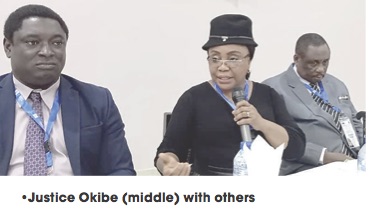
Notwithstanding the buck-passing, Justice L.C. Okibe said the judiciary was committed to the successful implementation of the ACJL in Enugu State.
She called for collaboration of all stakeholders in the criminal justice sector for speedy dispensation of justice.