Follow Us on Google
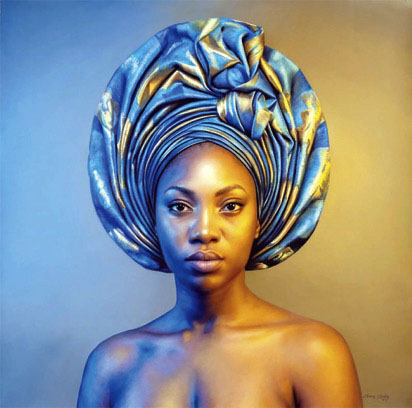
The beauty, cultural significance and expressive power of the Nigerian woman’s headgear take centre stage as Alexis Galleries presents Gele, a dual exhibition featuring contemporary artists Arinze Stanley and Dotun Popoola from October 24 to November 11, 2026.
Uche Obasi and Chidera Ogbu co- curated the exhibition said “ Bringing together hyperrealist drawing, painting and monumental metal sculpture, the exhibition explores the gele as more than a fashionable accessory. It examines the headgear as a symbol of womanhood, identity, self-expression and cultural heritage, drawing attention to the beauty and individuality of the women who wear it.”
Popular at weddings, religious gatherings, festivals and other significant occasions, the gele has become a familiar feature of Nigerian social life. Yet, beneath its elaborate folds, vibrant colours and dramatic forms lies a deeper story about how women present themselves and communicate confidence, dignity and personal identity.
Through their distinct artistic approaches, Stanley and Popoola reinterpret this familiar cultural symbol, transforming it into a powerful visual statement about Nigerian women and the communities to which they belong.
Stanley, a Lagos-based visual artist known for his hyperrealist drawings, said the Gele series represents a significant shift in his artistic practice. His earlier works, including The Machine Man and Bullets and Denims, explored social challenges affecting young Nigerians, including police brutality. His recent works, however, increasingly celebrate the colourful and beautiful aspects of Nigerian society.
He described the series as an expression of love and appreciation for women, particularly the way they adorn themselves and carry their gele with the confidence of queens.
“For me, the gele is a crown worn by every queen,” he said, explaining that its significance lies partly in the freedom women have to choose how they style and present themselves.
Stanley added that the gele also represents a shared cultural experience that transcends ethnic boundaries. Rather than concentrating exclusively on issues that divide Nigerians, he believes artists should also highlight the traditions, experiences and cultural expressions that unite them.
His engagement with the subject has consequently expanded his artistic vocabulary. Previously known predominantly for monochromatic drawings executed with charcoal and graphite, he has increasingly experimented with colour, texture and mixed media.
The Gele series, he explained, has been instrumental in this transformation, encouraging him to explore possibilities beyond his established techniques. For the forthcoming exhibition, he will present five works, comprising four drawings and a sculptural installation that marks his first venture into sculpture.
Stanley acknowledged Popoola’s influence on the project, noting that his fellow artist originally proposed the idea. Although the exhibition was conceived several years ago, competing schedules and other commitments delayed its realisation.
The eventual presentation, he said, fulfils a shared ambition to celebrate the beauty surrounding them and create works that audiences would remember.
For Stanley, the subject is also deeply personal. His understanding of the gele does not depend primarily on academic interpretations or historical scholarship but on everyday experiences within his family and community.
Other News
His mother, sisters and wife wear the headgear, making it a familiar part of his immediate environment. Through his artistic perspective, he seeks to document and appreciate how Nigerian women use it to express themselves.
“I have always seen the world as an artist through my lens, so I want to tell stories that I love through my works that mean something to me,” he said.
This personal connection informs the series’ treatment of colour and form. Drawing inspiration from the bold palettes associated with Nigerian celebrations, including events such as Ojude Oba, Stanley uses saturated colours to reflect the visual richness of the gele.
The exhibition presents different styles, shapes and colours, allowing the headgear’s versatility to emerge through his compositions. One of the works features a white gele, while others explore the possibilities of pastel and acrylic alongside his evolving drawing techniques.
Stanley said his exploration of colour was also encouraged by artists who participated in a residency programme at his studio. While his works remained largely black and white in 2021, some resident artists experimented with colour, prompting him to reconsider his approach.
He described the development as a convergence of influences that eventually led him from pencil drawings towards sculptural experimentation.
Popoola approaches the subject through monumental metal sculpture, transforming the female figure and her headgear into commanding forms. Working with scrap metal, he constructs sculptures that give physical weight and architectural presence to the familiar folds of the gele.
One of the works featured in the exhibition depicts a matriarch wearing a glossy red gele that spreads behind her head like a regal crown. Gold filigree patterns and a long, tassel-like golden detail accentuate the sculpture, reinforcing its sense of grandeur.
The contrast between Stanley’s intimate portraits and Popoola’s monumental figures offers complementary interpretations of the same cultural symbol. While Stanley draws attention to the expressions and inner lives of individual women, Popoola emphasises their commanding presence through scale, material and sculptural form.
Co-curated by Uche Obasi and Chidera Ogbu, Gele invites audiences to look beyond the headgear’s decorative appeal and consider its relationship with identity, tradition and contemporary expression.
For both artists, the gele is not merely something a woman wears. It is a cultural statement that acquires meaning through the woman herself.
Through their works, Stanley and Popoola celebrate this enduring symbol while demonstrating how familiar Nigerian traditions can inspire fresh artistic interpretations. The exhibition ultimately positions the gele as both a marker of cultural continuity and a testament to the confidence, creativity and individuality of Nigerian women.