Follow Us on Google
By Christy Anyanwu
A conversation with environmental scientist and chemical engineer Temitope Isaiah Asefon on water-quality source tracing, industrial contamination prevention, quality assurance and translating environmental research into practical public-health protection.
Environmental scientist and chemical engineer Temitope Isaiah Asefon is focused on a problem that sits at the intersection of science, industry and public health: how to detect environmental risks early and prevent them from becoming larger crises. With experience spanning industrial production, environmental health and safety, quality assurance, academic research and municipal environmental work, Asefon uses environmental data, water-quality monitoring and analytical tools to identify pollution sources and strengthen contamination controls. In this interview with Christy Anyanwu, he discusses his research, the importance of water-quality source tracing, the role of data analytics in industrial operations and why effective environmental monitoring must ultimately lead to prevention.
Please introduce yourself and describe the area you work in.
My name is Temitope Isaiah Asefon. I am an environmental scientist and chemical engineer whose work spans environmental health and safety, quality assurance, water-quality monitoring, pollution-source identification, contamination control and risk management.
I hold a Master of Science in Environmental Science from Youngstown State University, as well as graduate training in Environmental Control and Management and a bachelor’s degree in Chemical Engineering from Obafemi Awolowo University.
My career has taken me through industrial production, environmental health and safety, academic research and municipal environmental work. The common thread is prevention. I am interested in how chemical, microbiological, environmental, statistical and process data can be combined to identify risks early, understand their sources and support corrective action before they become larger environmental or public-health problems.
You began in chemical engineering and industrial production. What moved you towards environmental science?
It was less a departure from chemical engineering than an expansion of it. Chemical engineering taught me to think in terms of processes, material flows, reactions, operating conditions and control. Working in production and environmental health and safety made the consequences of those processes much more concrete. A deviation is not only an efficiency problem; depending on the process, it can become a worker-safety issue, an environmental release, a water-quality problem or a product-quality concern.
Environmental science gave me the tools to follow those effects beyond the process boundary. I became especially interested in water because it connects industrial activity, ecosystems, communities and public health. That eventually led to my graduate research on pollution-source identification in the Mahoning River watershed.
Your master’s research examined chloride and bromide in the Mahoning River watershed. What were you trying to understand?
I was trying to answer a practical question: when water chemistry changes, can we use patterns in the data to learn something about where the pollution may be coming from?
Chloride is useful for water-quality monitoring, but it can enter a watershed from several sources. Looking at chloride alone may therefore tell you that conditions have changed without clearly telling you why.
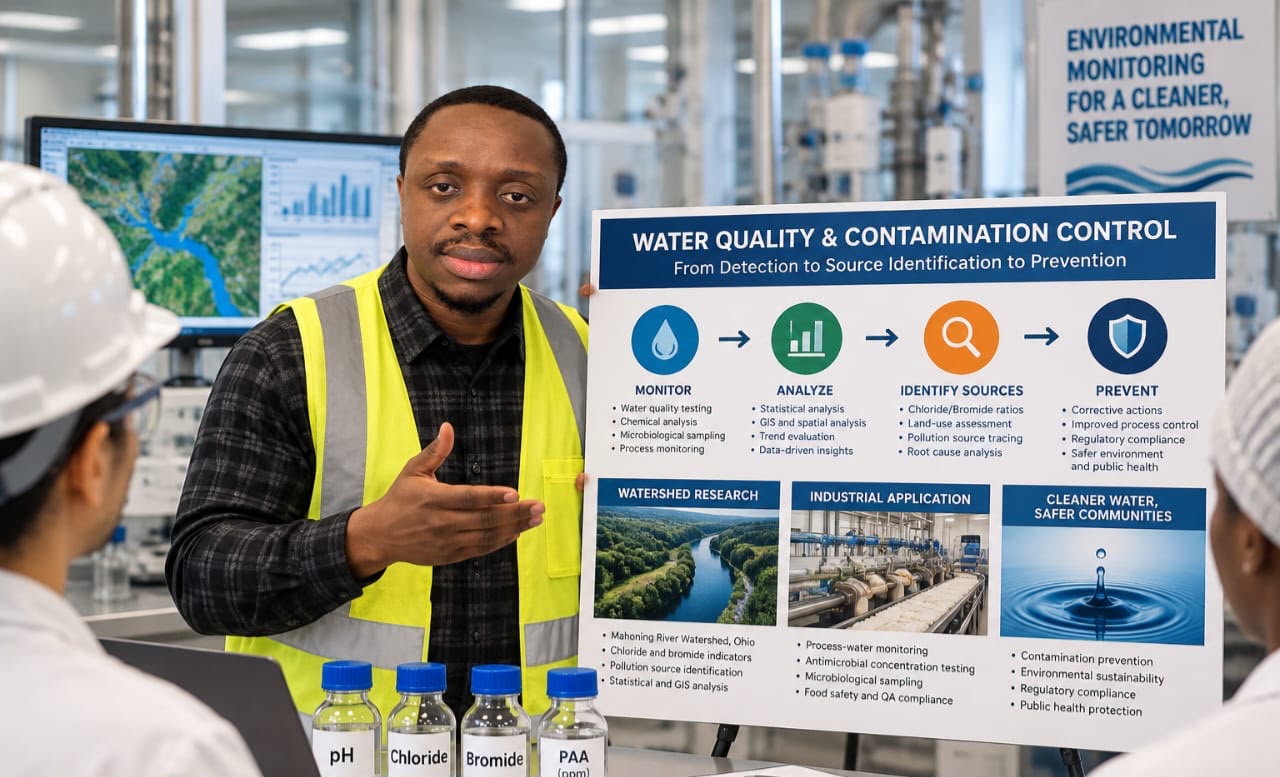
My thesis, “Utilizing Chloride and Bromide Levels as an Indicator of Water Quality in the Mahoning River Watershed,” examined chloride and bromide together and used their relationship as part of a source-tracing approach. I also incorporated statistical analysis and GIS-based watershed information.
The objective was not simply to report concentrations, but to develop a more informative way of interpreting water-quality measurements in the context of potential pollution sources.
Why does pollution-source identification matter?
Because detecting contamination and understanding its likely source are two different problems. Detection tells you where to look more closely. Source identification helps determine what intervention may actually work.
If the same water-quality signal can be associated with several human activities, responding without additional evidence can waste time and resources. I am interested in combining chemical indicators with statistical patterns, spatial information, land use and process knowledge so that monitoring becomes more useful for prevention and corrective action.
The closer we can get to the source and pathway, the better positioned we are to control the problem rather than repeatedly responding to its symptoms.
You presented this research at the 2024 Water Management Association of Ohio Conference. What did that experience add?
Presenting the work at the 53rd Annual WMAO Conference in Columbus allowed me to discuss the research with people working directly in water management, environmental monitoring and related technical fields.
A poster presentation is useful because people can challenge the assumptions, ask how a method might work in another setting and point out practical considerations that are easy to miss when you are focused on your own dataset.
It also reinforced something that now shapes my work: a monitoring method becomes more valuable when it can be communicated, tested, adapted and used outside the original study. I want my research to contribute to practical environmental decision-making, not remain only an academic exercise.
Your publications also address data analytics in water treatment and synergistic approaches to water-pollution mitigation. How do these studies fit together?
They reflect the same broader question from different angles: how can we use better evidence to prevent or reduce environmental harm?
My work on data-driven techniques in water-treatment facilities looks at how data analytics can support safety protocols and optimisation. My work on synergistic chemical and ecological approaches considers pollution mitigation more broadly.
The connection is that environmental problems rarely respond to one measurement or one intervention. Chemical monitoring, ecological understanding, process controls, statistics and operational data can complement one another. I am interested in building frameworks that connect those pieces so that environmental and industrial systems can be managed more proactively.
Your proposed work emphasises integrating environmental monitoring with industrial process control. What would that look like in practice?
I envision an integrated framework in which water-quality measurements, chemical-control data, microbiological results, process conditions, statistical analysis and, where appropriate, geospatial information are evaluated together rather than in separate silos.
For example, a recurring deviation in a water-intensive operation should not be treated only as a single failed measurement. Historical trends, process conditions, sanitation data, chemical concentrations and microbiological results may reveal patterns that help identify the underlying source.
Over time, that can support earlier warning, stronger root-cause analysis, better corrective and preventive actions, and more efficient use of water and treatment chemicals.
Why are water-intensive food-processing operations an important setting for this work?
Water is involved throughout food processing—in washing, chilling, sanitation, antimicrobial applications, equipment cleaning and other process steps. That means water quality and process-water control sit at the intersection of product safety, worker practices, chemical management, environmental performance and public health.
The challenge is that these systems generate a large amount of operational information, but information only becomes useful when it is interpreted in a way that supports action.
I am interested in helping turn routine monitoring into a stronger contamination-prevention system rather than treating each measurement as an isolated compliance record.
What role do microbiological monitoring and chemical controls play in contamination prevention?
They provide different but complementary information. Chemical controls, such as verifying antimicrobial concentration and pH, tell us whether an intervention is operating within its intended range. Microbiological sampling provides evidence about contamination and the effectiveness of control measures. Sanitation and process observations add another layer.
The strongest approach is to interpret these together. A microbiological result may prompt us to look at chemical concentration, process conditions, sanitation or other potential contributors. Likewise, a chemical deviation may indicate a need for additional verification.
The goal is to build a chain of evidence that supports timely and defensible corrective action.
You have worked in municipal environmental health, industry and academia. How has that range shaped your perspective?
It has shown me that the same environmental problem looks different depending on where you stand. A regulator or municipal environmental professional may focus on exposure and compliance. A laboratory focuses on measurement quality. An industrial operation focuses on keeping a process under control. A researcher asks whether the pattern can be explained and generalised.
I try to connect those perspectives. My experience in environmental sampling, laboratory work, EHS, production and teaching helps me think about whether a method is scientifically sound, operationally realistic and useful to the people who have to make a decision from the result.
What have you learned from environmental field sampling and laboratory work?
That data quality begins long before statistical analysis. Sample collection, preservation, instrument condition, calibration, documentation and consistent procedures all affect whether a result can be trusted.
My work has involved water and soil sampling and instruments such as pH meters, spectrophotometers, dissolved-oxygen probes and filtration units.
That experience has made me careful about data-driven claims. A sophisticated model cannot rescue unreliable measurements. Before asking what a dataset means, I want to know how the data were produced and whether the process was controlled well enough to support the interpretation.
How does being a Lean Six Sigma Black Belt influence your environmental work?
It makes me think about implementation. Environmental science can identify a problem, but improvement requires a structured way to define the problem, measure it, analyse causes, implement changes and verify whether those changes worked.
Lean Six Sigma is especially compatible with the way I think about monitoring because it emphasises variation, root causes, measurable improvement and control.
This skill is useful when an environmental or contamination-control idea has to move from a technical recommendation into an operational system.
You have begun communicating with researchers whose work covers wastewater treatment, hydrogeology, pollutant transport and environmental health. Why is collaboration important?
Because contamination problems do not respect disciplinary boundaries. Chemistry may identify a signal, hydrogeology can explain movement, environmental engineering can address treatment, GIS can add spatial context, statistics can identify patterns and public-health analysis can explain why the exposure matters.
I have been interested in collaborations that bring those perspectives together. A method developed in one watershed or industrial setting should be tested carefully before it is assumed to work elsewhere.
Collaboration makes that possible because researchers with different expertise can examine the same problem from different directions and identify limitations that one person might miss.
What role do you see data analytics and technology playing in environmental monitoring over the next five years?
I expect monitoring to become more integrated and more predictive, but I think the important issue is not simply collecting more data. Facilities and environmental programmes already generate large amounts of information. The challenge is connecting the right measurements and turning them into decisions.
Statistical trend analysis, GIS, automated data logging, dashboards and, eventually, more advanced predictive methods can help identify patterns earlier. But technology should strengthen measurement and judgment, not replace them.
A dashboard is useful only if the underlying data are reliable and the person using it understands what action a change in the signal should trigger.
What informed your choice of study and professional direction?
My path has been shaped by the connection between engineering systems and their environmental consequences. Chemical engineering gave me the process foundation. Environmental Control and Management broadened that towards environmental protection, and my M.S. in Environmental Science at Youngstown State University allowed me to focus directly on watershed monitoring, source tracing, GIS and environmental data analysis.
My professional experience then added the implementation side: production, EHS, regulatory compliance, municipal environmental work, laboratory practice and quality assurance.
I chose this direction because I want to work on environmental problems at the point where scientific evidence can still change an operational decision.
How do you define success in your work?
Success is when monitoring leads to prevention. A technically accurate report matters, but I want the information to change what happens next—an earlier investigation, a corrected process condition, a prevented exposure, a reduced contamination risk or a better-designed control.
In the longer term, I would like to develop and validate monitoring and contamination-control approaches that can be adapted beyond one facility or one watershed.
If a method helps organisations identify problems earlier, use water and treatment resources more intelligently, strengthen environmental compliance and protect public health, then the work has moved from measurement to impact.