Follow Us on Google
By Chukwuma Umeorah
Human capital is one of the most crucial investment any individual, business, or organisation could make in our world today. In a continent where economic transformation depends not only on infrastructure or policy but on people, the deliberate cultivation of talent has become both a necessity and a strategy for survival. Across Africa, the banking landscape is changing fast. Technology, shifting demographics, and a relentless push for innovation continue to redefine what it means to lead in the financial services industry. At the centre of this transformation stands a new generation of professionals who understand both the numbers and the nuances of a modern economy.

On October 19, 2025, the United Bank for Africa (UBA) Plc demonstrated its commitment to grooming such leaders as 700 young professionals graduated from its Graduate Management Accelerated Programme (GMAP) in Lagos. It was more than a ceremony; it was a statement of continuity and conviction, a reminder that the future of African banking will not be built by chance, but by design.


UBA’s Group Chairman, Tony O. Elumelu, who mounted the podium to address the graduates, now full-time employees spoke from a point of self reflection, having once walked the same uncertain path into corporate life. His words, though simple, mirrored his personal experience. “We are happy to have you as part of this tribe. At UBA, we strongly believe in the transformative power of young people, and that is why we designed this programme that allows us to transfer the baton of knowledge and experience onto others.”
For the billionaire investor and proponent of Africapitalism, youth empowerment is not a buzzword. It is strategy. The GMAP, he told them, embodies the bank’s belief that leadership must be cultivated deliberately and handed forward with trust and accountability. “A few decades ago, I started out just like you, fresh out of the university,” he recalled. “And I am glad that this organisation is providing for you that same opportunity that I got. I look forward to seeing you guys prove your worth.
“It’s not just about making money. It’s about taking advantage of opportunities to advance our aspirations. We are all equal partners. We are all fellow stakeholders. We are all part of the same institution. So keep everything clean. I don’t need to be a CEO to come up with ideas. Up to my level, certainly not. So you all, please, take this, and I look forward to receiving exciting, inventive ideas and recommendations from all of you.”
This charge, served as a clear reminder that UBA’s idea of leadership begins with ownership. In that hall, filled with hundreds of newly minted professionals, the message landed like a baton being passed in a relay that never really ends.
Elumelu gave a word of advise to the young professionals saying, “Anything that you think is good, based on the training and orientation that you got, that we need to do to advance our aspirations, feel free to share that., We are all equal drivers. We are all fellow stakeholders. We are all equal partners.”
Also addressing the professionals was the Group Managing Director/Chief Executive Officer, Oliver Alawuba, who took the podium to further expand on the company’s trajectory. “This is not merely a graduation ceremony; it’s a celebration of potential, perseverance, and purpose.”
He reminded the graduates of the demands of their journey: a six-month learning curve combining classroom sessions, digital simulations, field projects, and on-the-job immersion. “You’ve been exposed to the UBA way, where excellence is not optional, but expected. Where integrity and teamwork define our culture, and where every challenge is viewed as an opportunity to lead. This program reflects our belief that Africa’s future will be shaped not by chance, but by capable and courageous leaders like you.”
Across the audience, heads nodded. Many had spent long nights studying financial models, balancing credit analysis assignments with field work, learning to sell ideas as persuasively as products. It was a process that, as Nweke put it, had “stretched, tested, and transformed” them not only as professionals but as members of the UBA family.
To UBA, leadership development is not an HR function; it is a corporate imperative. The bank’s over 75-year-old legacy is built on the understanding that no institution can outlive the quality of its people. And so, every cohort of GMAP graduates represents both an investment and a renewal, a fresh infusion of skill, curiosity, and courage into an organization that operates across 20 African countries and major global financial centres.
Nweke urged the graduates to embody that ethos as they enter the workforce. “As you transition from trainees to full-fledged professionals, take ownership of your careers. The next phase is not about waiting to be told what to do; it’s about showing initiative, demonstrating value, and leading with impact wherever you are posted to work. Be curious, be hungry, keep learning, challenge the norm, and above all, stay anchored to the values that make UBA unique.”
For the Group Head of Human Resources, Modupe Akindele, the GMAP is more than a recruitment exercise. It is a leadership pipeline built to outlast generations. “The GMAP birth was from an initiation from the Group Chairman,” she explained. “All through his own experience, within 12 months of joining a similar programme, he became a branch manager. So we’re re-democratizing that luck.”
Her words, precise but warm, echoed a deep belief in people. “We believe that in building succession and in building for Africa, you have to capture its young. You have to start to build character, to build personalities who can lead. These are the people who will become our future leaders in UBA. They are coming to innovate, to create, and to take financial services to a different level.”
Akindele described a selection process designed to mirror the real world of banking: competitive, merit-driven, and demanding. “We open applications to everybody,” she said. “Whoever feels that they have the capacity to join or value to give to UBA can apply. We receive thousands of applications, but only a fraction make it through. They go through assessment centers, workplace simulations, and interviews with our executive directors before they are admitted into the academy.”
Once inside, the work begins. “The academy runs a six-month process, one week in the classroom and three weeks on the job, and it’s intense. Not everyone who gets in succeeds. But those who do graduate ready to fill critical roles within the organization, with a clear career path to succession.”
For Akindele, it is all part of a long-term plan to build continuity. “We’re more than a bank,” she said. “We’re an institution that wants to create value for Africa as a whole. And these young men and women are the ones who will take this value and vision that we have for Africa to the next level.”
Among the graduates, the stories were as diverse as the countries they came from. Some had left behind comfortable jobs to pursue a career they believed offered more purpose; others were first-generation professionals breaking family boundaries. But the unifying thread was transformation of thought, of discipline, of identity.
For Ayomitide Ebo, who recieved the award of Top Performer (Overall) for Cohort 18, the journey had been nothing short of life-changing. “The training has been rigorous, but it has been transformative also,” she said. “We went through a series of assessments and a six-month banking school, and today we are being graduated to join the tribe. I’m so glad to be part of the tribe of excellence, and I hope to contribute more to take the brand higher and to make it Africa’s global brand indeed.”
On her part, the Top Performer (Overall) for Cohort 17, the experience was just as meaningful. “It has been challenging, sleepless nights,” she recalled. “I’m happy that it paid off. To work in UBA is something I’ve always admired since I was young. I’m just happy that everything paid off for me.”
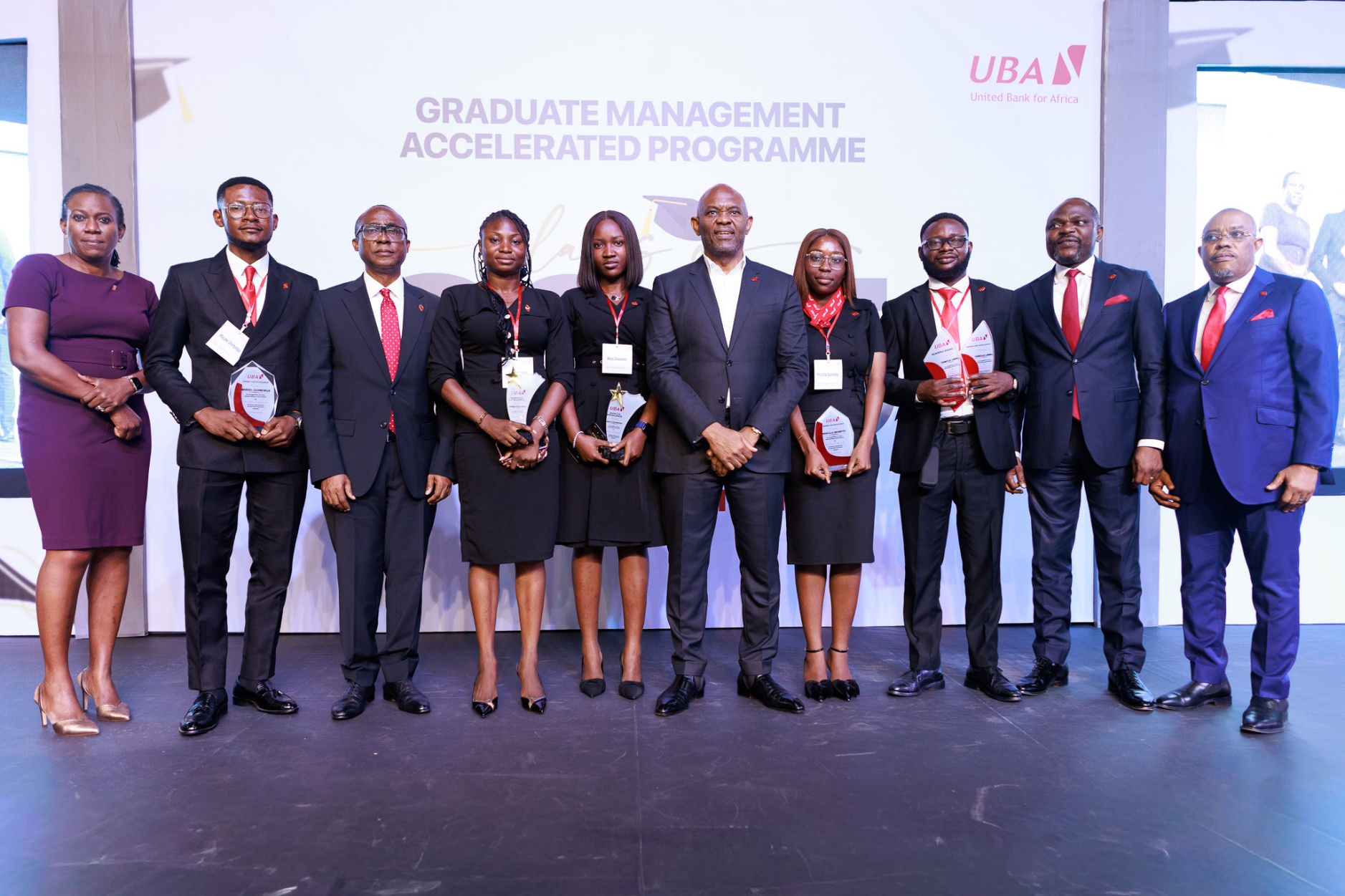
Awards were also presented to other outstanding individuals including Ahmed Ibrahim who was recognised as the Top Performer in Treasury category (Cohort 17), Damola Lawal clinched the award for Top Performer: On the Job Training category. Other graduands who performed exceptionally were also recognised and awarded in several other different categories.
The pride in their voices spoke volumes about what the GMAP represented. In a continent where youth unemployment remains a persistent challenge, UBA’s decision to invest in human capital stands as both a business strategy and a social commitment.
Since its inception just over three years ago, the GMAP has graduated more than 4,000 young professionals, many of whom now occupy key positions across UBA’s subsidiaries and other industries. The programme has become a model for talent acceleration within Africa’s financial ecosystem, a proof that structured mentorship and merit-based opportunity can redefine the future of work on the continent.
As the event drew to a close, and graduates lined up for their photographs and networking. One could sense the gravity of what has taken place. This was not merely about banking. It was about continuity, culture, and the courage to trust the next generation.
As the day drew to an end, 700 young Africans stepped out of the hall with certificates in hand and purpose in their stride. They were no longer trainees; they were trailblazers bearing an enduring legacy and proof that the future of African banking is already here.