Follow Us on Google
From Aloysius Attah, Onitsha
Issues surrounding Fragile X genetic disorders were recently brought to the fore during a virtual capacity-building workshop for healthcare workers drawn from the six geopolitical zones of Nigeria.
Fragile X disorders include Fragile X syndrome (FXS), an inherited genetic condition that causes physical abnormalities, behavioural challenges and a wide range of health problems such as developmental delays, intellectual disability, learning difficulties, anxiety, attention-deficit hyperactivity disorder and autism spectrum disorder.
It is recognised as the most common inherited cause of intellectual disability. Premutation-associated conditions (FXPAC) may lead to premature menopause, infertility, anxiety, depression, chronic pain and other mental health challenges in women, as well as tremors, dementia and other neurological problems in both men and women.


Targeted treatments are now available to help improve symptoms, while research into gene therapy is ongoing.
Globally, Fragile X syndrome is estimated to affect about 1 in 5,000 males and 1 in 4,000–7,000 females. With Nigeria’s population exceeding 200 million, experts estimate that tens of thousands of individuals may be living with the condition undiagnosed.
Fragile X syndrome affects children’s intelligence, mental health, physical features and behaviour. Common manifestations include learning and comprehension difficulties, delayed communication and social interaction, and delays across developmental domains. Intelligence quotient (IQ) scores are often below age expectations, with delayed development of nonverbal communication skills such as gestures, body language and facial expressions, as well as language-processing challenges.
The CHAMP-FX Virtual Capacity-Building Workshop on Fragile X Disorders and Screening Methods for Healthcare Workers in Nigeria — the first structured national initiative of its kind — was designed to strengthen healthcare workers’ capacity for early recognition, screening, diagnosis and referral of Fragile X disorders.
The workshop coordinator and Principal Investigator of the CHAMP-FX project told Sunday Sun that CHAMP-FX stands for Advancing Mental Health and Well-being of Nigerian Children through Public Health Screening for Fragile X Disorders. It is a TETFund National Research Fund–supported multi-centre project involving partner institutions across the six geopolitical zones of Nigeria, with academic coordination based at Nnamdi Azikiwe University, Awka.
She explained that the CHAMP-FX team comprises multidisciplinary experts from across the country.
The workshop was conducted as part of the TETFund-supported CHAMP-FX project, which represents Nigeria’s first structured national programme integrating Fragile X screening research with coordinated healthcare worker training across the six geopolitical zones.
Delivered over two days via Google Meet, the programme engaged 147 healthcare workers from diverse professional backgrounds across Nigeria. Participants benefited from expert-led sessions addressing the spectrum of Fragile X disorders, gaps in awareness and screening, challenges of case recognition in low-resource settings, and ethical and counselling considerations.
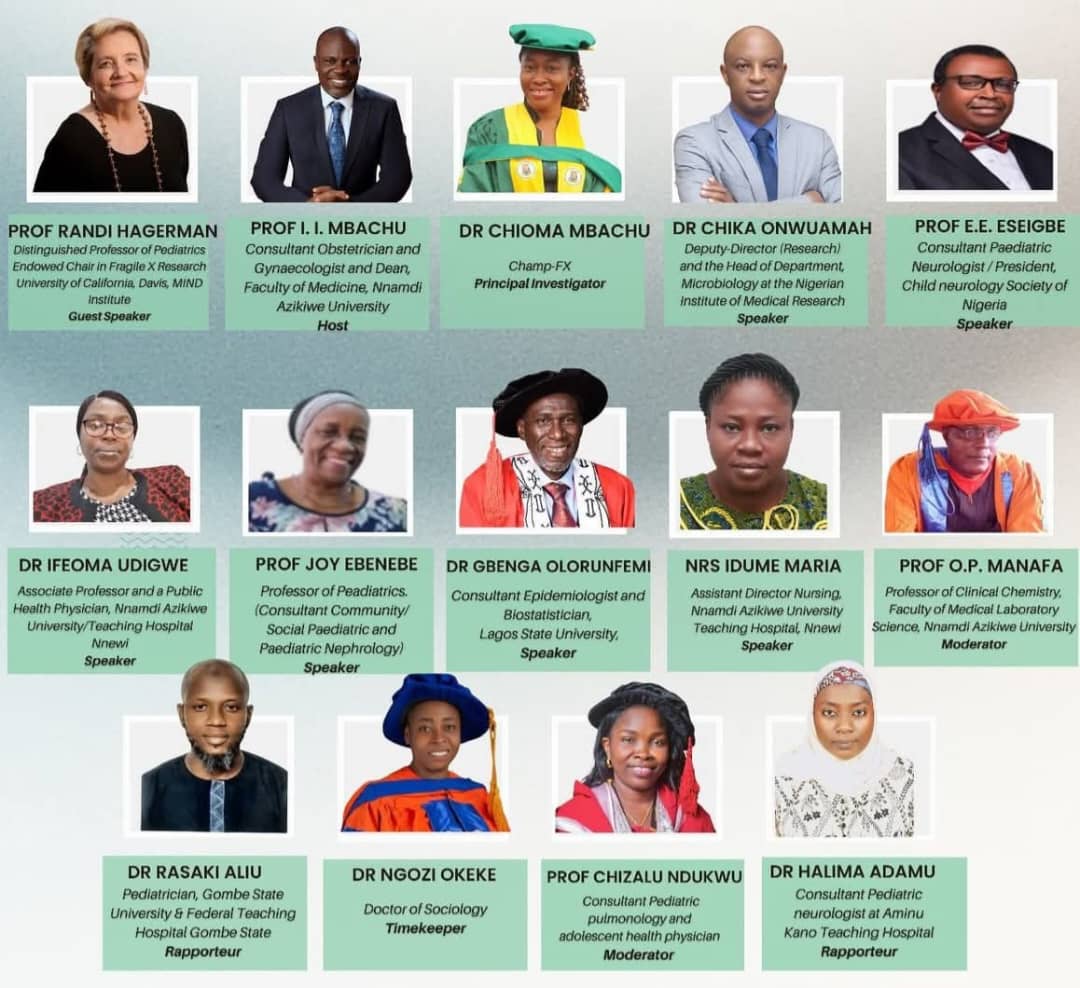
The workshop brought together a multidisciplinary faculty of experts, including Prof. Ikechukwu Innocent Mbachu; Prof. Edwin Ehi Eseigbe; Prof. Chizalu Ifeyinwa Ndukwu; Prof. Joy Chinelo Ebenebe; Prof. Randi Hagerman of the UC Davis MIND Institute, USA; Dr. Ifeoma Udigwe; Dr. Halima Adamu; Dr. Chika K. Onwuamah of the Nigerian Institute of Medical Research; Dr. Gbenga Olorunfemi; Mrs. Maria-Regina Chidiebere Idume; Dr. Ngozi Okeke and other clinical, laboratory and public health specialists who served as speakers, moderators, rapporteurs and facilitators.
The virtual format enabled wide participation, ensuring broad reach and effective knowledge dissemination.
Training was also provided on screening and diagnostic processes, including dried blood spot (DBS) collection and storage, laboratory workflows from DNA extraction to Oxford Nanopore sequencing, and essential principles of data analysis. Interactive question-and-answer sessions further enhanced participants’ understanding.
Providing further insight, the Principal Investigator, Dr. Chioma N. P. Mbachu, a Consultant Paediatrician and neurodevelopmental specialist, explained that Fragile X disorders are inherited genetic conditions caused by abnormalities in the Fragile X Messenger ribonucleoprotein 1 gene (FMR1) gene on the X chromosome.
“They result from expanded cytosine-guanine-guanine (CGG) repeats that disrupt production of a protein essential for normal brain function. The spectrum includes Fragile X syndrome and premutation-associated conditions such as Fragile X–associated tremor/ataxia syndrome (FXTAS), Fragile X-associated neuropsychiatric disorders (FXAND), and Fragile X–associated primary ovarian insufficiency (FXPOI), with symptoms ranging from intellectual and learning difficulties to neurological and reproductive problems,” she said.
Dr. Mbachu noted that these disorders remain significantly under-recognised and under-diagnosed in Nigeria.
Participants acknowledged that limited awareness among healthcare workers, weak screening pathways and constrained access to diagnostic methods have led to delayed identification, missed opportunities for early intervention and inadequate family counselling.
She said the CHAMP-FX project was developed to address these gaps by strengthening human and institutional capacity for recognition, screening and diagnosis of Fragile X–related disorders in Nigeria, in line with TETFund’s mandate to support research, innovation, capacity building and infrastructure in public tertiary institutions.
The workshop followed a structured agenda combining expert presentations, interactive discussions, assessments and practical demonstrations.
Day One focused on foundational knowledge, including the burden of Fragile X disorders in Nigeria, gaps in awareness and screening, research priorities and challenges in low-resource settings. A pre-test assessment established baseline knowledge.
Day Two emphasised applied competencies, covering community engagement, ethical and counselling considerations, emerging treatments, laboratory processes from DNA extraction to Oxford Nanopore sequencing, and practical DBS collection and storage. The workshop concluded with a post-test assessment to evaluate knowledge gains.
There were measurable improvements in participants’ understanding, with post-test scores significantly higher than pre-test results. Feedback also showed increased awareness of ethical considerations, counselling approaches and strategies for reducing stigma.
The workshop strengthened multidisciplinary collaboration and highlighted ongoing challenges, particularly limited access to screening and diagnostic facilities.
Participants recommended expanding awareness programmes, decentralising genetic testing services, adopting hybrid training models, and implementing strategies to reduce stigma and improve inclusivity for affected children and families.
The organisers expressed appreciation to TETFund National Research Fund for supporting the initiative, as well as partner institutions across Nigeria’s six geopolitical zones. They acknowledged the multidisciplinary faculty of speakers, moderators, rapporteurs and facilitators, the technical and ICT teams that ensured seamless virtual coordination, and the healthcare workers whose active participation and engagement made the programme impactful.
Reviewing the workshop outcome, Dr. Mbachu said the initiative marks an important step toward improving early detection, timely intervention and health outcomes for Nigerian children affected by Fragile X disorders.
“By building human and institutional capacity, the CHAMP-FX project advances TETFund’s mission to promote research, innovation and practical solutions to pressing health challenges,” she said.