Follow Us on Google
• She could speak four languages but can’t talk to me anymore
By Yemi Bankole
Lorne and Frances McInnes’ union exemplifies the proverbial marriage that’s made in heaven. The story of their marital life filled with fun, shared values, interests, love and support ran into a tragic twist about 14 years ago when Frances was diagnosed with Alzheimer with her condition gradually deteriorating. Eventually, the lady who spoke four languages – English, French, Spanish and Italian and even Latin- lost her speech ability and hardly recognises her husband, whom she met and fell in love with in high school. They got married shortly thereafter at age 22 and 19 respectively.

However, far from being lonely, Lorne has carved out a life of rich solitude with his life partner. The retired Army Colonel, has, like the officer-gentleman and her knight in shiny armour kept his altar vow to stand by Frances “for better, for worse.”
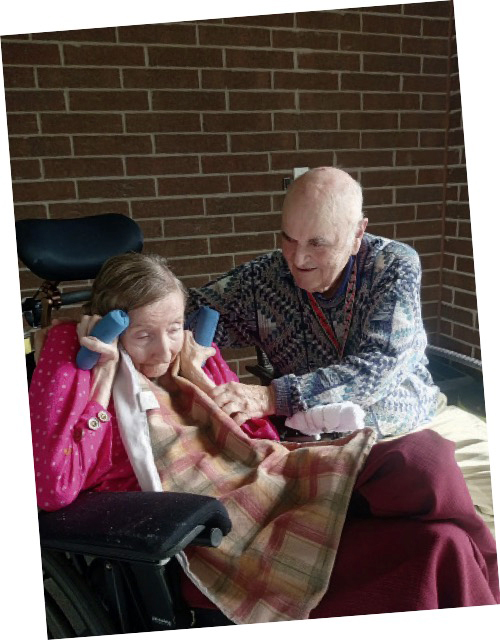
At Glebe Centre, a prestigious home for the elderly in Ottawa, Canada capital city, where Frances has had to be moved to receive adequate care and support her octogenarian spouse may not be able to provide in their own house, the retired military officer dutifully has in the past nine years when she was admitted, reported practically every day to see and keep his wife company. Not only that, he helps to feed her, takes her for a walk in the neighbourhood and tries to hold soft, gentle conversations with her. For all his labour of love and the affections he showers on her, all he gets from his once vivacious wife is a still, mute response and occasional smile she probably would give another kind stranger.
But that has not deterred Lornes. “She no longer talks to me, even though she could speak four languages and was quite fluent in three of them. But I continue to speak to her… sometimes I’m lucky if I get a smile…”, the man famously referred to as “The Best Husband in the world” by virtually everyone in the geriatric centre Saturday Sun in this interview.
Could you tell us about yourself and Frances?
My name is Lorne McInnes, and my wife, Frances McInnes. Her maiden name is Rutley. I was born and raised in Flin Flon, Manitoba, one of Canada’s keystone provinces. It’s a mining town known for its gold, nickel, zinc and copper deposits. Fran and I met in high school, Hapnot High School in Manitoba which in Canada covers Grades 7 to 12. I had just entered high school, while she was in Grade 10. Fran was a member of my Curling team—she played as the lead, while I was the skip. We got to know each other through the sport, and before long, we started dating.
After finishing high school, I worked in the parts department of a Ford garage. I later joined the military when I was 22. My wife, Frances, is three years younger than I am. She trained in Winnipeg, in St. Boniface Hospital, Manitoba, as a laboratory technician. As for me, I actually left high school when I was about 16 or 17, but I went back later to complete my education. In the meantime, I worked in Flin Flon, trying to find my footing as a young man, while Frances was completing her training as a lab technician.
Did your romantic relationship start in high school or much after?
We started out as just friends. That was around 1963 and we got married in 1963 in Winnipeg. I was 23, and she’d be 20. Now I’m 87 and she’s 84.
What was the attraction for you?
It was her beauty, but also her personality and our shared interests. She was a very pretty lady. I liked what she was doing, and she liked what I was doing, so things just clicked between us. Eventually, we realised marriage would work for us. We had known each other for about five years before we got married. Throughout my military career, she followed me across different postings in Canada as I progressed through various roles.
In the meantime, she built her own career in the medical field. She later specialised in urology and virology while we were in Halifax. By the time we moved to Ottawa, she was working at the National Laboratories, which had since been relocated to Winnipeg.
Tell us about your career as a serviceman?
I served in the Royal Canadian Ordinance Corps, where I worked primarily in supply before moving into finance. I split my career between those two fields for most of my time in the military. Over the years, I was posted to several locations, including Vancouver, Borden, Montreal, Germany, where I served for three years—Calgary, Kingston on two occasions, and finally Ottawa. I retired as Lieutenant Colonel. Basically, I’d have to move every two to three years. And she joined me with our two children – boys.
What are their names?
The oldest is Kelly Bryant, a 60-year-old man now. And the younger son, a year and a half apart, is Gordon Scott. Both carrying my name. Bryant retired a few years ago. He specialised in heating and cooling. My younger son, if everything goes well, he should finish up signing his documentation to retire from the government. He’s in computer mainframes. Technical support.
How was being married to Frances like?
I think it did very well, because we were both willing to explore, and Canada, as you know, is a very large country. So, we’ve been in big parts of it throughout our whole life.
She was resourceful. After the wedding, we settled together in Vancouver and set up our home. We were together quite a bit. But we had had to be separated at different periods. But she was quite capable of handling it all. Then I’d come back, and we would carry on.
I understand your wife is a polyglot. How many languages does she speak?
She’s fluent in three. She could speak English, Spanish, Italian, and French. But in high school, she took Latin. So that set a lot of bases for her future. And she’s always liked linguistics.
What actually happened to her?
She was diagnosed with Alzheimer’s disease. Because Alzheimer’s had occurred in her family, I already had an idea of what the outcome could be. We accepted the diagnosis and focused on moving forward together. I also knew there are about 200 different forms of dementia, with Alzheimer’s being one of them. For us, it wasn’t important to determine the specific subtype. We didn’t feel that knowing exactly which kind would change how we faced it, so we didn’t consider it necessary.
Some men who find their spouses in Frances’ condition – uncommunicative and loss of the intimate companionship they used to share would find it boring to stick by as you have done. Why do you do it?
Well, it’s love. That’s my partner. We went through a lot of difficult times over the years, and a lot of good times. And then when she started to deteriorate about 12 or 13 years ago, I stood by her. That’s what she would do for me. Since then, she’s been here in the Glebe Center for going on nine years now. And we spent a year and a half in another retirement home until this one became available.
She hardly speaks to you, yet you come here practically every day.
That’s just because of love and support. I come and put in at least four hours. But I have two boys who come when I’m not here. I just make sure I get somebody here everyday.
Does she still recognise you?
It’s sad at times, but mostly, if I can get a smile from her or she looks at me, I’m happy.
I talk to her every day, and we do a few minutes of exercise together. I also try to take her outside whenever I can. Today, we’re sitting on the balcony, and if the weather improves a little, we’ll go for a short walk by the canal. Over the past few years, I’ve taken her farther afield as well, but there’s only so much we can do now. At my age, I can no longer lift her in and out of the wheelchair by myself. I have to rely on my son to help, so her mobility is quite limited.
How do you cope with living without her in the house now?
Acceptance. There’s nothing I can do to change her condition. If there were something I could do that would help her, I would do it without hesitation. So, I cope by simply being present. Since I still get a bit of a response from her, that makes me happy. My routine is to visit every afternoon. If there’s something that requires me to come in the morning, I will, but it’s generally easier for me to come later in the day. I usually arrive between 2:30 and 3:00 p.m., which allows me to see the day staff before the afternoon shift begins.
I stay with her until after she’s been fed, and then I head home. On average, I spend about four hours with her every day.
Can you recall some of the happiest moments you’d both shared?
We had a lot of wonderful times together. In our earlier years, we loved camping and spent many holidays tenting. We also travelled quite a bit. We visited California, Florida, Texas several times, and the Grand Canyon. We both enjoyed being active and spending time outdoors. Another passion we shared was classical music. It has always been a big part of our lives. We even went on a musical tour of Italy, where we attended opera performances and classical concerts. We visited many of the country’s famous opera houses, and those are memories I still treasure. We’ve also enjoyed performances in New York, Toronto, Montreal here in Canada. Even now, I keep some of our favourite classical music playing for her. She listens to it, and so do I. We were also cross-country skiers for many years. We’d spend afternoons, or sometimes late mornings—skiing in Gatineau and the Laurentians. Later, we took up canoeing. We owned a canoe and often paddled on Meech Lake in Gatineau. Those outdoor adventures were some of the happiest times we shared.
It hasn’t crossed your mind to have a girlfriend?
No, I’m happy. We’ve been together, that was enough for me.
Your religious beliefs and values at work there, perhaps?
Not really. We’re not particularly religious. I just believe that whatever is going to happen will happen. We try to live our lives the best we can, spend time in nature, meet people, and treat everyone equally. That’s simply how we’ve always chosen to live. Yes, I’m a Christian. I’m United Church. She was Anglican. Like many children, we went to Sunday school and had that kind of upbringing. But as we grew older, the values we held on to became more practical than religious. I believe the Ten Commandments provide a good way to live, and I try to live by those principles. But beyond that, I’m not particularly religious.