Follow Us on Google
From Okwe Obi, Abuja
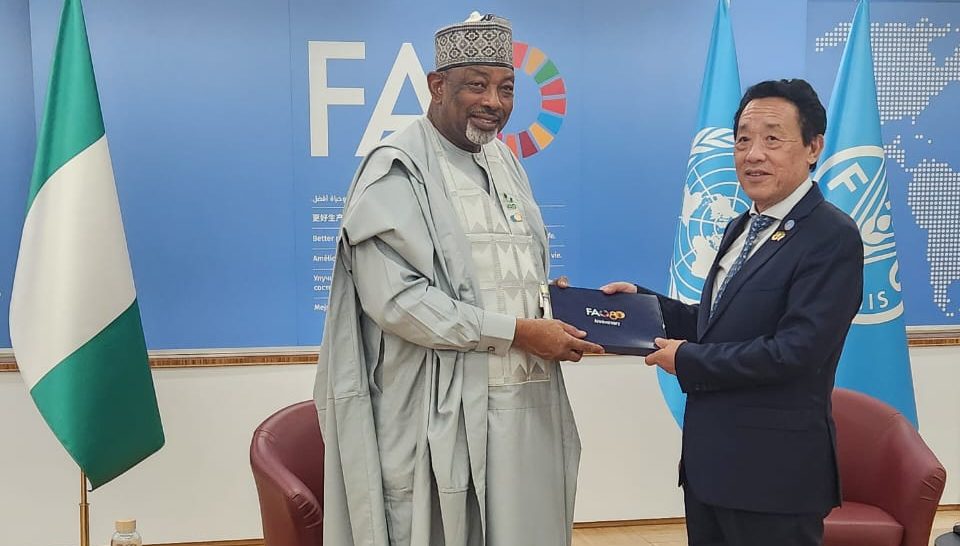
The Federal Government and Food and Agriculture Organisation (FAO) have reaffirmed their commitment and actions towards improving seeds and achieving food sovereignty through various agricultural programmes, policies, innovation, and global partnerships.
Speaking during the 2025 World Food Forum, Global “Seeds to Foods” Exhibition organised by FAO of the United Nations, Minister of Agriculture and Food Security, Abubakar Kyari, stated that the FAO–Türkiye–Nigeria South–South Cooperation is a programme designed to improve dryland farming, achieve food security, reduce poverty, enhance quality seeds, promote global partnerships and sustainable forest management in Nigeria with Borno State as its focus.
In a statement yesterday by the Head of Information, Ezeaja Ikemefuna, he said: “We see great potential to scale up this initiative, not only to improve livelihoods in Borno State, but to position Nigeria as a regional hub for the production and export of these high-value crops.
“With our vast arable land, entrepreneurial farmers, and the support of FAO, Türkiye, and other partners, we can unlock new markets and drive inclusive agricultural growth.
“This partnership stands as proof of vision in action, transforming ideas into impact and policy into progress. When we strengthen our seeds, we strengthen our farmers; when we secure our seeds, we secure our nation’s future.”
Kyari said that the programme involves the exchange of knowledge and resources, focusing on introducing new crop varieties, providing training for farmers, and establishing infrastructure like irrigation systems.
He added that the goal is to enhance food security and create more resilient agricultural practices through the mutual sharing of expertise between countries.
The minister revealed that the project introduced 10 Turkish crop varieties alongside 5 local Nigerian varieties, conducted 219 field demonstrations and 14 seed multiplication plots, and tested three sowing windows identifying October 15 as optimal for yields.
He added that the effort produced 7.5 tonnes of seed, including 684 kg from newly introduced legumes (notably chickpea and lentil).
Other News
“Capacity building reached 186 participants, 55 of them women, through trainings and exchange visits to Türkiye on seed processing, value addition, and post-harvest handling, backed by USD 200,000 invested in trainings, demonstrations, and institutional development.
“Infrastructure support included boreholes and field equipment to enable irrigation and dry-season farming,” he said.
He reiterated that the government will progress around one of the critical pillars of Nigeria’s agricultural transformation, which is a resilient and competitive seed system.
“Our pursuit of food sovereignty depends on the strength of the systems we build and the consistency of the actions we take.
“To sustain this progress, we must continue to promote policies that foster transparency, innovation, and private sector participation; invest in research and development to breed climate-resilient, high-yielding varieties; strengthen certification and quality assurance systems; and empower institutions such as the National Agricultural Seeds Council (NASC) to effectively serve both national and regional markets with certified, high-quality seeds,” the Minister added.
He applauded Governor of Borno State, Babagana Zulum, “whose leadership continues to inspire national admiration. By rebuilding communities, restoring livelihoods, and returning displaced persons to their homes and farms, he has shown that agriculture is more than an economic activity; it is a pathway to peace, stability, and dignity.”
The Minister mentioned that the Mohammed Lawan College of Agriculture, Maiduguri, has benefited from technical assistance in extension services, crop monitoring, and knowledge exchange. “This partnership demonstrates the power of South–South Cooperation in strengthening institutions and fostering innovation.”
He commended the Government of the Republic of Türkiye and FAO for this innovative collaboration, which has successfully piloted the introduction of new crops—lentils, fenugreek, coriander, chickpea, black cumin, buckwheat, and dry beans—in the dry lands of Borno State.
According to him, “these crops offer promising opportunities for improved nutrition, income generation, and climate resilience, representing an important step toward diversifying Nigeria’s agricultural base.”