Follow Us on Google

Job Osazuwa
A frail-looking elderly man, who appeared to be in his 80s, stood for about three minutes, shook his head and muttered some words before stepping into the stagnant, stinking pool of water that had taken over the better part of his street.
Everyone, including the reporter, watched this landlord as he clutched his walking stick and carefully navigated his way through the stretch of the flood on Kolawole Street in Araromi Quarters, Agboyi-Ketu Local Council Development Area (LCDA) of Lagos State.
It took him about 25 minutes to cover a distance that shouldn’t have taken him more than one minute. By the time he got to the front of his house, the water was around his waist.
The old man was one of the few residents who had refused to leave their houses on the street. But he was not the only one with bitter tales. Many other victims within and outside Lagos have been forced to vacate their homes after they were sacked by raging floods.
The rains have continued unabated, leading to floods that have dealt a devastating blow on most people. One might not be exaggerating in describing the flood as a messenger of tears, sorrow and death.
From Ajah, Lekki, Victoria Island, Ikoyi, Oworoshoki to Apapa, Ajegunle, Ikorodu, Ketu, Iyana-Ipaja and Agege in Lagos, thousands of people have been rendered homeless. Roads, offices, companies have been taken over by flood in the last few weeks. Gridlocks have become a painful, daily feature of the metroplois.
Many people have met their deaths in the floods, while property worth billions of naira has been destroyed as the skies opened up in fury in the last several weeks. Apart from those killed or rendered homeless by the flood as well as collapsed businesses, some residents are faced with health challenges occasioned by the pungent and infected floodwaters in some areas. It is indeed a season of lamentation for many Lagos residents.
Due to different factors, the rainy season has always come with its disruptive effects on account of flooding in many areas in Lagos. But this year’s rains have come with loads of disastrous consequences.
In different areas of Lagos visited by the reporter, it was gathered that landlords have become temporary tenants, waiting for the rain to subside before returning to their houses. Many occupants of the submerged houses were seen packing out their belongings, vowing never to return. In some areas, canoes have been constructed to help residents navigate in and out of their houses.
There were residents that were caught unawares, as water invaded their apartments while they were away to their places of work. One of such unlucky people was Mr. Friday Okoro, who lived in one of the flats on the ground floor of a storey building on Kolawole Street, Alapere, Ketu. He said he had gone to church with all his family members only to return and meet his property floating in his apartment. Most of his electronics and other valuables were damaged beyond repair.
Pointing down the flooded street, he said: “A woman drowned down there about two weeks ago. She didn’t know that that particular spot was so deep and she fell while trying to find a path to where she was going. By the time someone saw her, it was too late; it was her corpse that was recovered.
“I have been in this area since 2006; it has never been this bad. This is too much for us. I have been planning to return to my village but there is no money yet to execute my plans.
“When children are going to school in the morning, they go with extra clothes to swim through the water. Once they are out, they put on their uniform. And when they are returning, they remove their uniforms and put on casual wear. This has been on for almost two months now. They always fall inside the water. Funny enough, the government sited a health centre on the street. The project, which the immediate past governor, Akinwunmi Ambode, started, has been abandoned. The flood has taken over the uncompleted building.”
Okoro said, on many occasions, snakes have surfaced from the flood and attacked some residents. He lamented that mosquitoes and other dangerous insects have dominated the area in the last two months. He complained that children often fall sick, with frequent visits to the hospital.
“Most of the houses around here are empty because no tenants will renew their rent in such a condition. But, sadly, most landlords, even those who don’t live in the houses, will quickly return during the dry season and start renting out the houses to unsuspecting tenants. That has been the habit of the landlords around here,” he said.
Streets such as Adeyinka, Onasanya, Ewusu Otaiku, Adeyemi, Azuka Odili and Adigun Arigbede are at the mercy of the flood day and night. A church in the area, The Living Wonders Covenant Church, appeared to have been long abandoned by congregants.
One common thing in this community is the use of rainboots. They are worn by everyone, irrespective of social status, sex or age. The reporter was soon given one by a Good Samaritan when the resident discovered that the visitor had come to help share their story to the world. Incidentally, the reporter would soon experience his share of the people’s daily travails when he suddenly found himself inside a gutter that was hidden by the flood.
Beside St. Michael’s Catholic Church, Biola Bus Stop, Alapere, Ketu, is Utuh Road. Anytime it rains, no one dares to pass the road. Even the long rickety wooden bridge constructed by some community youths is totally covered by flood. When the reporter visited, right in the middle of the wooden bridge were seated two young lads on plastic chairs. Their job was to collect toll of N20 per adult. Each had a sizeable wrap of marijuana.
Beside the smaller churches such as Christ Gospel Apostolic Church and Christ Power Evangelical Church that were already affected, owners of schools and small-scale businesses in the area were counting their losses. Some of the victims told Daily Sun that the damage was unquantifiable. The sounds and signs of rain quickly spread apprehension in the community.
Another gravely affected street was Deji Oworu Street, off Church Street. On the street was Jomchin Nursery and Primary School, which was housed in the upper part of the storey building. Parents and staff of the school had to carry the pupils on their shoulders to get them to their classes without being soaked by the flood that occupied the school premises.
Prince Adekunle Ezekiel Oluwakayode, who owned the building on No. 43 on the street, said he had been in the area since 1982. He noted that it was the worst rainy season he has experienced in the past 30 years.
“The government was supposed to have dug a big channel to take the water to the big River Agboyi that is right behind us here. They started the project but later stopped for reasons I don’t know. There is no single tenant in my house at the moment. The 14 rooms are empty. I am still here because I can’t uproot my house and take it somewhere else.
“We heard that some Chinese companies are buying some lands on Ikorodu Road around Owode Ajegunle and are sand-filling the areas, which is inconveniencing us in this part. The government needs to protect us in this part of Lagos because we voted for the party that is in power now,” he said.
Ikechukwu Ugadu, who ran a provision shop on Kukoyi Street, off Church Street, lamented that sales were at their lowest since the flood started tormenting the area about two months ago.
Standing in the pool of water threatening to take over his shop, he said: “I pay N7,000 as rent every month. The residents who should buy what I sell have packed out. Most times, I open my shop and sleep for three to four hours without anyone coming here. It is sad watching as my goods expire.
“When I rented this place, there was flood at the other part of the street. The agent told me that I should not entertain any fear that my shop was safe but it is another story today,” he said.
Another resident said that she only came to her house to pick more clothes. She has been squatting in a church with her family, pending when the flood recedes. Another resident said former Governor Babatunde Fashola dug a canal in the area that would have accommodated much of the water, but some rich individuals bought some plots of land and built on them thereby preventing the free flow of water to the canal.
Tragedy struck penultimate week when the flood swept away an 11-year-old boy and his rescuer, one Wasiu, into a canal linking Aboru and Iyana-Ipaja on Ige Road in Alimosho Local Government Area of Lagos.
The incident followed the overflow of the canal. It was gathered that two young boys sent by their parents to buy cooking gas at a gas station unknowingly fell into the drainage through which water passed into the canal.
A community development association (CDA) leader in Oki town, Mr. Solomon Agboghoroma, regretted the development and blamed the failure of government to construct a bridge in the area for such incidents.
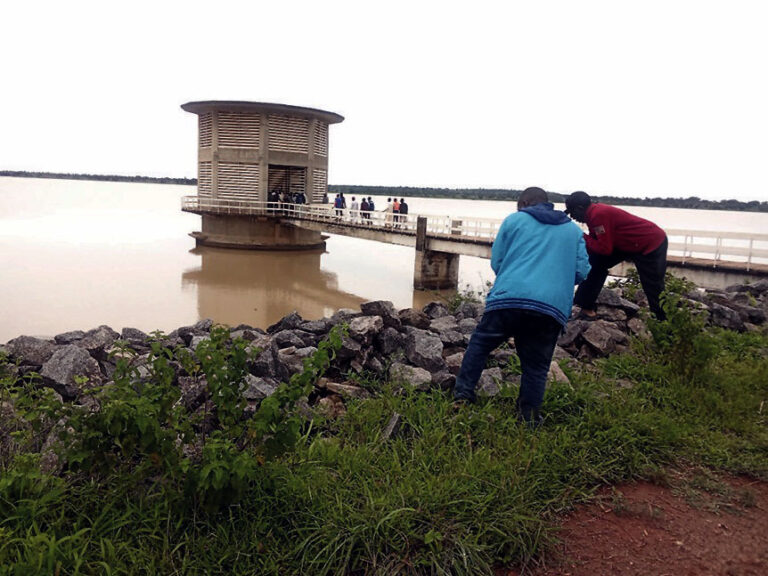
It was gathered that the recent release of water from the Oyan Dam in Abeokuta, Ogun State, contributed to the flood crisis in some communities in Lagos.
Director of service for the Ogun-Osun River Basin Authority, Femi Dokunmu, explained that water was released from the Oyan Dam after it was filled up due to the unrelenting downpour.
Dokunmu said: “The agency has been taking measures to ensure that we do not have any flood. The primary purpose of the dam is to control flood by storing water to prevent flooding downstream. If the volume of water that comes in through rainfall does not go downstream, it will reduce the chances of the river overflowing its banks.
“We have a proactive measure of systematically releasing the water during the dry season before the rain starts, which has helped us in years when there was no heavy rainfall. Now that we have heavy rainfall, it is increasing the level of water in our reservoir and the river can no longer accommodate such volume of water due to the rainfall. That is why we had to allow the water to go downstream by opening the gates of the dam to release the water that has inundated our reservoir.”
Meanwhile, the Lagos State Commissioner for the Environment and Water Resources, Mr Tunji Bello, has said that the state government was already n talks with officials of the Ogun-Osun River Basin Authority to find a solution to the issue. He explained that the rise in sea level had also contributed to the current flooding in many parts of Lagos, especially as the lagoon could not discharge water and had caused backflow into drainage outlets.
Many communities around Akute and Warewa, as well as estates in and around OPIC in Ogun State have been flooded in the last two weeks.
But environmentalists and other experts in building construction and drainage have opined that a master drainage plan would bring a permanent solution to the frequent flooding in Lagos and Ogun states. They also charged government at all levels to tackle the issue of climate change and its effects, especially by being proactive.
However, the managing director of the Ogun/Osun River Basin Development Authority, Mr. Oluwafemi Odumosu, said the water released was less than 10 per cent.
“Flooding does not necessarily have to be caused by the opening of the dam. Of course, we have a dam on the Ogun River that we manage but there are other causes of flooding such as rainfall. We do normal scientific water releases; we don’t just release the water without generated data.
“It will be in our interest and that of everyone to open the dam from time to time. If we don’t do that, and the dam has so much water and overflows, there will be catastrophe. It will sweep away properties,” he said.