Follow Us on Google
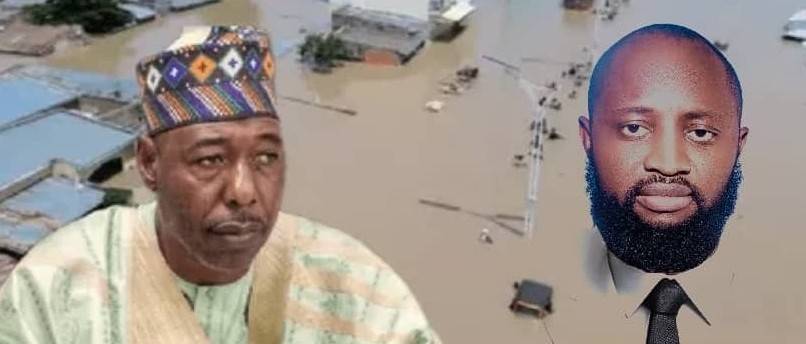
Borno State governor, Professor Babagana Zulum, has been urged to focus his infrastructural drive on providing functional drainage systems in Maiduguri and other cities in the state to permanently scale the perennial flooding disaster ravaging the north east state.
While emphasising the fact that the state is in desperate need of modern drainage systems beyond the overhead bridges being built by the state government, Professor Christopher Chinedumuije, a Professor of Disaster Management and Humanitarian Studies, in an open letter addressed to Governor Zulum, stated that “Borno State has one of the worst drainage systems in Nigeria, if not the worst.”
Professor Chinedumuije, added that “While Borno has struggled over the years with the pains of insurgency and displacement, a new and preventable humanitarian crisis is tightening its grip on the State – flooding,” saying that it is “a recurring and increasingly devastating emergency that is no longer just a climate issue, but a glaring failure of leadership and infrastructure prioritization.”
He noted that “Borno State has one of the worst drainage systems in Nigeria — if not the worst. From densely populated urban centers in Maiduguri to peri-urban communities, floodwaters have no escape. Streets turn into rivers. Markets drown. Schools close. Homes are swallowed.
‘”And yet, instead of urgently investing in a modern, comprehensive, and state-wide drainage system, your government is building overhead bridges.
“This is not just illogical. It is dangerously absurd.”
He questioned the rationale behind building overhead bridges in a flood-prone state where the ground is already impassable when it rains, saying that it is pointless elevating roads to the sky while the citizens are stuck wading through flooded neighborhood.
According to him “The flood of 2024 was a disaster of epic proportions. Entire communities in Maiduguri and beyond were submerged. Children missed school. Small businesses were ruined. People were displaced for weeks with no durable support. Health centers were overrun with cases of waterborne diseases.
“And all of this — all of it — could have been minimized if not entirely prevented had there been functional drainage infrastructure,” he said.
Professor Christopher Chinedumuije advised that”Instead of conducting post-disaster reviews and prioritizing investments in climate resilience and stormwater control, your government appears to have moved on without a lesson learned.
“The 2024 flood should have been the breaking point — a moment to pause, reflect, and reorient state priorities. Sadly, it wasn’t. And that silence, that failure to act, is now the loudest alarm for disaster.”
He said governance is all about solving real problems. The real problem in Maiduguri is not traffic congestion — it is infrastructural suffocation caused by nonexistent or dysfunctional drainage systems. No one has ever died from a traffic jam, but people have died — and continue to die — from floods.
“By continuing with the construction of prestige projects like overhead bridges while ignoring the most basic of human needs — drainage and flood control — your government is communicating a dangerous message: that appearances matter more than protection.
“This mentality is a threat to the very essence of governance. And unless reversed, it will come back to haunt the very legacy you’re trying to build.”
He warned that if Borno State continues on this path, there will be “ncreased flooding leading to annual displacement of families, destruction of farmlands, and worsening poverty; public health catastrophes — cholera outbreaks, malaria, and other diseases caused by stagnant water will multiply; collapse of critical infrastructure, including roads, health centers, and schools, due to unchecked erosion,” among other devastating effects of not giving comprehensive drainage systems the critical attention it deserves.