Follow Us on Google
By Henry Uche, [email protected]
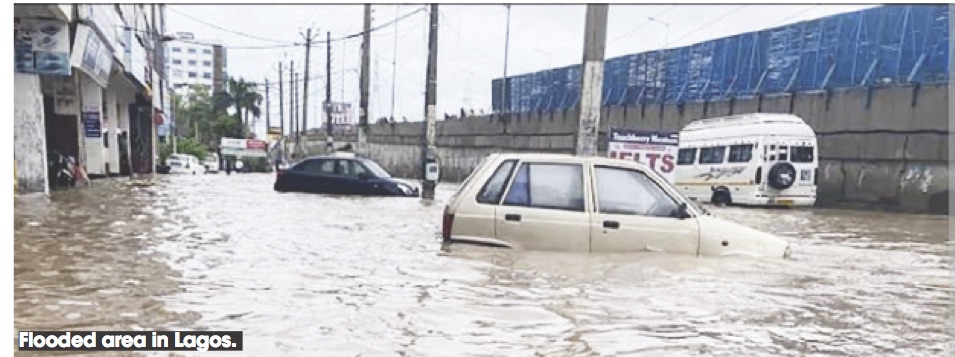
News of Cameroonian government’s plan to open the floodgates of Lagdo Dam has sent shockwaves down the spine of flood- prone states of Nigeria and their governments over the impending crisis that would be hitting them in no distant time.
. According to the Director General of National Emergency Management Agency (NEMA), Ahmed Mustapha Habib, no fewer than 11 states including Adamawa, Taraba, Benue, Nasarawa, Kogi, Anambra, Edo, Delta, Bayelsa, Rivers and Cross River are likely to feel the negative impacts of this annual ritual. : It would naturally be coming with displacement of citizens, loss of lives, properties, farmlands, among other losses.
Though there have been several warnings and advice by the government urging residents in flood-prone areas to evacuate for their safety, risk and crises management experts have equally offered strategic and proactive measures to solve this problem at once as well by urging Nigerians to pickup insurance cover to mitigate its consequences.
At a Nigeria’s Governor’s Forum held recently, NEMA’s DG, Mustapha Habib Ahmed, urged the 36 state governors to take proactive action to mitigate the effects of the impending floods.
NEMA has also distributed relief items to victims of 2022 flood in Bauchi and other parts of the country, after alerting Nigerians to brace up for severe flooding in 2023, however it was never enough to offer relief materials while the problem remains a recurrent decimal.
Earlier this year, the House of Reps summoned NEMA DG over flood prediction to brief the House on measures taken to prevent flood disasters and manage the socio-economic impact on people in flood-prone areas.
Recall that this same flood displaced in 2022 displaced over 1.4 million people, killed over 603 people, and injured more than 2,400 persons. Also, about 82,035 houses were damaged, and 332,327 hectares of land affected, while the value of property lost ran in billions of which farmers and other properties owners are yet to recover the shock.
In all these, hazards, risk, crises management experts have expressed fear over the fate of Nigerians and berate Nigeria government’s lackadaisical attitude towards issues that affect Life and property, as Nigerians awaits the flood in a matter of days.
Taking a swipe, the Deputy General Manager & Head of Risk Management and Compliance, at Sovereign Trust Insurance, Mr. Sanni Oladimeji, contrary to position of NEMA’s DG on the Agency’s readiness, bemoaned leaders’ laxity towards risk management and other risk-related issues, since risk remains a phenomenon no one would relegate at one’s peril.
According to him, there was need for the Federal and State governors to embrace the concept of risk, hazards and crisis management. He added that the recent decision to release significant water from Cameroon’s Lagdo Dam should give everyone concerns about its potential disasters across the country.
“We treat risk matters with kid gloves. So sad. However, there’s more to be done in the immediate, medium and long term to mitigate and avert future consequences of this impending disaster. In the immediate term, safety of lives comes first priority, the state governments should make adequate arrangements for designated relief camps, materials and security.
“Government agencies should then engage the habitants on need and coordinate evacuation from the areas. The Federal government can do more to protect lives and property by declaring a State of Emergency including using the military reserves or paramilitary formations to support and enforce evacuations.
“In the medium term, the state governments can embark on construction of reservoirs for temporal storage of flood water dam and reservoirs as well as construction of bypass and diversion channels to carry some of the excess floodwater away from the area being protected. Also, improvement of river channels to enlarge their discharge capacities in the area would reduce the impact.”
Oladimeji urged States government to be prevailed upon to stop allocating land in designated flood plains, maintain dredging and waste management efforts, and rethink incentives to invest more in flood mitigation efforts.
“In long term, States should be allowed to build, and manage dams. A Dam directly funded by the States could generate power, support irrigation and create jobs and earn revenue for the states,” he advised.
Similarly, former Chairman of Nigerian Insurers Association (NIA), Mr. Gus Wiggle, went the memory lane of this Dam, and decried how successive administrations of Nigeria failed to act proactively.
“The Lagdo dam we are told was built in 1982, we were also told that there was an MoU between the Nigerian Government and Cameroon that whenever the dam will be opened Nigerian government will be notified by their Cameron counterpart, Nigerian government was also expected to build two (2) dams such that when the dam is opened from the Cameroonian end, these dams will absorb the waters.
“What has happened, where are the two dams to be built by the Nigerian government to absorb the flow of water from the Cameroonian end since 1982?
We are not just a serious country when it comes to the concerns of her citizens. All the past governments since that 1982 have never been proactive as to control these floods when thy occur.
“All we do is wait for the flood to sweep away the citizens, destroy their farm land and then send NEMA to give relieves to the affected citizens and create another IDP, that’s all, and wait for the next flood to come, nothing is done to dredge the rivers and its tributaries, make a clear policy for living by the riversides. There is little that can be said that the government does not know.”
Wiggle added, “The exposure has been identified, how do you mitigate it, I don’t know the minds of NEMA but to inform residents living around there should keep away.”
While the devastating flood situation has become a recurring decimal, different narratives have been put forward as the cause.
The federal government in October 2022 said the Lagbo Dam in Cameroon was not responsible for the natural disaster that ravaged Nigeria. While the former minister of Water Resources, Suleiman Adamu accused the Cameroonian government of not informing the Nigerian government before releasing water from Lagdo DAM.
Whatever be the case, Nigerians expect the Minister of Water Resources and Sanitation, Professor Joseph Terlumun Utsev, a thoroughbred professional with expertise in Civil and Water Engineering and hands-on experience in water resources engineering and management, to work with NEMA to save life and property.
The Seasonal Climate Prediction (SCP) released earlier by the Nigerian Meteorological Agency (NiMET), comes to mind in a time like this, hence the need for the government and citizens to take steps to mitigate the impact of the expected floods.
NEMA’s boss said NiMet’s prediction helped the Agency to conduct analysis of disaster risk implications and produce disaster early warning messages for the protection of lives and assets, adding that the unprecedented flood disaster in 2022 was an eye-opener, thus the agency intends to be proactive and intensify inter-agency collaboration to forestall any negative impacts.
Following, insurance experts have advised the policyholders, State governments and Nigerians at large to prepare for the foreseen disaster. Heirs insurance for instance, has affirmed its readiness to compensate individuals and corporates who have taken up policies/ cover against flood on their Life and properties.