Follow Us on Google
By Steve Agbota
The Federal Government and members of the Union of African Shippers’ Councils (UASC) have decried the persistent imposition of peak season surcharges (PSS), high freight rates, and other arbitrary fees by shipping lines, which significantly threaten trade competitiveness across Africa.
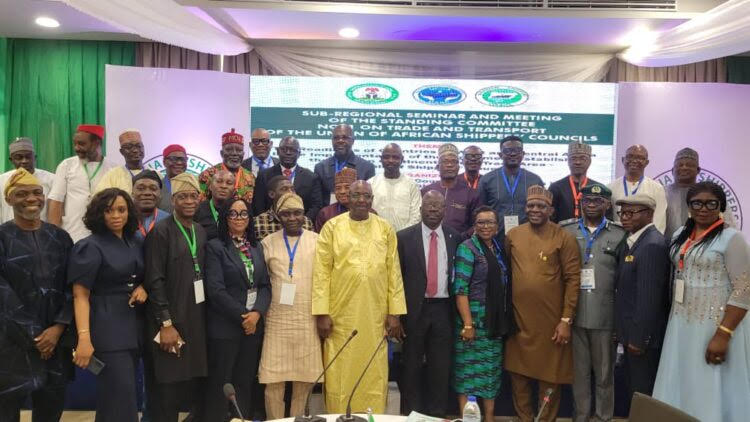
The concerns were raised on Wednesday at the opening of a two-day Sub-regional seminar and meeting of Standing Committee No. 1 on Trade and Transport of the Union of African Shippers’ Councils,” held in Lagos.
The event, themed “The Readiness of Countries of West and Central Africa in the Implementation of the Agreement Establishing the AfCFTA-The Role of Shippers’ Councils,” was organised by the Nigerian Shippers’ Council (NSC) and UASC under the auspices of the Federal Ministry of Marine and Blue Economy.
However, the Minister of Marine and Blue Economy, Adegboyega Oyetola, stressed that the effect of the peak season surcharge recently introduced by shipping lines on the economies of West and Central Africa has been a major issue for discussion by the Standing Committee No. 1.
Oyetola, who was represented by the Permanent Secretary of the ministry, Mroruntola Olufemi, said that the arbitrary surcharges and high freight rates are recurring challenges in the sub-region that continue to erode trade competitiveness, placing undue burdens on importers and exporters.
According to him, it is, therefore, imperative that member States, through UASC, engage constructively with shipping lines and international partners to ensure transparency, fairness, and equity in the determination of surcharges and freight rates.
“Our goal must be to establish mutually beneficial frameworks that safeguard shippers’ interests while ensuring the sustainability of shipping services,” he said.
He urged African nations to confront persistent constraints in transport logistics, trade facilitation, port efficiency, and shipping costs to unlock trade opportunities.
Other News
Oyetola said these are areas where National Shippers’ Councils of countries must play a decisive and proactive role, aligning their interventions with the objectives of the African Union and the implementation roadmap of the African Continental Free Trade Area (AfCFTA).
Moreso, he said across the sub-region, shippers’ councils occupy a strategic position as advocates of shippers’ interests and regulators of port economic activities.
He said that promoting fair freight rates, transparent shipping practices, and efficient cargo movement, national suppliers’ councils help reduce the cost of trade and enhance the competitiveness of African exports.
Also speaking, the Executive Secretary/Chief Executive Officer of the Nigerian Shippers’ Council, Dr Pius Akutah, lamented that the peak season surcharges and other arbitrary charges imposed by shipping lines have serious implications for trade competitiveness in West and Central Africa.
He said the theme of the seminar underscores the need for the sub-region to position itself effectively in the emerging continental trade architecture.
Akutah charged African shippers’ councils to develop a unified regional position that promotes fair competition, transparent freight practices, sustainable shipping practices and efficient movement of goods across borders in the sub-region.
In his remarks earlier, the Secretary-General of the Union of African Shippers’ Councils (UASC), Abdurahman Abba Kafougou, urged the 19 member states to intensify efforts toward harnessing the opportunities offered by the AfCFTA for the benefit of African shippers.
Kafougou encouraged experts in the industry to engage in in-depth discussions on several critical issues affecting trade facilitation across the continent, which include the effective use of Incoterms 2020, strategies to reduce the cost and time of cargo delivery, and the establishment of reliable information tools for shippers through unified platforms or border-based information centres.
He emphasised that the discussions aim to strengthen regional cooperation and efficiency within Africa’s shipping and logistics ecosystem, adding that these measures are vital to enhancing competitiveness and ensuring the smooth implementation of AfCFTA.