Follow Us on Google

From Okwe Obi, Abuja
The Federal Government has rolled out emergency agricultural support for 4,000 smallholder farmers affected by the 2026 rainy season floods in Ogun State to help them restore damaged farms and recover their livelihoods.
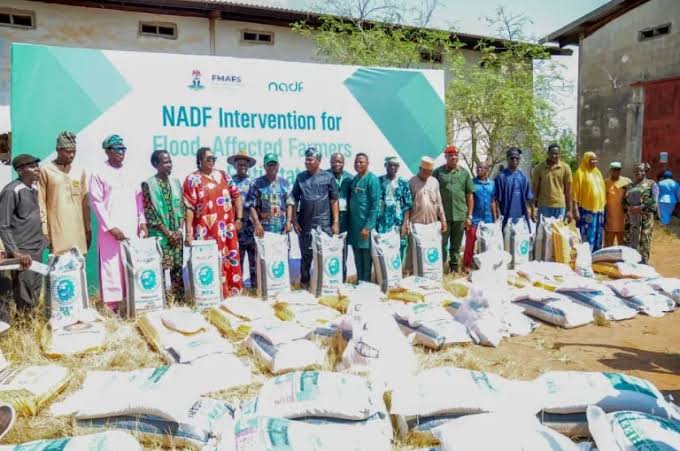
The beneficiaries comprise 2,800 maize farmers and 1,200 rice farmers, who will receive fertilisers, herbicides and pesticides under the National Agricultural Development Fund’s (NADF) Agricultural Emergency Intervention in Enterprise Recovery for Flood-Affected Smallholder Farmers.
Speaking at the flag-off of the programme in Ogun State, the NADF Executive Secretary and Chief Executive Officer, Mohammed Ibrahim, represented by the Head of Mechanisation Unit, Olakunle Dabiri, said the intervention was designed to help farmers recover from flood-related losses and prevent disruptions to subsequent farming seasons.
He said the floods destroyed farmlands, damaged agricultural assets and threatened farmers’ incomes, making urgent support necessary to restore food production.
“Without timely intervention, a disaster measured in days can easily become a crisis that lasts for seasons,” he said.
Ibrahim explained that the programme would focus on three areas: identifying and verifying affected farmers, distributing emergency farm inputs and promoting climate-smart farming practices.
He said the needs assessment, conducted in collaboration with state governments, was aimed at determining the extent of damage and ensuring that assistance reached genuine beneficiaries.
On measures to prevent future losses, he said the Fund would promote agricultural extension services, early-warning systems and training to prepare farmers for climate-related emergencies.
He stressed that transparency and accountability would guide the implementation of the programme.
“Every beneficiary under this programme will be properly verified, and a comprehensive database will be developed to ensure transparency and efficiency,” he said.
According to him, NADF would also deploy its digital monitoring and evaluation system to track the distribution of inputs, identify farmers supported and assess the level of recovery achieved.
He said the intervention was expected to be completed within seven weeks, adding that timely delivery of the inputs was necessary to prevent affected farmers from missing critical farming opportunities.
Other News
Ibrahim said the success of the programme would be measured by the number of farms restored and livelihoods recovered rather than the quantity of inputs distributed.
“The true measure of success will not be the quantity of inputs delivered. Rather, it will be seen in the fields restored to cultivation, the livelihoods rebuilt, the harvests secured, and the resilience strengthened across our farming communities,” he said.
He urged beneficiaries to use the inputs responsibly and embrace climate-smart farming practices to improve productivity and withstand future environmental challenges.
In his remarks, the Ogun State Commissioner for Agriculture, Bolu Omotowo, commended NADF for supporting farmers in the state, describing the intervention as an important contribution to efforts to increase agricultural production.
He said the programme complemented the agricultural development initiatives of Governor Dapo Abiodun, particularly in improving farmers’ access to inputs, equipment and mechanisation services.
Omotowo recalled that NADF had distributed more than 20,000 bags of fertiliser to farmers in the state about four months ago during the planting season.
He also disclosed that the state government had recently provided eight tractors to its eight farm settlements, alongside tipping trailers, ploughs, harrows, maize planters and cassava planters.
He said the equipment was intended to encourage mechanised farming, reduce dependence on traditional farming methods and increase food production.
“This is to ensure that our farmers are no longer tilling the ground the old way and are beginning to incorporate mechanisation in their farming. This will indeed boost food productivity in our state and will also boost food productivity in Nigeria,” he said.
The commissioner, however, appealed to NADF and other development partners to extend agricultural support to other crops beyond rice, maize and cassava.
He specifically called for assistance for cotton farmers, noting that cotton remained an important agricultural commodity in Ogun State.
“We will be looking forward to supporting our farmers that cultivate cotton, because our farmers cultivate cotton in Ogun State,” Omotowo said.
He assured farmers that the distribution of the emergency inputs would be transparent and urged beneficiaries to make effective use of the support to rebuild their farms and businesses.