Follow Us on Google
By Merit Ibe
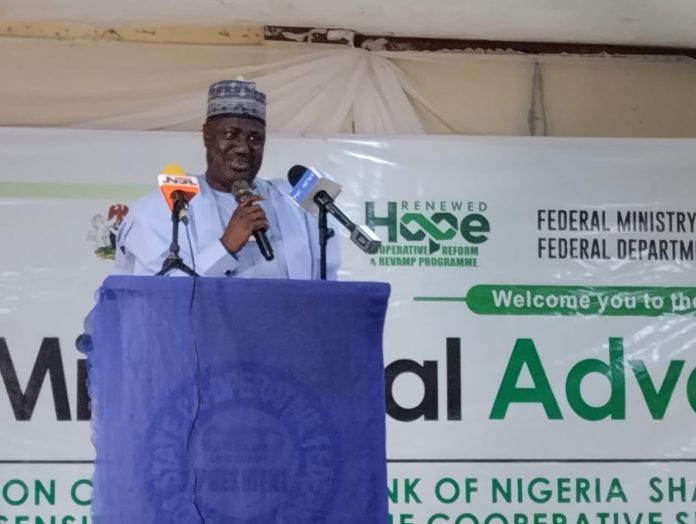
The federal government has commenced a nationwide ministerial advocacy tour on the Cooperative Bank of Nigeria’s share capital mobilisation and the digitalisation of the cooperative sector, beginning with the South West zone.
The initiative, driven through the Federal Ministry of Agriculture and Food Security, signals the start of a coordinated reform push aimed at strengthening cooperatives as a vehicle for inclusive growth and economic empowerment.
The advocacy programme, which began on Monday in Lagos, was organised by the ministry’s Federal Department of Cooperatives as part of efforts to modernise and expand the reach of the sector.
Speaking at the launch, the Minister of State for Agriculture and Food Security and Supervising Minister of Cooperative Affairs, Senator Aliyu Abdullahi, described the South West engagement as a critical milestone in repositioning the cooperative ecosystem.
He said the reform agenda is designed to deepen financial inclusion, support enterprise development and enhance food security through a more structured and digitally enabled cooperative system.
Abdullahi added that strengthening the Cooperative Bank of Nigeria through expanded capital mobilisation would improve its capacity to fund grassroots businesses and cooperative ventures nationwide.
He noted that the nationwide tour would engage stakeholders across all zones, build consensus on reforms and accelerate the adoption of digital tools to improve transparency, efficiency and service delivery within the cooperative sector.
Abdullahi explained that the decision to begin the nationwide sensitisation tour from the South-West was deliberate, noting that the modern cooperative movement in Nigeria originated in the region following the 1934 Strickland Report, which led to the Co-operative Societies Ordinance of 1935.
Abdullahi said the advocacy tour was a direct outcome of resolutions reached at the 8th Regular Meeting of the National Council on Cooperative Affairs held in Abuja in March 2026.
He said the council approved the Renewed Hope Cooperative Reform and Revamp Programme, a comprehensive framework designed to strengthen the cooperative sector and align it with the administration’s goal of building a one-trillion-dollar economy.
The minister stated that the proposed Cooperative Bank of Nigeria is aimed at rebuilding a strong cooperative financial system capable of supporting farmers, artisans, traders, SMEs, women, youths and Persons with Disabilities through affordable and accessible financial services.
On the benefits of the initiative to farmers and traders, Abdullahi explained that through processing and post-harvest activities, more products are supplied into the market, which improves competition.”Most times, what people call a competitive system is not truly competitive. But if cooperatives are properly structured, they can improve people’s lives and support economic growth.He viewed that the cooperative system is not a complete solution to every problem, “but it is an important system for addressing many challenges. That is why cooperation is very important, and it helps make market prices more stable and affordable for everyone.”
Abdullahi empahsised that the reform programme is designed to reposition the cooperative sector as a strategic vehicle for economic growth, poverty reduction, job creation and food security under the Renewed Hope Agenda of President Bola Tinubu.
Other News
He listed the seven strategic pillars of the reform programme to include governance reforms, cooperative financing and establishment of the Cooperative Bank of Nigeria, digitalisation and data management systems, capacity building, value chain development, inclusion of youths, women and PWDs, as well as strategic partnerships and investments.
According to him, cooperatives globally have proven effective in mobilising grassroots capital, stimulating local production, creating jobs and strengthening food systems.
He said Nigeria could no longer afford to neglect the economic potential of the sector, stressing that the establishment of the Cooperative Bank of Nigeria and the digitalisation of cooperative operations are the key transformational drivers of the reform programme.
Abdullahi assured that the proposed bank would operate with modern governance and regulatory standards while preserving cooperative ownership.
Analysing the ownership structure, he said it allocates 65 per cent controlling equity to cooperative societies, unions, federations and individual cooperators, 30 per cent to private and institutional investors, and five per cent to employees of the bank and affiliated cooperative enterprises.
He said the arrangement would ensure that cooperatives retain control while investors also participate meaningfully and benefit from sustainable returns.
Also speaking, the Lagos State Commissioner for Commerce, Cooperatives, Trade and Investment, Mrs Folashade Bada Ambrose-Medebem, said cooperatives remain one of the most effective platforms for promoting grassroots productivity, financial inclusion and community wealth creation.She noted that the vision of building a one-trillion-dollar economy cannot be achieved through macroeconomic policies alone without strong grassroots economic institutions.
Ambrose-Medebem said Lagos State had adopted deliberate policies to modernise and strengthen the cooperative ecosystem through digitalisation, improved governance and financial inclusion initiatives.
According to her, the state has intensified digital registration processes, electronic documentation systems and member data management platforms to improve efficiency, transparency and regulatory oversight in cooperative administration.She added that the digital reforms would improve trust, strengthen accountability and encourage participation among young entrepreneurs and professionals.
The commissioner further stated that Lagos State has expanded access to finance for cooperative-based MSMEs through intervention financing and cooperative lending structures, supporting entrepreneurs, artisans, traders and agro-processors.She stressed the importance of capacity building, financial management, digital bookkeeping and governance reforms in ensuring sustainability within the cooperative sector.Ambrose-Medebem also highlighted the need for stronger collaboration between federal and state governments, improved cooperative data systems and enhanced digital interoperability among cooperative institutions, financial institutions and regulators.
She said Lagos State remains committed to cooperative sector transformation as a critical pillar of sustainable economic development.
In his remarks, the Federal Director of Cooperatives, Dr Mohammed Bashir Abdulkadir, said the engagement demonstrated the government’s determination to build an inclusive, digitally driven and financially empowered cooperative ecosystem in Nigeria.
He expressed optimism that through strong governance, strategic partnerships and digital transformation, the cooperative sector could become a major force for inclusive economic growth and national development.