Follow Us on Google
From Fred Ezeh, Abuja
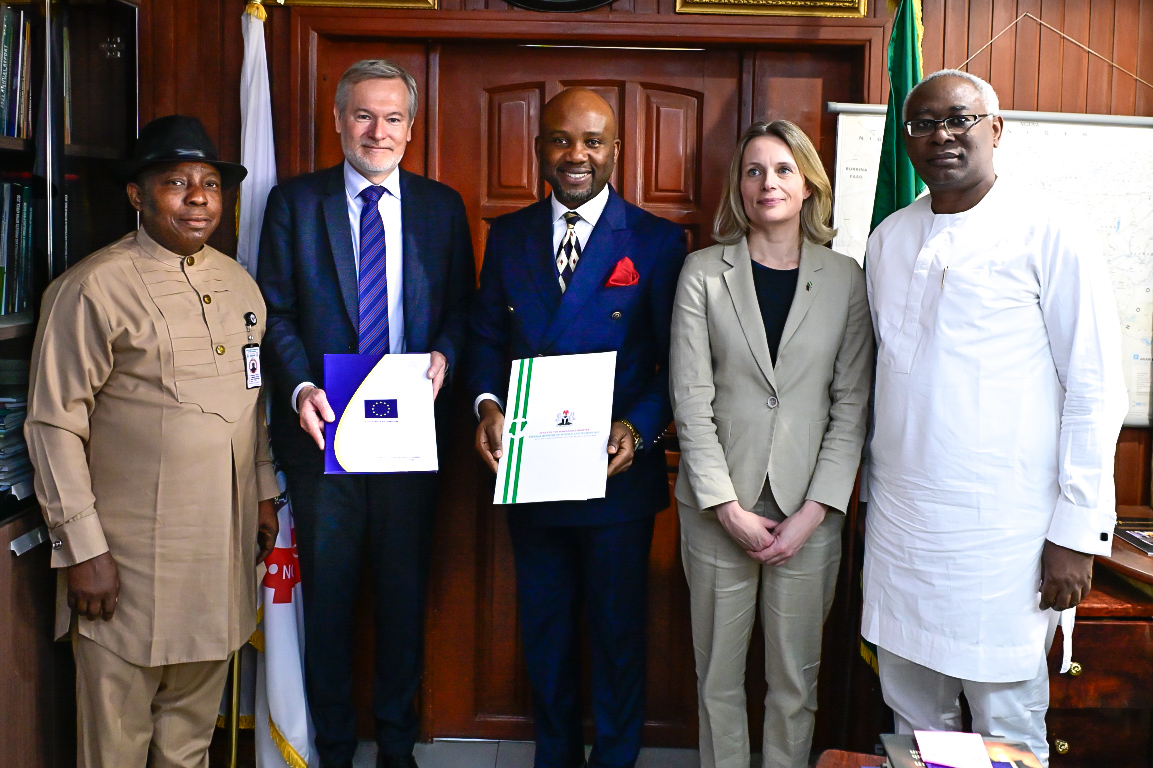
Federal Government and the European Union (EU) have formally opened negotiations for a bilateral Science and Technology Cooperation Agreement that would mark a major step towards strengthening research collaboration, accelerating innovation, and deepening strategic cooperation under the EU’s Global Gateway strategy.
The inception meeting, held at the Federal Ministry of Innovation, Science and Technology, Abuja, signaled a decisive move to build stronger innovation ecosystems, expand Nigerian participation in Horizon Europe, and align scientific cooperation with shared priorities for sustainable growth and economic transformation.
The proposed agreement reflects the commitments of the 2023 EU–Nigeria Strategic Dialogue and the 2024 EU–Nigeria Summit, and will also align with the AU–EU Innovation Agenda (2023–2033). It aims to provide a long-term political and legal framework to assess past cooperation, strengthen institutional partnerships, and jointly define future actions.
EU Ambassador to Nigeria and ECOWAS, Gautier Mignot, described the launch as both historic and strategic. “We are not starting from scratch. Our researchers already cooperate actively, particularly under Horizon Europe, the largest research and innovation programme in the world.
“This agreement will provide the legal and political framework to accelerate and scale up our collaboration. It sends a strong signal that the EU is committed to deepening its partnership with Nigeria in science, technology, and innovation.”
He noted that the initiative reflects the Global Gateway approach of building sustainable, mutually beneficial partnerships that support local capacity, strengthen knowledge systems, and deliver long-term development impact.
Nienke Buisman, Head of Cooperation for Asia, the Pacific, Africa, and the Middle East at the European Commission and EU Chief Negotiator, explained that the framework is designed to be flexible, future-oriented, and built on trust.
“This is an overarching framework agreement between the EU and Nigeria. It sets out the purpose, principles, and forms of cooperation, while allowing priorities to evolve over time. The framework distinguishes between direct cooperation, such as joint workshops, exchanges, and studies, and indirect cooperation through participation in each other’s programmes.
Other News
“Predictability and trust are essential for long-term collaboration, particularly where knowledge creation and intellectual property are shared.”
Nigeria’s Minister of Innovation, Science and Technology, Kingsley Tochukwu Udeh, described the negotiations as a defining moment for Nigeria’s research ecosystem. “The historic significance of this agreement is clear. Nigeria is entering into a science and technology framework with the EU at a time when innovation is central to our national development agenda.
“This agreement will not gather dust. Its implementation will include a joint science and technical cooperation committee, and our commitment will be reflected in measurable outcomes and concrete actions,” he said.
Nigeria’s Chief Negotiator, Tope Toogun, emphasised that the country would use the process to align international scientific cooperation with national development priorities and presidential reform objectives.
“In the coming weeks, we will refine the priority areas we wish to present, focusing on sectors that drive economic growth and national competitiveness.
“Proposed areas of cooperation include agriculture and food security, public health, environmental sustainability and climate resilience, digital transformation, and space applications. Nigeria has also proposed joint activities to increase national participation in Horizon Europe, strengthen its research funding architecture, improve science and innovation indicators, and enhance technology foresight capacity,” he said.
EU–Nigeria cooperation in research and innovation has expanded steadily in recent years. Under Horizon Europe, 55 projects involving Nigerian entities have received approximately €20 million in funding across sectors such as health, agriculture, food systems, and the environment.