Follow Us on Google
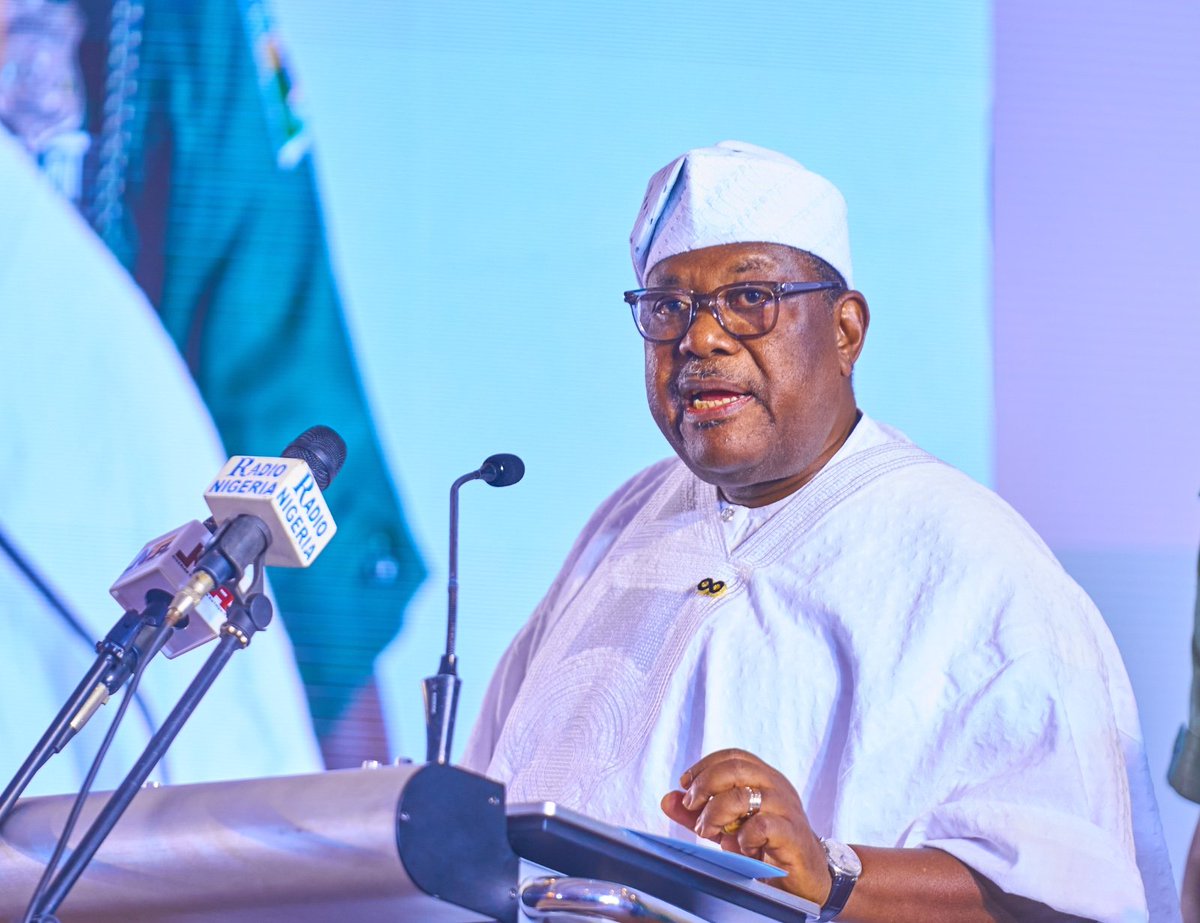
The Federal Government of Nigeria on Wednesday told policymakers, technology executives and civil servants gathered at the Digital Transformation Summit 2026 that Nigeria’s economic future, public service delivery and global competitiveness now rest on how effectively the country harnesses digital technology.
“The future of governance will be digital. The future of economic competitiveness will be digital. The future of public service delivery will be digital,” Secretary to the Government of the Federation (SGF), George Akume, declared as he opened the summit in Abuja, adding, “Technology has become indispensable to national growth and development.”
Speaking at the event, which also marked Galaxy Backbone’s 20th anniversary, Akume described the organisation as a national asset that has matured into a cornerstone of government digital infrastructure. “Galaxy Backbone has, over the past two decades, evolved into a key national asset, providing digital infrastructure, cloud services, connectivity, cybersecurity solutions, and secure networks that support government operations across Nigeria,” he said.
He framed the summit as a practical forum to align President Bola Tinubu’s digital transformation vision with the administration’s Renewed Hope Agenda. “The digital transformation vision of President Bola Tinubu aligns with the administration’s Renewed Hope Agenda, which prioritises innovation, institutional efficiency, transparency, inclusion, and economic growth,” he said. But he warned that ambition alone is not enough. “Powering Nigeria’s digital future requires more than ambition,” he said. “Sustainable progress depends on robust infrastructure, innovation, collaboration, and institutions capable of delivering services at scale.”
Calling for stronger intergovernmental cooperation, the SGF urged federal, state and local authorities to exploit existing platforms and partnerships. “The digital infrastructure already exists. The expertise exists. The partnerships exist. What is required is greater collaboration, stronger adoption, and a shared commitment to accelerating digital transformation at every level of government,” Akume said, adding praise for Galaxy Backbone’s support to Ministries, Departments and Agencies (MDAs). “I commend Galaxy Backbone for its role in supporting MDAs through shared digital services and national infrastructure,” he said, calling the organisation “a trusted partner in government digitalisation efforts.”
Head of the Civil Service of the Federation, Didi Walson-Jack, on her part, told delegates that digitalisation has ceased being an abstract aim and is now central to civil service reform. “You are here because you recognise that the future of governance must be digital, connected, secure, responsive, and performance-driven,” she said. Walson-Jack emphasised traceability, accountability and measurable progress as the new definitions of “movement” in a digital government.
“For us in the Federal Civil Service, digitalisation is not a slogan or a ceremonial project, but a practical reform aimed at improving the way government works, reducing avoidable delays, strengthening institutional memory, and ensuring that citizens receive better, faster, and more transparent service,” she told the summit.
She said the Federal Civil Service had already digitalised work processes across all 38 ministries and extra-ministerial departments before the end of December 2025 — a milestone she presented as proof that the system can respond when leadership is clear.
Other News
“The paperless Civil Service is not about removing paper for the sake of removing paper. It is about removing delay, reducing avoidable bureaucracy, strengthening transparency, and ensuring that government work can be tracked, measured, retrieved, and delivered with speed,” Walson-Jack said, noting early benefits such as faster correspondence, improved approvals and better institutional memory.
Walson-Jack also singled out Galaxy Backbone’s platforms — the iGovernment Cloud, GovMail and secure connectivity services — as foundational to the civil service’s transformation. “You are not simply providing technology, Galaxy Backbone. You are supporting governance, enabling continuity, and helping government to work as one connected system,” she said, adding a pointed note on digital identity and continuity: “When an officer leaves a desk, government information must not leave with that officer. Institutional memory must remain within government because the work belongs to the institution and not the individual.”
The Head of the Civil Service of the Federation urged wider uptake of the government’s home-grown AI assistant, “service-wise GPT”, telling the audience: “If you want to get information about Nigerian public service, you are better off going to service-wise GPT than going to any of the other AI assistants. It has already recorded over 50,000 conversations.” She asked delegates to test the tool in the hall and warned that civil servants should not lag in adopting practical digital solutions. “What people need is clarity, training, leadership, and systems that make their work easier,” she said.
Galaxy Backbone’s Managing Director/CEO, Professor Ibrahim Adeyanju, framed the summit as a call to national purpose. “Today, we are gathered not merely to discuss technology. We are here to discuss the future of Nigeria,” he told attendees. “For Nigeria, the opportunity is immense. With one of Africa’s largest populations, one of its most vibrant entrepreneurial ecosystems, and a young, innovative population, our digital future is not merely an aspiration, it is a necessity.”
Adeyanju warned that digital transformation is simultaneously an economic, governance and nation-building agenda. “The next phase of Nigeria’s digital transformation requires deeper collaboration, greater innovation, and stronger partnerships than ever before,” he said, urging an ecosystem approach that brings together government, the private sector, development partners, academia, innovators and citizens.
He also stressed digital sovereignty as a strategic priority. “It requires us to strengthen our commitment to digital sovereignty; the ability to build, secure, manage, and leverage our digital assets in ways that advance national development and protect our strategic interests,” Adeyanju said, positioning Galaxy Backbone as an “enabler, aggregator, and platform” for federal and state governments, businesses, and development organisations.
The three-day summit, which attracted ministers, agency heads, technology leaders and civil servants, aims to shape policies and public-private partnerships that will scale secure cloud services, fast broadband connectivity, data governance and cybersecurity across government.