Follow Us on Google
- NUJ condemns journalist assault
- as BusinessDay BusinessDay reporters, photographers narrowly escaped harm
- As Onanuga seeks sanction for Kanu’s lawyer over protest participation
From Juliana Taiwo-Obalonye, Adesuwa Tsan and Ndubuisi Orji, Abuja
The #FreeNnamdiKanuNow protest in Abuja turned violent on Monday as Police deployed teargas, affecting journalists and disrupting business activities in the Central Business District (CBD).
A heavy security lockdown constricted Abuja’s Three Arms Zone and key government precincts as demonstrators took to the streets demanding the release of IPOB leader Nnamdi Kanu.
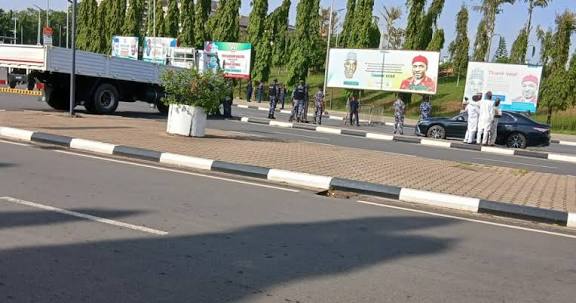
Military, police, and DSS personnel were deployed in force, turning back workers and restricting access to the Federal Secretariat, the National Assembly, the Supreme Court, and the Presidential Villa. By mid-morning, the city center resembled a ghost town as access points were sealed and movement limited along routes into the capital’s political heart.
Barricades spanned from the National Mosque area through the Supreme Court junction, with commuters from the Mararaba and Nyanya axes halted at multiple checkpoints. Security sources confirmed the deployment was a coordinated operation designed to thwart any attempt by violent actors to hijack the protest, following intelligence reports warning of potential disruptions. The Federal Secretariat complex, normally teeming with civil servants, vendors, and visitors, was unusually quiet; only a handful of early arrivals managed to gain entry before access was shut down entirely.
A food vendor who identified himself as Chidi told Daily Sun he managed to access the precincts before the lockdown fully took hold. “I arrived this place around 5:30–6 a.m. to prepare for the day. That is why I could get access. What I can say is that this place was like a ghost town. The only people around here were security personnel and they were strict in turning people down. I saw permanent secretaries and directors turned back. However, it was peaceful.
There was no confrontation around here because the protesters could not even come near here. This is the worst lockdown I’ve seen, and I’ve been in this Secretariat for many years now. Between Court of Appeal and here, there were about four to five checkpoints manned by military men armed to the teeth. If you are a security and not in uniform, they send you back. It was very serious,” he recounted. Success Ezeji, whose office is at the Head of Service building, confirmed she was turned back at the National Mosque area in the early hours.
By mid-morning, the usual bustle along Federal Secretariat Road and approaches to the National Assembly had vanished, with armed personnel manning multiple barriers. The FCT Police Command urged residents to avoid the Central Business District and adhere to traffic diversions “to prevent any breach of peace.” The protest, organised by groups sympathetic to IPOB, follows renewed calls from the South East Governors’ Forum and several lawmakers for a political resolution to Kanu’s detention. Although organisers pledged a peaceful demonstration, the visible security presence underscored government concern about the potential for unrest, given past experiences with pro-Biafra protests.
Across the city, security checks around the Presidential Villa intensified, with heightened stop-and-search measures and a pronounced show of force as officials monitored the area. Access remained restricted even for villa-tag holders, signaling heightened caution in the wake of the protests.
In a separate development, the Nigeria Union of Journalists (NUJ), FCT Council, condemned the unlawful arrest and assault of AFP journalist John Okunyomih during the #FreeNnamdiKanuNow protest. Secretary Comrade Jide Oyekunle described the incident as “a gross violation of press freedom and an affront to democratic principles.” Okunyomih was reportedly manhandled by armed soldiers and policemen and had his camera and equipment damaged near the Unity Fountain. The NUJ demanded an immediate investigation and called on the Inspector-General of Police, Kayode Egbetokun, and FCT Commissioner of Police, CP Dantwaye Miller, to identify and sanction those responsible, and to replace the damaged gear.
Other News
“The harassment of journalists performing their legitimate duty is unacceptable. Security agents must be reminded that journalists are not enemies of the state but partners in nation-building,” Oyekunle stated. The Council urged authorities to uphold constitutional guarantees and international press freedom standards and to replace the damaged equipment to deter future attacks on media professionals.
Eyewitness accounts highlighted the challenges faced by journalists on the frontline.
BusinessDay reporters Tony Ailemen, Tunde Adeniyi, Ladi Patrick-Okwoli, and Michael Godwin narrowly escaped harm when Police fired teargas directly at the back window of their vehicle while they covered the protest.
Ailemen, when contacted, explained that the crew was conducting a vox pop near the Ministry of Finance bus stop around 1 p.m. when the police action occurred.
Before targeting the journalists, Police had fired teargas at an elderly woman selling Okpa, a traditional Igbo cake, forcing bystanders to flee and leaving her exposed. “We identified ourselves as press, but the police still fired in our direction,” he recounted. “They launched teargas at our car, and we had to flee.” The cameraman, Mr. Adeniyi, sustained injuries from the teargas attack. It was only due to the prompt intervention of commuters at the bus stop that the BusinessDay team was able to recover.
The President’s Special Adviser on Information and Strategy, Mr. Bayo Onanuga, has urged legal authorities to impose sanctions on Mr. Aloy Ejimakor, a lawyer representing Nnamdi Kanu, leader of the Indigenous People of Biafra (IPOB), for participating in Monday’s #FreeNnamdiKanu protest in Abuja.
Speaking through his official X account, @aonanuga1956, Onanuga expressed surprise at seeing Ejimakor among the protesters, who were reportedly mobilised by Sahara Reporters publisher and 2023 African Action Congress (AAC) presidential candidate, Omoyele Sowore. “I was quite taken aback to spot Aloy Ejimakor in the middle of that small protest group led by Sowore. It makes me question his judgment,” Onanuga said.
He criticised Ejimakor’s involvement as contrary to the principles governing legal conduct, referencing the ongoing treason trial against Kanu. “With the prosecution’s case concluded, it is imperative that Mr. Ejimakor focuses on presenting a strong defence in court,” Onanuga emphasised. “Instead, he has chosen to join a career anarchist in a protest that only undermines the judicial process.”
Onanuga described the demonstration as “shambolic” and raised concerns about Ejimakor’s professional ethics. He called on relevant legal bodies to “review and consider sanctions to uphold the integrity of the legal profession in light of this unethical behaviour.”
The heightened security environment around the Unity Fountain and other protest hotspots contributed to a tense atmosphere, even as demonstrators remained orderly according to organisers.
As protesters pressed their case for Nnamdi Kanu’s release, the day’s events centered on a tension between civil liberty and public order. The government’s readiness to deploy extensive security apparatus in advance of a potentially volatile protest underscores a broader priority: preventing violence while maintaining stability in a city that has historically borne the weight of contentious demonstrations.