Follow Us on Google
From Juliana Taiwo-Obalonye, Abuja
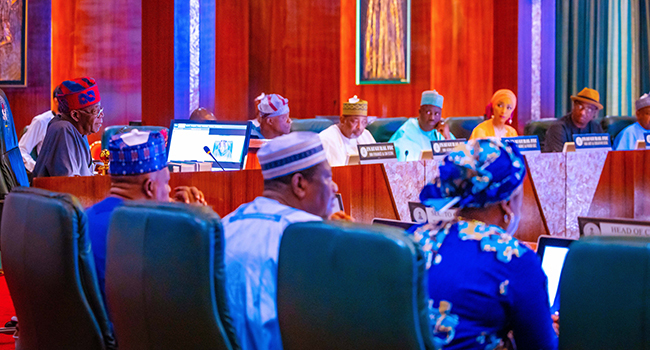
The Federal Executive Council (FEC) presided over by President Bola Tinubu has approved the establishment of a Humanitarian and Poverty Alleviation Trust Fund as part of the administration’s efforts to cushion the economic hardship on vulnerable Nigerians.
He conveyed his approval to a session of the Federal Executive Council (FEC) which he chaired at the Aso Rock Villa, yesterday.
Minister of Humanitarian Affairs, Betta Edu, made the disclosure while briefing State House Correspondents alongside her colleagues from Information and Orientation, Education, Solid Minerals Development and Financing, said the fund is expected to garner up to $5 billion annually.
According to her, there would be a Governing Board to supervise the implementation of the Fund as will be carefully worked out by members of the committee.
“It will involve the minister for finance and other ministers that are relevant to the process.This is a flexible form of financing that is supposed to help Nigeria adequately respond to humanitarian crises and challenges as well as adequately address the issue of poverty in Nigeria. This of course is a victory for the poor and indeed, would bring help and succour which the Renewed Hope Agenda stands for…This is a flexible form of financing that can help us get contributions from different sectors. So we’re going to have contributions from the government, from the private sector, development partners, individuals, philanthropic individuals, and other innovative forms of crowd-funding and pooling of funds together.
“This to allow for an emergency response to the humanitarian crisis in Nigeria. Every other day we hear about the crisis, the floods and the rest of it. We need to be able to respond adequately as a country.”
Asked how much the government was looking at, Edu said: “Every year we hope to be able to raise at least $5 billion within this fund and this is from the various sources that I’ve mentioned and even more. We are hopeful that with the creation of this funding, we can sit down with all the key stakeholders, including other ministries, and actually work out the full modality of implementation in Nigeria.”
The minister said the council also approved the ratification of the Protocol on the protection of the rights of older persons in Nigeria.
“We have signed up to the African charter and this has made us one of the countries within Africa that has approved that older people be protected and should not be discriminated against at any level.
“And this gives them a lot of protection and the government of President Bola Ahmed Tinubu is interested in their welfare and protecting their rights”, Edu stated.
The Council also approved a draft policy for the solid minerals sector, encompassing oil activities, operations, guidelines, regulatory framework, sourcing, mining, and all other dynamics in the sector.
Minister for Solid Mineral Development, Dele Alake, said the approval empowers the ministry to act precisely on various issues, including security measures, combating illegal mining activities across the country, and securing Nigeria’s economic survival.
“The solid mineral sector is critical to Nigeria’s economic survival due to ongoing changes in the global oil market, the push for climate change, and the shift towards green energy. Illegal mining activities, from artisanal miners to high-level involvement, are significant challenges. We are reorganising the security structure and engaging inter-agency cooperation to combat this menace.
“The approval today, as part of the policy, allows the Solid Minerals Ministry to act on all matters related to deregulation, management, operation, and environmental sanitization of the Solid Minerals sector. This makes the sector more investor-friendly, ensuring security and stability for investments and attracting both local and foreign investors. Therefore, the operationalisation of the solid mineral sector through today’s policy approval aims to sanitize the sector,” he added .
Minister of Finance, and Coordinating Minister of the Economy, Wale Edun, on his part said Council approved five loans totaling N3.45 billion for the Executive of five projects, conditioned in the five memos he presented.
The memos approved include concessional loans with zero-interest financing by the World Bank and the International Development Association, the concessional financing arm of the bank.
He said the projects approved for funding were in the power and the renewable energy sectors.
Council, he said, also approved funding for states for resource mobilization programmes to help them with the internally-generated revenue efforts.
Council also approved a project for adolescent girls’ initiative for learning and empowerment, essentially, saying, “it’s a programme to support young girls from the age of 11, secondary school age, and to ensure that at the end of the schooling, they have one skill or the other that is marketable, as well as the academic laurels.”
Edun said, the fifth financing that Council approved is for the women project.
“This is an additional project. The first one was very successful. It was all about empowering women, upscaling their skills levels, and of course, giving them some financial inclusion, including in the banking system.”
“So those were five loans totaling N3.45billion. And as you know, the tenure is all around 40 years, moratorium period of around 10 years and interest very low, or in the cases of the either loans, zero interest, although some fees would be incurred.”
Minister of Education, Tahir Mamman on his part approved two memos his ministry presented.
He said: “Two things I want to mention and comment on which are a very important part of the deliberations and resolve in the council today.
“One is additional funding for the training and empowerment of adolescent girls in Nigeria. One of the major policies of the government is to target the education, training and empowerment of young girls into society.
“Initially from seven participating states, we will now have about 11 additional states participating in this project, which will lead to the empowerment of girls between 10 to 20 right across the participating states.
“This is a very major escalation of this programme that is meant to empower our girls, our teachers and the provision for additional schools in the country.
“The second which is actually quite in line with part of the agenda of this government to ensure that the number of girls and people out of school are reduced, if not eliminated altogether.
“The Council being a contract-awarding institution, today took a very major decision to review policy in that direction. So that the Public Procurement Act is brought into into practice as it were as to the handling of projects and government activities in Nigeria. So that is up for review.
“So that the Public Procurement Council can exercise its powers under that act and then the council will now concentrate on issues of national importance, on issues of policy. So I thought these are some of the things that’s worthy of note.”