Follow Us on Google
From Isaac Anumihe, Abuja
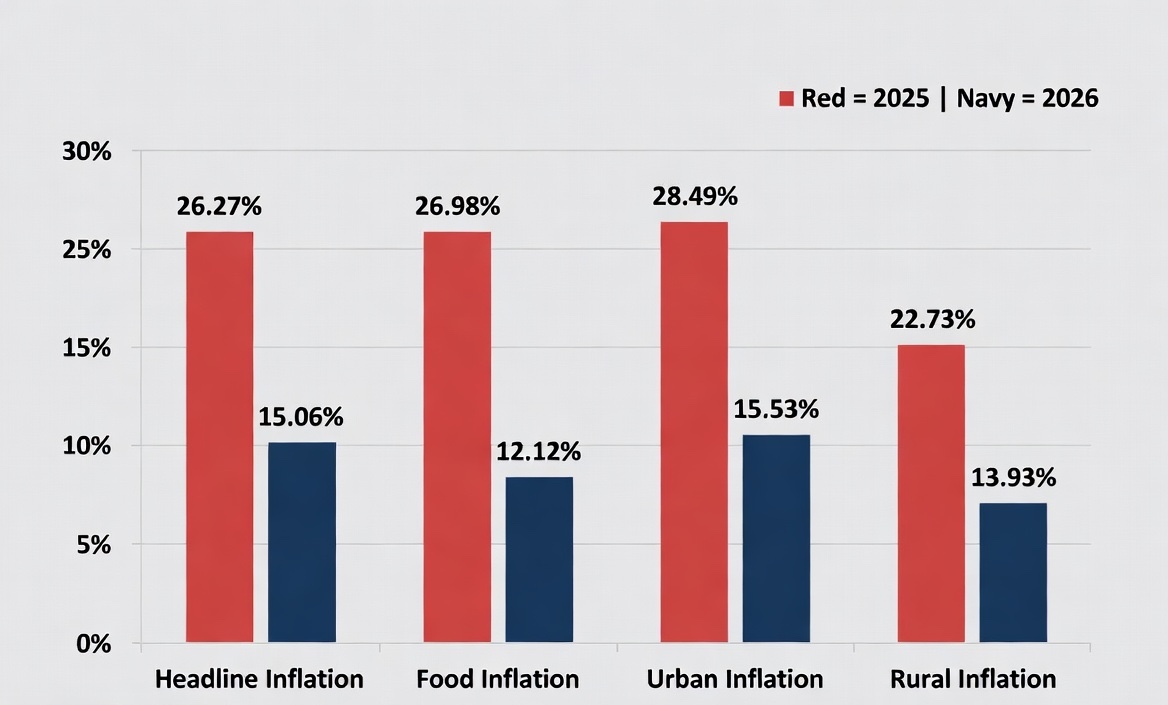
The inflation rate in February 2026 eased to 15.06 per cent, down from 15.10 per cent in January 2026, as food inflation also declined to 12.12 per cent on a year-on-year basis, 14.86 percentage points lower compared to the rate recorded in February 2025 (26.98 per cent).
However, the headline inflation showed a decrease of 0.04 per cent compared to the January 2026 headline inflation. But on a year-on-year basis, the headline inflation rate was 11.21 percentage points lower than the rate recorded in February 2025 (26.27 per cent).
“This shows that the headline inflation rate (year-on-year basis) decreased in February 2026 compared to the same month in the preceding year (i.e., February 2025).
“On a month-on-month basis, the headline inflation rate in February 2026 was 2.01 per cent, which was 4.89 percentage points higher than the rate recorded in January 2026 (-2.88 per cent). This means that in February 2026, the rate of increase in the average price level was higher than the rate of increase in the average price level in January 2026.”
Meanwhile, on a year-on-year basis, in February 2026, the urban inflation rate was 15.53 per cent, representing 12.96 percentage points lower compared to the 28.49 per cent recorded in February 2025. But on a month-on-month basis, the urban inflation rate was 2.55 per cent in February 2026, up by 5.27 percentage points compared to January 2026 (-2.72 per cent).
“The corresponding twelve-month average for the urban inflation rate was 21.25 per cent in February 2026. This was 1.81 percentage points higher compared to the 19.44 per cent reported in February 2025.
“The rural inflation rate in February 2026 was 13.93 per cent on a year-on-year basis. This was 8.80 percentage points lower compared to the 22.73 per cent recorded in February 2025. On a month-on-month basis, the rural inflation rate in February 2026 was 0.71 per cent, up by 4.00 percentage points compared to January 2026 (-3.29 per cent). The corresponding twelve-month average for the rural inflation rate in February 2026 was 20.28 per cent. This was 3.80 percentage points higher compared to the 16.47 per cent recorded in February 2025,” NBS said.
Food inflation rate in February 2026 was 12.12 per cent on a year-on-year basis, 14.86 percentage points lower compared to the rate recorded in February 2025 (26.98 per cent). However, on a month-on-month basis, the food inflation rate in February 2026 was 4.69 per cent, up by 10.70 percentage points compared to January 2026 (-6.02 per cent).
According to NBS, the increase in February’s Consumer Price Index (CPI) can be attributed to the rate of increase in the average prices of beans, carrots, okazi leaf, cassava tuber, crayfish, millet flour, yam flour, snails, ogbono (apon) – dried unground, cowpeas, etc.
The average annual rate of food inflation for the twelve months ending February 2026 over the previous twelve-month average was 19.08 per cent, which was 18.31 percentage points lower compared with the average annual rate of change recorded in February 2025 (37.40 per cent).