Follow Us on Google
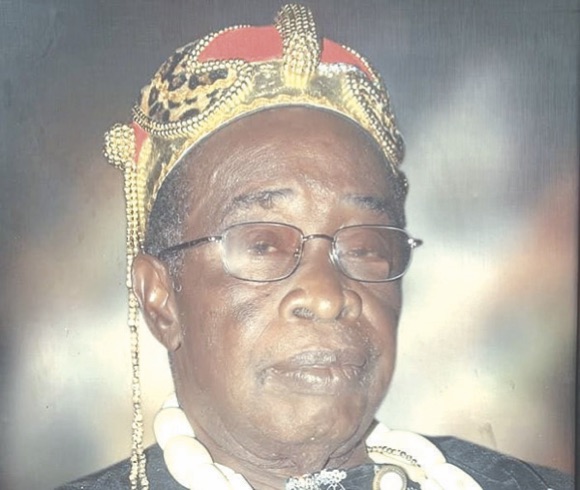
By Abia Onyike
The life story of Ezeogo Agom Eze can be likened to that of Dr. Nnamdi Azikiwe, who was written about in the Epilogue to his biography, “My Odyssey”, as “the classical account of a talented and ambitious youth overcoming all kinds of obstacles to reach his goals. He knew he had a rendezvous with history and this sustained him through the darkest moments”.
Dr. Agom Eze was a very intelligent and meticulous person. In 2009, exactly 16 years before his death, he had published his autobiography. He was 77 years old then. The autobiography was titled, “Born To Serve”. This title synchronized with the postulation of Aristotle that “the aim of a wise leader is to serve and not to lead”. The public presentation of the book, held at the Women Development Centre, Abakaliki, attracted the cream of society from far and wide, which included the former Governor of Ebonyi State, Chief Martin Elechi. Ezeogo had invited me to be a member of the small committee that planned the book presentation and I read his citation at the epoch-making event.
Agom Eze was born on September 6, 1932, to the late Chief Agom NWA Eze and his wife in Onuofia, Umudome, in Onicha community, Onicha LGA of Ebonyi State. He was the second son of his father. His father was a well-to-do man at that time by their local standards. He was a judge in Onicha Native Court and a member of Afikpo Native Authority representing Onicha. He was a titled man, a successful farmer and had many cows. Agom Eze, who died a few months ago at the ripe age of 93, would be laid to rest on November 21, 2025.
The young Agom Eze attended three primary. schools: the Church of Scotland (CSM) schools at Agunkwo, Ugoni Okposi and Uburu, all in old Ohaozara axis. He finished his primary education in 1945 and passed the entrance examination to Hope Waddel Training Institution, Calabar. This famous school was attended by other pioneers such as Alvan Ikoku, Sir Louis Odumegwu Ojukwu, Dr. Nnamdi Azikiwe and Dr. Akanu Ibiam.
Hope Waddel, established in 1895, was the first secondary school in the Eastern Region. And even as at 1900, when there were only eight secondary schools in Nigeria, there was no secondary school in Igboland until 23 years later When Methodist College was established in Uzuakoli, in 1923, followed by DMGS, Onitsha, in 1925, Government College, Umuahia, in 1929, and CKC, Onitsha, in 1933. Agom Eze left Hope Waddel in 1950, having passed the Cambridge School Certificate in flying colours. Because of his father’s sudden death in 1951 in a motor accident, his entry into the university was delayed. His father had promised him and preparations were in top gear for him to enter the University of Ibadan before his demise. His father’s death delayed his university education for about 10 years.
Like all geniuses, Agom Eze was very down-to-earth, easy-going, humble and humorous. He was employed at Afikpo Native Authority in 1951 and posted to Nguzu Edda. He would later resign the job and to join the Post and Telecommunications (P&T) in Kaduna. He and his elder brother, Sam Agom, agreed to look after their father’s family after his death. S.O. Agom, himself having finished at Metropolitan College, Onitsha, was employed at Afikpo Native Authority.
Agom Eze decided to join the Northern Nigeria Civil Service as a treasury clerk. He would be posted to Bida, Kaduna and Kano. But in 1957, the Eastern Nigerian Government sent him to the University of Ibadan to do a diploma course in Local Government Administration. He finished and returned to Afikpo Divisional Council as assistant secretary. In 1958, he was transferred to Uzo Uwani County Council as secretary of council. While there, he sat for four Advanced Level papers and cleared them in one sitting. In 1960, the Federal Government sent him to the University of London on scholarship to study Economics. He bagged his bachelor of science degree with honours in 1963 and followed it up with a doctorate degree in 1966, bypassing the master’s programme because of his superlative academic performance.
Agom Eze’s return to Nigeria from the United Kingdom in the first week of January 1967 was as remarkable as it was instructive. He insisted on returning to Nigeria despite the worsening political crises in Nigeria. The Nigerian military had seized power and effectively dismantled all the political parties. They also dismissed the political class. Dr. Agom Eze, his wife and young daughter, Ijeoma, sailed for three weeks from Liverpool across the North Atlantic on a passenger/cargo ship called M.V. Tarkwa, diembarking at Port Harcourt. They were received by an enthusiastic crowd, led by no less a person than Nigeria’s first Minister of Education, Onyiba Aja Nwachukwu. It was a hero’s welcome as the convoy moved from Port Harcourt to Onicha Igboeze. The symbolism could not be lost on anyone as the baton of leadership had been passed on to Ezeogo. He had returned with the golden fleece. And he did not disappoint.
Dr. Agom Eze joined the Department of Economics, University of Nigeria, Nsukka (UNN), as a lecturer in 1967. After the civil war, he resumed at UNN and became a senior lecturer. It was from there that he joined the government.
Agom Eze straddled various sectors of public life in Nigeria as a collosus. He was the first person from the old Afikpo Division(comprising five LGAs today) to become a commissioner of cabinet rank in government. He was appointed a commissioner in 1975. He served under the then Military Governor of old Imo State, Commander Ndubuisi Kanu. When Kanu was posted out of Imo State, Dr. Agom Eze was retained as commissioner by two other military governor’s, Col. Adekunle Lawal and Col. Sunday Adenihun. He headed three key ministries, including Works, Housing and Transport, Education and Information as well as Industry, Trade and Cooperatives. As Commissioner for Education, he became popular for the free education and class promotion policies he introduced at that time. Pupils and schoolchildren chanted his name in primary and secondary schools across Imo State.
Agom Eze was a child of destiny. He was not only destined to serve, he was destined to lead. He was a born leader and had greatness thrust upon him. He enjoyed the legitimacy sentiments of those he led. He was never an impostor and was even reluctant to take up positions of authority. He believed in the views of Franklin Roosevelt, the 32nd President of the United States of America, who said that “the test of our progress is not whether we added to the abundance of those who have much; it is whether we provided enough for those who have too little”.
Agom Eze was a man rooted in wisdom, strategy and diplomacy. Like Sun Tzu teaches: “Avoiding unnecessary fights is not a sign of weakness. It is a sign of strength and mastery of self and circumstances”.
Ezeogo Agom Eze built up the old Ohaozara County Council and restructured it into the major power bloc it is today. He was the brain behind the creation of Ohaozara LGA in 1976, Onicha LGA in 1989 and Ivo LGA in 1996. In those old good days, he enjoyed the unalloyed loyalty of his followers such as Prof. Chigozie Ogbu, who later became the Deputy Governor of Ebonyi State, and Elder Anyim Ude, who was elected into the Senate to represent Ebonyi South Senatorial District in 2007. The triumvirate constituted the inner caucus of leadership in the areas, thanks to Agom Eze’s deep vision. He was one of the leaders in the old Afikpo Division whose plans were very futuristic. In 1995, he was elected the pioneer president of Old Afikpo Union in order to provide a platform to unite the area to join forces with the Abakaliki bloc as the struggle for Ebonyi State’s creation gathered momentum. He became a rallying point and a crucial bolt in the political machinery that fought for the creation of Ebonyi State.
From 1972 to 1986, Dr. Eze was either board chairman or director of Cooperative and Commerce Bank. He later floated the following financial institutions: Hallmark Bank PLC, Hallmark Assurance, Hallmark Fi Trading Company, Alpha Brokers and APIC, a firm of management consultants.
Ezeogo was a child of destiny. He believed in using his God-ordained talent to articulate economic policies for the good of the common man. His entire career was devoted to rendering selfless service to humanity. He followed in the footsteps of the earlier pioneers from Ebonyi State who lived lives of simplicity, communalism, honesty and genuine patriotism to the fatherland. Some of the leaders I am referring to include Dr. Akanu Ibiam, Dr. Offia Nwali, Chief Francis Oji, Chief Samuel Mgbada, Chief Ajanwachukwu, etc. During the struggle for the creation of Ebonyi State, Agom Eze became one of the crucial bolts in the political machinery that fought for and had the state created in 1996.
As we wave goodbye to Dr. Agom Eze, we are very proud to be associated with the great legacies he left behind. We are not in any way hesitant to identify with his sterling and vantage contributions to humanity. He was a proud Ebonyi man.We pray that God will grant him eternal rest.
• Onyike writes from Abakaliki, Ebonyi State